You will be happy listening to this album

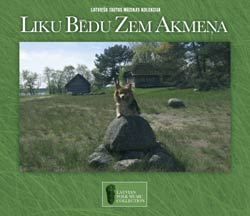
Liku bēdu zem akmeņa

Liku bēdu zem akmeņa, the newest compact disc in UPE Recording Co.‘s Latvian Folk Music Collection, is a variation on an earlier CD containing the “most beautiful” songs. As the title suggests, the songs on this disc are meant to be music by which to bury your sorrows, music to put you in a good mood.

It is, in fact, very happy music. Most of the songs are also quite well-known among Latvians, so listeners need not become accustomed to rarely heard melodies. The CD begins with “Div’ dzelteni kumeliņi” and the very catchy tune “Es uzkāpu kalniņā.” “Strauja, strauja upe tecēj’” and a Cajun-inspired “Aiz kalniņa dūmi kūp” follow on their heels. The version of “Puiši, puiši, kas tie puiši” reminds me of an American hoe-down. Although in a minor key, “Ķēvīt, mana svilpastīte” is upbeat and hearty, as usual. It is followed by “Tur es dzēru, tur man tika” and “Es nenācu šai vietā,” both very popular drinking songs. “Lobs bej puika myusu Jezups” in the Latgalian dialect is a less common song that borders on a Slavic sound. It tells of Jezups—a good young man, only a little bit short—who proposes to the neighbor girl Madaļonka. Then comes “Bēdu, manu lielu bēdu,” “Visi ciema suņi rēja” and “Tumša, tumša tā eglīte.” The disc ends with the good old standard “Div’ pļaviņas es nopļāvu.”

Some of the songs are played a bit too fast for singing along. Kristīne Kārkle is skilled enough to sing “Strauja, strauja upe tecēj’” with almost no time for a breath between verses, but mere mortal singers may not be able to keep up. Līga Priede’s slightly smoky voice is just as strong as Kārkle’s but prefers the higher ranges. Kārkle and Priede sing on only four songs; brothers Valdis and Māris Muktupāvels’ voices dominate the rest of the CD. Ainars Mielavs and Kristaps Rūķītis also sing, while Māris Muktupāvels and Aleksander (Kep) Dmitrijev provide accompaniment on accordion and an assortment of guitar-type instruments, including banjo and mandolin.

The liner notes provide lyrics for each song, as well as literal translations into English. As would be expected, none of them has a sad ending. Liku bēdu zem akmeņa contains only folk songs, no new compositions. The musicians stay true to the traditional lyrics and melodies, but this is not hard-core folklore. Except for the tender hay-mowing song at the very end, the overall sound of this CD is not unlike that of UPE’s Alus dziesmas minus some of the beer. It’s good, foot-tapping, jolly music. But, even though the musicianship is impeccable and each song in and of itself is very well-arranged, it seems that the disc as a whole lacks a bit of inspiration. I also find that the constant happy tempos and volume of the recording are too much to take in at one sitting. I almost feel like Liku bēdu zem akmeņa is trying too hard to put me in a good mood.

My advice is to listen to two or three songs when you need a fix of happy music. Then set the disc aside until you need another fix, listen to a couple more songs, set the disc aside again, and so on. It is kind of like brief regular dates with your therapist: periodically airing out the sorrows from your mind and burying them under a rock, rather than letting them pile up in your mind for years. That was probably UPE’s intention for this CD all along.

Details

Liku bēdu zem akmeņa

Various artists

UPE Recording Co.,  2007

UPE AMCD 006

Where to buy

Purchase Liku bēdu zem akmeņa from BalticShop.

Note: Latvians Online receives a commission on purchases.

Basketball hall of fame inducts Semjonova

Uljana Semjonova of Latvia, who was a star women’s basketball player for the Soviet Union, is one of 20 players, coaches and referees inducted Sept. 12 into the International Basketball Federation’s Hall of Fame.

Semjonova, born in 1952 in Medumi near Daugavpils, had a career that spanned more than two decades. She played from 1967-1987 with TTT Rīga before joining Spain’s Tintoretto team from 1987-1988 and then France’s Valenciennes Orchies from 1988-1989. She also helped the Soviet women’s basketball team twice win the Olympic gold medal, in 1976 in Montreal and in 1980 in Moscow.

Described by the basketball federation as the winningest player in the history of women’s basketball, the 2.13-meter, left-handed Semjonova played center.

From 1970-1985, she was 12 times named Latvia’s most popular athlete, according to the Geneva-based basketball federation.

Since 1991, Semjonova has headed the Latvian Olympian Social Foundation (Latvijas Olimpiešu sociālais fonds), an organization that supports sports veterans.

Semjonova was unable to attend the induction ceremony held in Madrid, Spain.

This is the second basketball hall of fame in which Semjonova has been enshrined. In 1993, she was added to the Basketball Hall of Fame based in Springfield, Mass., the first non-U.S. woman granted the honor.

Andris Straumanis is a special correspondent for and a co-founder of Latvians Online. From 2000–2012 he was editor of the website.

20 films from Latvia set for Swiss animation fest

Twenty films from Latvia are among the works of animation being screened from Sept. 11-16 during the Fantoche 07 festival in Baden, Switzerland. This is the first time Latvia has participated in the festival, according to the Ministry of Foreign Affairs.

Films from Latvia being shown are some classics of animation as well as more recent work.

“Latvia’s animated film-making scene is unfairly seen as a ‘white dot’ on the European cinema landscape because Latvian animation is anything but colourless, it is characterised by a rich palette of shades and shapes,” according to the official festival program. “The films explore the infinite nature of opposites and know no bounds in terms of design. Latvian animated film-making also has a lot to offer from a technical perspective. To this day it still nurtures its tradition of puppet films which dates back to 1966. However, studios have developed alongside that which have perfected the art of 2D and 3D animation.”

The lion’s share of Latvian films will be screened during two “Terra Incognita” showcases devoted to the country.

In the first showcase, director Arnold Burovs’ Pygmalion (1966) and Little Hawk (1978), Roze Stiebra’s Looking for the Northern Daughter (1980) and Tanzania (2003), Vladimir Lesčovs’ Insomnia (2004), Edmunds Jansons’ Scissorman (2005), Signe Baumane’s Woman (2002), and Aija Bley’s Island of Doctor D. (2005) and The Prickly (2005) will be screened at 18:30 hours Sept. 12 and 09:30 hours Sept. 15 in Kino Orient, Landstrasse 2, Wettingen.

In the second “Terra Incognita” showcase, Burovs’ The Last Leaf (1984), Ansis Bērziņš The Trumpeter of Tālava (1988), Jānis Cimermanis’ Latvian (2007), Nils Skapāns Telephone (2005), Gints Apsīts’ Ministry Messiah (2005), Lesčovs’ Lost in Snow (2007) and Stiebra’s Green Fairy Tale (1977), A Piece of Cake (2000), Where Are Your Running (1997) and Butterflies (1997) will be screened at 18:30 hours Sept. 13 and 12:15 hours Sept. 15 in Kino Orient.

Participating in the festival’s International Competition are two Latvian films, Bley’s Island of Doctor D. and director Lesčovs’ Lost in Snow. The competition includes 33 other films. Island of Doctor D. and Lost in Snow are scheduled at 20:45 hours Sept. 11 in Kino Linde, Mellingerstrasse 22, and at 16:15 hours Sept. 12 and 14:15 hours Sept. 13 in Kino Sterk, Bahnhofstrasse 22, Baden.

In a showcase of animation films intended for children between the ages of 4 and 7, nine films will be screened including two works by Skapāns, The Witch’s Button (2006) and Holes in the House (2000). Screenings are scheduled at 14:15 hours Sept. 12 and 14:15 hours Sept. 16 in Kino Orient.

For further information on the festival, visit www.fantoche.ch.

Andris Straumanis is a special correspondent for and a co-founder of Latvians Online. From 2000–2012 he was editor of the website.