Kastēns urges broader dual citizenship discussion

A work group studying how dual citizenship could be used to foster closer ties with the Latvian homeland should broaden its discussions to include World War II refugees and Soviet-era deportees, says Oskars Kastēns, special assignments minister for social integration affairs.

Kastēns announced Oct. 15 that he has sent a letter to Prime Minister Aigars Kalvītis asking that the work group’s duties be expanded. The letter also asks that membership in the work group be increased to include representatives from the World Federation of Free Latvians and the state Office of the Ombudsman.

The work group was formed after Kastēns’ office in August submitted a report to the Cabinet of Ministers outlining measures that could be taken to encourage repatriation to Latvia among the tens of thousands of citizens who in recent years have moved to Ireland, the United Kingdom and other Western European countries. One suggestion was that children born to Latvian parents abroad be allowed to hold dual citizenship, which under current law is not possible.

“However,” Kastēns said in his letter to Kalvītis, “I consider that it is necessary to deal not just with questions related to children born abroad, but also with refugees and deportees from the time of Latvia’s occupation, as well as with children who have been left without the care of parents.”

The World Federation of Free Latvians completely supports Kastēns’ recommendation, Jānis Andersons, head of the federation’s office in Rīga, told Latvians Online in an e-mail. Many political refugees and their descendants were unable to register for Latvian citizenship before July 1995, when the window closed on a Latvian government offer of dual citizenship for exiles.

A total of 30,793 Latvian citizens hold dual citizenship, according to the Office of Citizenship and Migration Affairs. Of those, 12,473 are in the United States, 4,283 in Australia, 3,788 in Canada, 2,759 in the United Kingdom and 1,615 in Germany.

In a Sept. 27 letter to the work group, the World Federation of Free Latvians urged consideration for political refugees and deportees—and their descendants—who left Latvia during the Nazi and Soviet occupations between June 17, 1940, and May 4, 1990. The first date is when the Soviet Union entered Latvia and the latter date is when the Latvian Supreme Soviet declared the restoration of the country’s independence.

The federation also argued for allowing dual citizenship for Latvian descendants in Brazil who never had Latvian citizenship because their forebears emigrated before Latvia declared independence in 1918.

The integration minister’s work group has until Dec. 10 to submit its recommendations to the Cabinet of Ministers.
Andris Straumanis is a special correspondent for and a co-founder of Latvians Online. From 2000–2012 he was editor of the website.

Things are going well for Double Faced Eels

Double Faced Eels

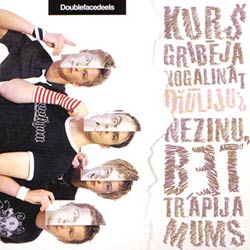
Following the successful debut album from 2005, Zilais valis (The Blue Whale), the Latvian alternative-pop group Double Faced Eels has released its second album. The new album’s title, Kurš gribēja nogalināt Džūliju? Nezinu, bet trāpija mums, roughly translates to “Who Tried to Kill Julia? Don’t Know, But We Got Hit.” The group has left its former label, Platforma Records, and has signed with the Lithuania-based company Antena.

The band also recently was nominated for a MTV Europe Music Award as Best Baltic Act. Things seem to be going well for the Eels.

The album starts off with the first single, a little pop song about a teacher named Dagmāra that has a cool effect with a scratching LP sound at the beginning and end of the track. The next song, “Radio,” is sung in English. Lead singer Mārtiņš Gailītis has received coaching for his English pronounciation and it is getting a lot better, though there’s still room for improvement. This song does rock and could be aired on any radio station outside Latvia without any problem.

“Prāts un sirds” (Mind and Heart) seems to be the serious song on the album. Guitarist Reinis Briğis really shines on this song with his haunting guitar solos. “Dārza rūķis” (Garden Gnome) is a satirical song about the political and social situation in Latvia. The lyrics to this song are not included in the album sleeve. Drummer Pauls Ķesteris shows off vocal abilities on “Salda dzīve ievārījumā” (Sweet Life), a snappy little song with honky-tonk piano and acoustic guitar. Midway through the song, Ķesteris gets messed up, but the band continues recording and the song keeps rolling along. I heard this song quite often on the radio when I was in Latvia this summer.

The title track, “Džūlija” (Julia) is next. It’s a nice song that asks the musical question, “Where is Julia, the girl who doesn’t care about anything?” Next is the MC5 classic “Kick Out the Jams” with Briğis doing a great lead vocal. His singing voice reminds me a lot of Grand Funk Railroad drummer Dom Brewer. Then follows a 21-second track called “Normunds negrib palaisties.” I think it’s Ķesteris making a lot of confusing and uncomprehendable sounds.

Two typical DFE powerpop songs follow, “Konfekte” (Candy) and “Šarmants vīrs” (Charming Man), not to be confused with The Smiths’ “This Charming Man.” Some listeners may have heard enough of DFE at this point, but if you like party music with power riffing guitars and tight drums and bass, DFE is certainly the kind of band you should be listening to.

Bassists Eduards Veinbrants takes his crack at lead vocals on “Mīlestība” (Love), which is a little sing-along song. It sounds like it was recorded at 3 a.m. after a party. Next is the beer commercial song, “Himna” (Anthem). Everbody stand up and raise your can of beer and salute!

“Kefīrs” (Kefir) is a popular and healthy dairy product in Latvia. The song is about this drink and the refrain goes “Man garšo kefīrs…bet naudas man nav” (I love kefir, but I don’t have any money).

You wonder if the Eels were looking in the crystal ball when they wrote “Dakteris” (Doctor). The song was written and recorded before Valdis Zatlers was nominated and became the new Latvian president. The chorus, “Dakteri, palīdzi Tu mums!” (Doctor, help us!) sounds like the Latvian people are pleading to the new president to help their country.

Who knows, maybe the Eels can look into the future? Let’s see if the band can win that MTV award later this fall in Munich, Germany, and perhaps 2007 will be the Year of the Eels.

Details

Kurš gribēja nogalināt Džūliju? Nezinu, bet trāpija mums

Double Faced Eels

Antena,  2007

Raitis Freimanis lives in Stockholm, Sweden, and is a founding member of the Latvian-Canadian band Skandāls.

Radisson, Grand Palace earn travel awards

The Radisson SAS Daugava Hotel and the Grand Palace Hotel, both in Rīga, have been named Latvia’s leading hotels in this year’s World Travel Awards.

The awards were announced Oct. 9 during a ceremony in England. Winners were determined by a vote of travel agents in more than 190 countries.

The Radisson, situated along the Daugava River across from Old Rīga, was named Latvia’s leading business hotel. Also nominated in the category were Hotel Bergs, the OK Park Hotel, the Reval Hotel Rīdzene and Rocco Forte’s Hotel de Rome.

The Grand Palace Hotel, located on Pils Street on the edge of the Old City, was named Latvia’s leading hotel. Also nominated were Ainavas, the Baltic Beach Hotel, the Grand Palace Hotel, the Radisson SAS Daugava Hotel, the Reval Hotel Rīdzene, the Reval Hotel Latvija and Rocco Forte’s Hotel de Rome.

Andris Straumanis is a special correspondent for and a co-founder of Latvians Online. From 2000–2012 he was editor of the website.