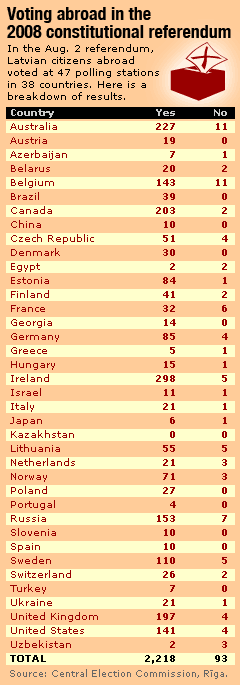
A total of 2,315 voters outside Latvia cast ballots at polling stations or by mail in the Aug. 2 referendum on constitutional amendments, according to provisional data from the Central Election Commission in Rīga.
As the last polling stations closed in Canada and the United States, it was already clear from results in Latvia that the referendum had failed to garner enough support. Voters were asked whether the constitution should be amended to give citizens the right to initiate a recall of the parliament.
Polls were open from 7 a.m. to 10 p.m. local time in Latvia and abroad. More than 628,000 voters participated in the referendum and 608,446 of them voted for the amendments. But the number was short. At least 50 percent of eligible voters, or a total of 757,607 citizens, had to cast ballots in favor of the amendments for them to become law.
With all 998 polling stations worldwide reporting, almost 97 percent of the vote was in favor of the amendments. Although the referendum itself failed, media reports suggest a number of politicians have taken notice of the strong expression of dissatisfaction with Latvia’s government.
Election results are being posted on the Web site of the Central Election Commission in Rīga, www.tn2008.cvk.lv.
Latvian President Valdis Zatlers voted just before noon in the Congress Hall in Rīga.
Outside Latvia, a total of 47 polling stations operated in 38 countries. Activity generally was low, but a few surprises also were recorded, according to local election commission officials contacted by Latvians Online.
An estimated 36,165 eligible voters, or 2.38 percent of the total, were found outside Latvia as of July 26, according to Office of Citizenship and Migration Affairs data. Of those, 10,358 persons (almost 29 percent), were in the United States.
Citizens age 18 and older could vote at any polling station in Latvia or abroad as long as they had a valid Latvian passport.
Australia
By about 6 p.m. local time, a total of 60 persons had voted in the referendum in Sydney, Australia, said local election commission member Imants Līcis. The first voter had shown up just as the polls opened at 7 a.m. The winter weather in Sydney was nice with a temperature of 15 degrees Celsius, Līcis said.
In Melbourne, election commission chair and Honorary Consul Jānis Roberts Dēliņš was not ready to report just how many had voted when contacted about 6 p.m., but expressed confidence that Melbourne would top Sydney despite a bit of rain. The first voter cast her ballot about 20 minutes after the polls opened, he said.
In both Sydney and Melbourne, the Latvian communities expressed interest in the proposed amendments, Līcis and Dēliņš said. The weekly newspaper Austrālijas Latvietis and Latvian radio programs covered the topic.
With just an hour to go before polls closed in Adelaide, election commission head and Honorary Consul Valdis Tomanis reported that 82 people had voted during a cold and rainy day. Voting began at the Adelaide Latvian Cooperative Latvian House “Tālava,” but by about 4 p.m. when it became cold balloting was moved to his residence, Tomanis said. The Central Election Commission in Rīga will inquire if the move was necessary, spokeswoman Kristīne Bērziņa said in an e-mail.
Australia had 4,286 eligible voters, according to the Latvian government data.
Asia
Egils Dzelme, chair of the local election commission in Japan and consul in the Embassy of Latvia, did not have much to report.
“We have no activity,” except for several embassy staff who had voted, he said. One Latvian citizen had contacted the election commission about voting, but still had not shown up with about five hours to go before polls closed.
The hot day, with temperature at about 35 degrees Celsius, and the fact that few Latvian citizens live in Japan (just one eligible voter is registered, according to the citizen and migration data) may have contributed to the lack of activity.
The situation was better in the Latvian embassy in Beijing, China, where a total of eight persons had voted by about 17:00 hours, said election commission member Andžejs Kaševskis. Most of the Latvian athletes slated to compete in the Olympic Games had not yet arrived in Beijing. If they had, the number of voters might have been higher. At least one other person, who had e-mailed the embassy, was expected before the polls closed, Kaševskis said.
With the temperature in Tashkent, Uzbekistan, at about 45 degrees Celsius in the shade (that’s 113 degrees Fahrenheit), Latvian voters perhaps could be forgiven for not showing up at the Embassy of Latvia. But few Latvian citizens reside in the country, said Pēteris Ancāns of the local election commission. By about 14:00 hours local time, just four people had voted in the referendum, Ancāns said.
In neighboring Kazakhstan, the Latvian embassy in the capital city of Astana was quiet. No one had voted by 17:00 hours, said Ričards Henkels, head of the local election commission. He said most of the small Latvian community in the country lives in the commercial center of Almaty, more than 1,300 kilometers to the south.
It was hot, windy and dusty in Baku, Azerbaijan, where Inese Miška and two other members of the local election commission were waiting for voters in the Latvian embassy. A total of five voters had cast ballots by about 16:00 hours, Miška said. Other than representatives of two banks, Parex Bank and Aizkraukles Banka, few Latvians live in Baku, she added.
Africa and the Near East
At the Latvian embassy in Ankara, Turkey, activity was light with only seven voters recorded by about 20:00 hours, said Ieva Cēsniece of the local election commission. If they were in the country, most Latvian citizens likely were in Antalya, a tourist area by the Mediterranean Sea eight hours by car south of Ankara, Cēsniece said.
Just four voters had participated in the referendum by about 20:30 hours in the new Latvian embassy in Cairo, Egypt, said Rita Pastere of the local election commission. The weather in the nation’s capital was typical for this time of year, “always sunny and about 35 degrees,” Pastere said.
Einārs Miķelsons, head of the local election commission in Tel Aviv, Israel, did not have impressive figures to report. With only about half an hour to go before closing, just 12 people had voted in the referendum. He said he did not expect any more voters, even though Shabbat (the Jewish day of rest from sunset Friday until sunset Saturday) was over and public transport was again running.
During the 2006 parliamentary election, Miķelsons said, about 50 Latvian citizens cast ballots. According to Latvian government data, more than 1,500 eligible voters were registered in Israel.
Europe
Voter activity was comparatively high in the Latvian consulate general in St. Petersburg, Russia, said Agnese Saliņa, head of the local electiom commission. During last summer’s referendum, only 10 people voted, but by 20:30 hours a total of 63 citizens had cast ballots this time, she said.
“The activity is much, much more,” she said, adding that a number of Latvian tourists contributed to the number.
Polling stations in Russia also were open in Moscow, Pskov and Kaliningrad. A total of 2,254 eligible voters were registered in Russia, according to Latvian government data.
The first voter showed up at about 9 a.m. at the Latvian embassy in Tbilisi, Georgia, said election commission head Andrejs Karpovičs. Reached about half an hour before polling was to end, Karpovičs said most of the 14 citizens who cast ballots did so during the first part of the day.
“In general, we were expecting more (voters),” said Sandra Novikova of the election commission in the Latvian consulate in Vitebsk, Belarus. Just three voters—the election commission members themselves—had cast ballots. Contacted an hour before the polling station was to close, Novikova said more than 300 Latvian citizens are registered in the Vitebsk area. In all of Belarus, 595 eligible voters were registered, according to Latvian government data. Voting also took place in the Latvian embassy in the Belarus capital of Minsk.
About 200 Latvian citizens, many of them seasonal workers, probably were in Greece on Aug. 2. However, with just 20 minutes left in the day, only six had voted at the Latvian embassy in Athens, said Santa Dālmane of the local election commission.
“Greece has lots of islands, and it is difficult to reach Athens,” Dālmane said, explaining that the seasonal workers are on those islands. Plus, it is the August vacation season and hot, both factors that may have affected turnout.
Jeļena Lobzova, head of the election commission in Dublin, reported unexpected high turnout at the Latvian embassy in Ireland. A total of 266 persons had voted by about 20:00 hours, she said.
“I am really happy that Latvian citizens here are active in the political process,” Lobzova said. Although the number of voters may be low compared to the tens of thousands of Latvian citizens who now live in Ireland, Lobzova said the turnout was outpaced only by the 2006 Saeima election. Voters were well informed about the referendum issue, she added.
Most of the voters were from Dublin, but two busloads traveled from Limerick and individuals came from other cities as well, Lobzova said. Weather conditions were typical, she said, with a mix of sun and rain.
Voting in Brussels, Belgium, which in the past has competed with Dublin, seemed off the mark. By about 21:00 hours, a total of 141 citizens had voted in the referendum, said Uldis Mikuts, chair of the local election commission.
“Keep in mind that July and August are traditionally vacation months,” he noted.
The first voter appeared relatively late, at about 9:20 a.m., Mikuts said, and was steady through the morning into the early afternoon.
Two polling stations were set up in Germany.
Notwithstanding that the street in front of the Latvian embassy in Berlin was closed for part of the day for an event, a total of 64 voters had cast ballots by about 21:00 hours, said Linda Rožudārza, secretary of the local election commission. The first voter appeared at 9 a.m. Many of the voters were young persons, either students or tourists, Rožudārza said.
At the Latvian consulate in Bonn, just 16 persons had voted by 21:00 hours, said Edīte Bieze of the local election commission. The first voter came quite late—at 10 a.m.
It was 1 p.m. before the first voter showed up at the Latvian embassy in Madrid, Spain. In all, 10 persons had voted by about 21:45 hours, said Zane Rožkalne of the local election commission.
Voting in the referendum also took place in Austria, the Czech Republic, Denmark, Estonia, Finland, France, Hungary, Italy, Lithuania, the Netherlands, Norway, Poland, Portugal, Slovenia, Sweden, Switzerland, Ukraine and the United Kingdom.
North and South America
Fifteen minutes from closing the polling station in São Paulo, Jānis Grimbergs said he was surprised by the turnout in Brazil. Grimbergs, Latvia’s honorary consul general, reported a total of 39 votes in person and by mail. And that was despite troubles with a postal workers’ strike and the fact that a number of Latvian citizens had failed to renew their passports.
In the United States, the first voter showed up at 7:02 a.m. at Latvia’s Permanent Mission to the United Nations in New York, said Krista Raupa of the local election commission. By 9 p.m., a total of 67 persons had voted in the referendum. They came from the New York City area as well as from locations such as Boston and Philadelphia, she said.
Voting also took place at the Embassy of Latvia in Washington, D.C.
In Canada, fewer than 50 persons had voted at the Latvian embassy in Ottawa, said Solvita Rakitko, head of the local election commission. Reached an hour before the polling station was scheduled to close, she said the first voter had appeared at about 9 a.m. Most voters were from the Ottawa area, while some came also from Montréal.
At the Latvian Canadian Cultural Centre in Toronto, at least 150 persons voted. Arnis Osvalds Markitants of the local election commission said the activity was surprising, because Aug. 2 was the start of the three-day Civic Holiday weekend in Canada.
The first voter in Toronto appeared just as the polling station opened at 7 a.m. Voters came from the Latvian communities in Toronto and Hamilton, but also include tourists from Latvia. The women of the cultural center, Markitants added, had prepared coffee, sandwiches and pīrāgi as refreshments for voters.
(Updated with total provisional results.)
Andris Straumanis is a special correspondent for and a co-founder of Latvians Online. From 2000–2012 he was editor of the website.