Javelin thrower adds silver to Latvia’s medals

We’ll take one of each, lūdzu. That could have been Latvia’s desire going into the Beijing Olympics, and thanks to men’s javelin thrower Ainārs Kovals it has now been fulfilled. Kovals scored a personal best Aug. 23 and earned a silver medal in the event.

Latvia now has earned gold, silver and bronze in the Summer Games, repeating a performance last registered in the 2000 Sydney Olympics. President Valdis Zatlers congratulated Kovals and said the javelin thrower had provided a great ending for Latvia’s athletes in these Summer Games, the president’s press office announced.

The 26-year-old Kovals hurled his javelin six times in the final, which took place in Beijing’s National Stadium, according to results posted on the official Web site of the Beijing 2008 Olympic Games. It was Kovals’ last throw, a distance of 86.64 meters, that turned out to be his personal best and that also earned him the silver medal.

The gold medal went to Andreas Thorkildsen of Norway, who set a new Olympic record on his fifth and final throw of 90.57 meters. The bronze medal went to Tero Pitkamaki of Finland, who could not quite catch Kovals with his best throw of 86.16 meters.

Another Latvian, Vadims Vasiļevskis, finished ninth in the 12-man field. His best was a distance of 81.32 meters.

For his silver medal, Kovals can expect a monetary award of LVL 50,000 from the Latvian government.

Latvian men’s BMX cyclist Māris Štrombergs won the gold medal Aug. 22 during the sport’s debut in the Olympics. Weightlifter Viktors Ščerbatihs claimed a bronze medal Aug. 19.

In the medals count, Latvia now has one up on Estonia, which has claimed one gold and one silver in the Beijing Games. Lithuania has five medals: two silver and three bronze.

Andris Straumanis is a special correspondent for and a co-founder of Latvians Online. From 2000–2012 he was editor of the website.

Polls ready for referendum on higher pensions

Beginning in Australia and moving westward, polls will open at 7 a.m. local time Aug. 23 as Latvians worldwide will vote in the second referendum in three weeks, this time on whether to boost state pension payments.

Voters will be asked whether they support changes to the pension law that would raise the minimum monthly retirement benefit to no less than three times the state welfare payment. Under the amendments, the minimum pension payment could rise to LVL 135.

Using Latvia’s initiative and referendum law, supporters gathered more than 177,000 signatures to force the Saeima to consider the amendments. But the Saeima rejected the amendments, forcing the issue to a national referendum.

Supporters—including the Pensioners and Seniors Party (Pensionāru un senioru partija)—say higher pension payments are needed in part because of high inflation in Latvia. Even if pension payments are increased to at least LVL 135 per month, they would fall short of the living wage, which according to Latvia’s Central Statistical Bureau stood at LVL 161 in June.

Politicians in the ruling government coalition oppose the proposed law, saying they would be hard-pressed to find money in the national budget to fund higher pensions. The People’s Party (Tautas partija), one of the coalition partners, warns on its Web site that passage of the amendments could result in Latvia having to raise the retirement age, reduce pensions or increase social security taxes.

They also note the Saeima has already acted to push up pension payments—although not to the level sought in the pension law amendments.

For the referendum to count, at least half the number of voters in the last parliamentary election, or 453,730 citizens, must cast ballots. For the referendum to be approved, at least half of those have to vote in favor.

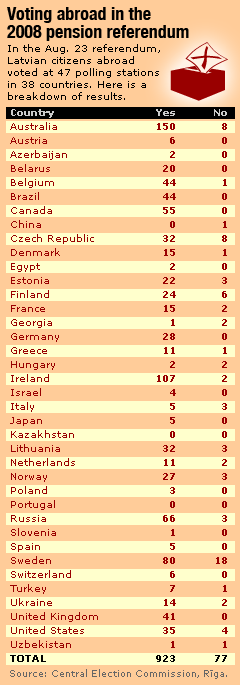
In addition to hundreds of polling stations in Latvia, a total of 47 polling stations will be open in 38 other countries. Despite continued uncertainty about the military situation in Georgia and the presence of Russian troops there, the polling station in the Latvian Embassy in Tbilisi for now will be among those open, said Kristīne Bērziņa, spokeswoman for the Central Election Commission in Rīga.

Polling places abroad include:

  • Australia: Adelaide Latvian Cooperative Latvian House “Tālava”, 4 Clark St., Wayville, SA; Melbourne Latvian House, 3 Dickens St., Elwood, VIC; and Sydney Latvian House, 32-34 Parnell St., Strathfield, NSW.
  • Austria: Embassy of Latvia, Stefan Esders Platz 4, Vienna.
  • Azerbaijan: Embassy of Latvia, 44 J.Jabbarli St., Baku.
  • Belarus: Embassy of Latvia, 6a Doroshevicha St., Minsk, and Consulate of Latvia, 27a B.Hmelnickogo St., Vitebsk.
  • Belgium: Embassy of Latvia, 158 av. Molière, Brussels.
  • Brazil: Honorary Consul-General, Rua Jacques Felix 586, Ap. 12, Sao Paulo.
  • Canada: Embassy of Latvia, 350 Sparks St., Suite 1200, Ottawa, and Latvian Canadian Cultural Centre, 4 Credit Union Drive, Toronto.
  • China: Embassy of Latvia, Unit 71, Green Land Garden No 1A, Green Land Road, Chaoyang District, Beijing.
  • Czech Republic: Embassy of Latvia, 3 Hradeshinska St., Prague.
  • Denmark: Embassy of Latvia, 17 Rosbaeksvej, Copenhagen.
  • Egypt: Embassy of Latvia, 22nd Floor, Office No. 2224, North Tower, Nile City Towers, Cornish El Nil, Ramlet Boulack, Cairo.
  • Estonia: Embassy of Latvia, 10 Tõnismägi St., Tallinn.
  • Finland: Embassy of Latvia, Armfeltintie 10, Helsinki.
  • France: Embassy of Latvia, 6 Villa Said, Paris.
  • Georgia: Embassy of Latvia, 4 Odessa St., Tbilisi.
  • Germany: Embassy of Latvia, Reinerzstr. 40-41, Berlin, and Consulate General of Latvia, Adenauerallee 110, Bonn.
  • Greece: Embassy of Latvia, 38 Vas. Konstantinou Ave., Athens.
  • Hungary: Embassy of Latvia, Vas Gereben utca 20, Budapest.
  • Ireland: Embassy of Latvia. 92 St. Stephen’s Green, Dublin.
  • Israel: Embassy of Latvia, Amot Investments Tower 15th Floor 2, Rehov Weizman, Tel Aviv.
  • Italy: Embassy of Latvia, Viale Liegi 42, Rome.
  • Japan: Embassy of Latvia, 37-11 Kamiyamacho, Shibuya-ku, Tokyo.
  • Kazakhstan: Embassy of Latvia, “Kaskad” Business Center, Kabanbai Batira Ave. 6/1, Office No. 122, Astana.
  • Lithuania: Embassy of Latvia, 76 M.K. Čiurlionio St., Vilnius.
  • The Netherlands: Embassy of Latvia, Balistraat 88, XX’s-Gravenhage.
  • Norway: Embassy of Latvia, Bygdoy Allé 76.
  • Poland: Embassy of Latvia, 19 Królowej Aldony St., Warsaw.
  • Portugal: Embassy of Latvia, Rua Sacramento a Lapa 50, Lisboa.
  • Russia: Latvian Chancery, F. Engelss St. 52a, Kaliningrad; Embassy of Latvia, Capligina St. 3, Moscow; Consulate of Latvia, Narodnaja 25, Pskov; and Consulate General of Latvia, Vasilevskij ostrov, 10 linija 11, St. Petersburg.
  • Slovenia: Embassy of Latvia, Ajdovscina 4, Ljubljana.
  • Spain: Embassy of Latvia, c/Alfonso XII 52-1, Madrid.
  • Sweden: Embassy of Latvia, Odengatan 5, Stockholm.
  • Switzerland: Permanent Mission to the United Nations, 137 rue de Lausanne, Geneva.
  • Turkey: Embassy of Latvia, Reşit Galip Caddesi, No. 95 G.O.P. Çankaya, Ankara.
  • Ukraine: Embassy of Latvia, 6B Ivana Mazepi St., Kiev.
  • United Kingdom: Embassy of Latvia, 45 Nottingham Place, London.
  • United States: Embassy of Latvia, Massachusetts Ave. N.W., Washington, D.C., and the Permanent Mission to the United Nations, 333 East 50th St., New York, N.Y.
  • Uzbekistan: Embassy of Latvia, 16A Lashkarbegi St., Tashkent.

Polls will stay open until 10 p.m. local time. Eligible voters are citizens age 18 and older. To vote, citizens should bring a valid Latvian passport to their closest polling station.

The pension law referendum is the second referendum this month. On Aug. 2, more than 628,000 voters turned out for a referendum on amending the constitution to allow citizens to initiate a recall of the Saeima. However, the number of voters fell short of the required 757,607, which represents half the number of eligible voters. Because the Aug. 2 referendum was on a constitutional issue, the number of voters needed for that referendum to count was higher than for the pension law referendum.

Further information on the referendum process and on how to vote is available on the Web site of the Central Election Commission, www.cvk.lv.

Andris Straumanis is a special correspondent for and a co-founder of Latvians Online. From 2000–2012 he was editor of the website.

Vancouver artists participate in Rīga quadrennial

Passersby in the Maskavas forštate neighborhood of Rīga may soon be scratching their heads, wondering why a wardrobe full of photographs, books and knick-knacks is sitting out in the open. The large piece of furniture, in fact, will be an installation by Latvian-Canadian artist Rita Beiks and her collaborator Norman Spence, both of Vancouver.

The installation will be part of “Dictatorship of the Majority,” the 2008 Rīga Sculpture Quadrennial open-air exhibition sponsored by Centre for Art Management and Information (Mākslas menedžmenta un informācijas centru, or MMIC). Beiks and Spence are two of 15 artists chosen for the international exhibition, which runs from Aug. 29 to Oct. 10.

Entitled “Time Piece,” Beiks’ and Spence’s installation will feature a wardrobe similar to one built in the 1930s or 1940s and found in many Latvian homes. On display in the wardrobe will be photographs in digital frames. The artists have sought photographs from Latvians in the diaspora, and also will be asking for contributions from residents of Maskavas forštate.

Beiks has more than a passing interest in Maskavas forštate: two of her uncles lived in the neighborhood before World War II.

“Time Piece” will be on display in Klusais dārzs, a park bounded by Jēkabpils, Daugavpils, Katoļu and Lazdonas streets.

Beiks responded to several e-mail questions.

Q: How did you and Norman Spence come up with the idea for the wardrobe as the centerpiece of the installation?

Beiks: The concept is mine. Norm will be be responsible for creating the cabinet and faux painting it to appear antique. I will fill the cabinet with the photos, frames and objects. How did I come up with the idea for the wardrobe?  Well, it’s rather long and convoluted and complicated, but I will detail it here. I had received the call to artists and knew I wanted submit an idea but I couldn’t come up with one. With only two weeks to the deadline date, on March 1st, the first anniversary of my father’s passing, the idea came to me very clearly. I was at Norm’s house talking about my father, and how much we were missing him. While he sympathized, Norm was having difficulty understanding my loss, as his own father had disappeared from his life when he was just a boy, and he never had a relationship with his father like I did. Norm and Sarah (my sister-in-law) have a large fireplace mantle, with an old clock and many family photos on it, and on the wall surrounding it. Although I had seen the mantle many times before, when I looked at it that evening, I realized that this connection to family, loved ones and memory through photos is pretty much universal. Looking at the photo of Norm’s mother and father’s picture on that mantle, I realized, too, that we all have our own story. Many people’s lives didn’t turn out as they had planned, or expected, but life carries on. But at the end of the day, family is still the most important thing. We keep photos to remind us. Some years ago, working with a number of homeless folks in Vancouver on an art project, I noticed that while folks may not have a home,  they carry their family with them where ever they go—in a photo or in their mind’s eye. It provides comfort on even the darkest days. I had decided to recreate a crumbling fireplace and mantle with a number of photos and other mementos. However, after speaking with my Mum, I realized that most living in Latvia, then or now, wouldn’t have had a fireplace mantle like this. So where do Latvians display their mementos? Almost everyone has a wardrobe of some type—we’d seen it ourselves at every home we visited during our visit there last summer. In fact, the image I used in the proposal comes from the apartment we stayed in in Rīga. The whole apartment was like a time capsule from 1944. The apartment itself looked like someone just left, and was coming back. It was full of personal mementos, artwork and photographs. It reminded me of home. You could feel the attachment that this apartment owner had for these items, and the love for those in the photos, so carefully placed.

Q: Do you think being of Latvian heritage had anything to do in being chosen for the quadrennial?

Beiks: I don’t know why the jury made the short list they did. We were not given any sort of feedback. However, I suspect that the story spoke to them, and I am guessing that the fact that I am of Latvian heritage would have been of interest to them. The artwork also refers specifically to the Maskavas forštate neighborhood, and Latvia as a whole. I assume that a number of the other sculptures will be more general in nature, and may not reference at all the history of the neighborhood or even specifically relate to where the work is situated. Ours very clearly will, and this too may have been of interest. As listed on the Quadrennial Web site, “The event intends to foster understanding and links between the centre and periphery in contemporary art. The Sculpture Quadrennial Rīga 2008 aims at breaking down elitism in art and culture space through openness and culture accessibility, involving groups of the society whose environment rarely is a site for contemporary art practice. The main interests of the event are emotions and lifestyle of the residents of marginal and disadvantaged city areas instead of the identification of a particular city space.” I think our piece speaks to this desire as well, and fit their mandate.

Q: Where exactly will the installation be placed?

Beiks: Norm is in Rīga already, and working on constructing the cabinet. We have yet to determine where exactly in the Klusais dārzs it will be located. We are utilizing solar panels to help power the electronic photo frames, so we are looking for an open area, accessible to light. We hope to be near Lielā Kalna and Daugavpils iela (in the southeast corner of the park—ed.).

Q: Your proposal addresses how the wardrobe will be protected from the elements. What about security? Maskavas forštate, unfortunately, has a reputation of being a rough neighborhood. Do you have any concerns that the wardrobe might just disappear?

Beiks: Yes, we do have concerns about the security of the piece. We will have the unit anchored in concrete, if possible, and the photo frames and other items will be behind a tough plastic material called Lexan that is almost impossible to break through. I am hoping, too, that if people from the neighborhood contribute photos to the project, that there will be some ownership and pride in the work which will help to protect it. Of course, after all this, if someone really wants to destroy it or remove it, they will. I feel it will almost be part of the work. However, we do have it in our agreement with the MMIC that we will have to repair any damage that may happen to the work during the exhibition, and replace it if needed. (Difficult to do from Canada!) We of course won’t be able to replace the unit if it gets totally destroyed either. The budget just won’t allow for it. We are contributing significantly from our own resources to be able to do this, so we certainly hope that the unit will survive for the 6 weeks. The agreement also allows MMIC to hold back 70 percent of the payment until the end of the project, to ensure that we fulfill our obligations. So, yes, we are praying that it survives! Once the Quadrennial is over, we are considering donating the piece to some community organization or seniors home.

Q: What progress have you made in collecting photographs? Will contributors of photographs be somehow acknowledged?

Beiks: I have begun to receive some photos through a posting on the Latvians Online forum. I have collected many photos from family and other Latvians here in Vancouver and in Toronto. I originally said that names will not be used in the work, but I am now thinking that if people would allow it, I will have a list of credits at the end of the slide show with names of the photo contributors and names of those pictured. I think it would be interesting to see, and where they are from.

Q: What progress have you made in obtaining photographs from the Maskavas forštate community?

Beiks: None as of yet. I will be spending time in the community prior to installation to solicit participation. Trying to make a connection within the community needs to be done in person.

Further information on the 2008 Rīga Sculpture Quadrennial is available by visiting www.sculpturequadrennial.lv. Persons interested in submitting photographs for the installation may e-mail Beiks at egc@shaw.ca.

Klusais dārzs

Klusais dārzs, a park in the Rīga neighborhood of Maskavas forštate, will be the site for Rita Beiks’ and Norman Spence’s art installation. (Photo courtesy of the Centre for Art Management and Information)

Wardrobe

A wardrobe similar to this will be the foundation for “Time Piece,” an art installation by Rita Beiks and Norman Spence to be exhibited in Rīga. (Photo courtesy of Rita Beiks)

Andris Straumanis is a special correspondent for and a co-founder of Latvians Online. From 2000–2012 he was editor of the website.