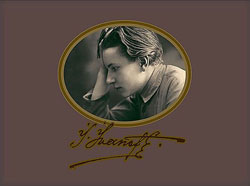
The composer of 20 full symphonies, Jānis Ivanovs (1906-1983) left an enduring mark on Latvian orchestral music. Much of what he composed is difficult to find on compact disc, but earlier this year Upe tuviem un tāliem released a collection of Ivanovs’ instrumental concertos—his cello concerto, violin concerto and piano concerto. The orchestra behind them all is the Latvian National Symphony Orchestra, conducted by Imants Resnis.
The highlight of the CD Jānis Ivanovs (1906-1983): Instrumentālie koncerti is the “Cello Concerto in B minor.” Composed in 1938 (before the Soviet occupation), the work shows Ivanovs at his melodic best. The cello is performed by Agnese Rugēvica, principal cellist in the Latvian National Symphony Orchestra as well as the Bergen Symphony Orchestra in Norway. The second movement, the “Adagio,” is particularly lyrical and haunting, emotionally expressed in the minor key.
This is one of Ivanovs’ best known works and it is clear why. The melancholy and stress of the work (elegantly brought out by Rugēvica) leave a lasting impression on the listener. Perhaps Ivanovs was sensing that war was soon to break out—or perhaps not. (The completist may also want to seek out the CD Janis Ivanovs: Orchestral Works, Vol. 2, released on the Campion label but long out of print. It features another excellent interpretation of the concerto, this time by renowned cellist Māris Villerušs.)
Thirteen years later, in 1951, Ivanovs composed the “Violin Concerto in E minor.” With Soviet occupation well underway, composition had a Stalinist ideology forced upon it. Music needed to be composed in a way that the people could understand. Even with that enforced ideology, Ivanovs crafted an excellent work, even incorporating some scenes from everyday Latvian life into the music. This performance features the young violinst Vineta Sareika, a graduate of the Paris Conservatoire who was nominated for the Latvian Music Award in 2007 for her performance of the concerto with the Liepāja Symphony Orchestra. Sareika adds a delicate touch to the almost naïve, though illustrative, melody, particularly in the first movement.
The most modern sounding work on the CD is the “Piano Concerto in G minor,” composed in 1959. Piano duties are performed by well-known Latvian pianist Juris Žvikovs, who teaches at the Latvian Academy of Music and who in 2006 released the excellent and thorough collection of Latvian piano music, Latviešu klaviermūizkas antoloģija. This concerto, composed at the end of the 1950s, helped usher in a new style in Latvian orchestral music that would develop further in the 1960s. It is characterized by more complex themes and even, at times, a certain amount of harshness. In contrast to the first and third movements, the second movement of the “Piano Concerto” displays Ivanovs’ trademark grasp of melody and interplay between the solo instrument and orchestra. Žvikovs seamlessly moves between the urgency of the first and third movements and the more melodic second movement, displaying an intimate knowledge of the work and how to present it.
Particularly notable about this release is the packaging. It is presented as a photo album, faux leather cover and all. There are plenty of pictures, as well as thorough liner notes on the composer, the works and the performers all written by Ilma Grauzdiņa. An English translation is provided. The packaging strikes me as a bit gimmicky, though it certainly stands out and shows a clear appreciation of the music and talent of the composer and the performers. At the same time that Upe tuviem and tāliem introduced the Ivanovs CD, it released a similar disc of instrumental concertos by composer Romualds Kalsons.
The packaging may be gimmicky, but the music certainly is not. These are some of the most important (and best) works of Latvian classical music, and are a worthy addition to any listener’s library. Though unfortunately long neglected, the orchestral work of Ivanovs is brought back out into the light by the always excellent Latvian National Symphony Orchestra and conductor Resnis, as well as the soloists. This great Latvian composer’s legacy remains assured.
Details
Jānis Ivanovs (1906-1983): Instrumentālie koncerti
Jānis Ivanovs
Upe tuviem un tāliem, 2008
UPE TT 032
Where to buy
Purchase Jānis Ivanovs (1906-1983): Instrumentālie koncerti from BalticShop.
Note: Latvians Online receives a commission on purchases.
Egils Kaljo is an American-born Latvian from the New York area . Kaljo began listening to Latvian music as soon as he was able to put a record on a record player, and still has old Bellacord 78 rpm records lying around somewhere.