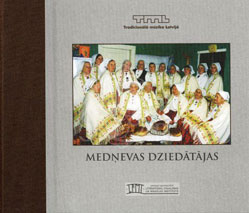
In 1987 a group of women in the Medņeva area of far northeastern Latvia established an ensemble devoted to the singing of local folk songs. The Medņeva Ethnographic Ensemble sang and continues to sing songs that the group’s members learned from their parents and grandparents or remember from work parties and celebrations when they were children.
The group members have also interviewed their neighbors and other locals and learned songs from them. Several researchers recognized the value of documenting this ensemble and its repertoire, which resulted in the recent publication of Medņevas dziedātājas, a book accompanied by a pair of compact discs, by the Institute of Literature, Folklore and Art at the University of Latvia.
Most previous collections of folk songs have been just that: a book full of melodies all transcribed into the same key, each with only a verse or two of text, only the name and birth date and place of the singer, and no further notes on the usage or origin of the song. In this book, however, ethnomusicologist Anda Beitāne has taken a much more holistic approach. The book begins with a general introduction to traditional music and its documentation in the Medņeva area, followed by a fairly technical description of the Medņeva ensemble’s typical repertoire. Next is a section on the history of the Medņeva ensemble, written by the singers themselves. This section gets a bit tedious, as it seems to list practically every performance the ensemble has done in its 20-plus years. From a documentary standpoint, however, would that every folk ensemble had such a biography written about it!
Only then are the actual song transcriptions presented. If earlier song collections tried to squeeze as many melodies as possible onto a page, then this book devotes at least two pages to each song. Each song is transcribed in exactly the key that the singers sing it in—a very precise and correct gesture, but one that will frustrate those who are not so well versed in reading music, because sometimes the key of D flat (five flats) or B (five sharps) just happens to be most suitable for the women’s voices. The transcriptions also laboriously include all of the harmonies and variations that the women sing. Notes, quotes and comments by both Beitāne (in Latvian) and the Medņeva singers themselves (in deep Latgalian dialect) about the origin and history of each song precede the transcriptions.
After the transcriptions are autobiographies and photographs of each singer in the ensemble. These are particularly interesting and make the songs very personal—the more you read and listen, the more you get attached to these ladies. Many of the older singers tell of hard times and childhoods spent working as shepherds for nearby farmers. Others tell of war, kolkhozes (collective farms) and deaths in the family, but also of beauty, dear friends, bread baking and even beekeeping.
The main focus, though, is the two CDs with recordings of the 35 songs included with the book. Since notation is only an approximation of music, the recordings allow one to hear the manner, tempo and tone in which the songs are meant to be sung. Most of them will not be familiar to casual readers and listeners, which makes the material a wonderful source for learning new songs. All are sung in Latgalian (except for a one brief verse and refrain in Russian) and sound quintessentially “Latgalian.” The majority of the songs are upbeat and cheerful, but these are unfortunately not the CDs to play at your local Latvian social event. Authentic rural singing is, shall we say, an acquired taste.
At first I was going to write that these discs and book are purely for educational and research purposes, because who is going to want to listen to a bunch of septuagenarians singing? And I’ll admit that the first time I listened to the discs, they were playing in the background and—big surprise—I thought they sounded like just a bunch of old ladies. The second time, though, I took a different approach and listened to them in my car, where I had no choice but to pay attention. I now understand why folklorists get so carried away about the Medņeva ensemble and similar singers. It’s not only their particular repertoire of songs, but—to use the current buzz word—the manner in which they sing, which can best be described as “juicy,” as one would say in Latvian.
Many folk ensembles depend on a couple of main singers, with the the rest singing along en masse. But practically every Medņeva singer has a strong, distinctive voice and is able to begin songs and sing the main lines of them. Yes, they are old ladies (to be fair, there are also younger women in the group), but their voices are in surprisingly good shape.
The women sing virtually everything in at least two-part harmony, if not three and four parts. That said, only one song on the two discs (“Man patika mīžu druva”) makes use of a pure drone harmony. Several songs can be classified as talka (collective work in the fields) songs, others are linked to specific seasonal celebrations or weddings. The Medņeva women are also skilled at apdziedāšana (teasing songs), and the discs contain several examples of this. A garmon (a type of button accordion) player accompanies the women on a couple of songs, otherwise everything is sung a capella.
The book is in Latvian and contains many quotes in Latgalian. At the end, though, is a nice 10-page translation in English of the book’s first section. The translation provides a more than adequate context for and description of the Medņeva singers and their repertoire. But, obviously, an understanding of Latvian, and particularly Latgalian, will give the reader a much fuller impact.
Beitāne writes, “This is the first instance in Latvian ethnomusicology where traditional singers have been given the opportunity to offer information about themselves.” Indeed, other than a 1999 book devoted to the singer Veronika Porziņģe from Alsunga, this book differs dramatically from all previous collections of Latvian folk texts and melodies in that it emphasizes the actual people involved in the musical traditions, rather than just the material they produce. I believe it’s a worthy approach, and not just for research purposes. This book is a wonderful monument to the gutsy ladies of Medņeva and their musical legacy, and—for the right person—it will be positively inspiring.
Details
Medņevas dziedātājas
Anda Beitāne, comp.
Rīga: Latvijas Universitātes Literatūras, folkloras un mākslas institūts, 2008
ISBN 9934803208
On the Web
The Web site for the Institute of Literature, Folklore and Art at the University of Latvia includes information on where to order its publications. LV