Latvia readies for Winter Olympics; record contingent heads to Canada

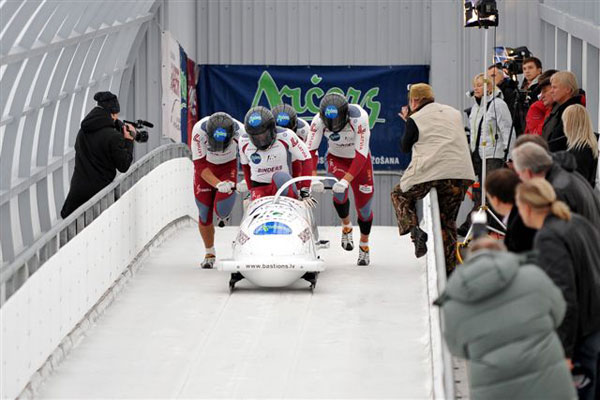
Latvian bobsleigh team

The Latvian bobsleigh team, led by driver Jānis Miņins, is among those set to compete in the 2010 Winter Olympics in Canada. (Photo courtesy of the Latvian Bobsleigh Federation)

The Winter Olympics, which this year begins Feb. 12 in Canada, is all about speed and finesse on ice and snow. For that you need cold weather or mountains. While Latvia has no mountains to speak of, it is the 10th most northerly country in the world and traditionally has had lots of snow and cold winters.

Not surprisingly, Latvia was one of 16 nations to participate in the first Winter Olympics in 1924 in Chamonix, France, sending just two athletes. This year, the country is sending its largest contingent ever—59 athletes competing in 10 disciplines.

Latvian Olympic Committee chair Aldonis Vrubļevskis on Jan. 26 announced the make-up of the team heading to Vancouver and Whistler.

Haralds Silovs is entered in both short- and long-track speed skating. Veterans Ilmārs Bricis will lead a team of nine in the biathlon. Pilot Jānis Miņins is part of an eight-man bobsleigh team. Also competing are two cross-country skiers, three downhill skiers and a snowboarder. Turin medalist Mārtiņš Rubenis and veteran Anna Orlova head a team of 10 lugers, including brothers Andris and Juris Šics. Brothers Mārtiņš and Tomass Dukurs will start in the skeleton.

Latvia’s men’s hockey team will play in Vancouver against Russia, the Czech Republic and Slovakia in the so-called “Group of Death” in the preliminary round. The top three teams in each of three groups will advance to the qualification playoffs and then on to the quarterfinals, semifinals and finals.

The National Hockey League is taking a break during the Olympics, allowing NHLers to join their national squads. Dallas Stars veteran defenceman Kārlis Skrastiņš will anchor Latvia’s 23-man squad. Sixteen of the players are from Dinamo Rīga of the upstart Kontinental Hockey League (KHL). Familiarity with each other will help the Latvian players as they face squads studded with top NHL stars. Also joining Latvia’s team will be rookie NHL blueliner Oskars Bārtulis; American Hockey League player Kaspars Daugaviņš, who got called up to the NHL for one game this season; a couple of players from Latvia who play elsewhere in the KHL; and two who play in the top German circuit.

As usual, there is some controversy around the selection of the national team, this time with the exclusion of the NHL Los Angeles Kings pugilist Raitis Ivanāns and top Atlanta Thrashers prospect defenceman Arturs Kulda, who has the best +/- results (calculated by subtracting the times the opposing team scores from the times your team scores in even strength or shorthanded play when you’re on the ice) in the AHL. This is typically indicative of a player’s defensive play and Kulda is waiting for a shot at the NHL. Kulda was recently included as one of three spares who will only play if others are injured.

Heading into the Vancouver 2010 Winter Olympic games, Latvia’s medal favourite is skeletonist Mārtiņš Dukurs. Born in 1984 and competing since 1998, Dukurs won this year’s World Cup skeleton title ensuring that he’ll start first at Whistler, the Olympic venue 124 kilometers north of Vancouver. His brother Tomass finished fourth. Dainis Dukurs is their father and coach.

Miņins’s four-man bobsleigh crew is currently ranked second in world standings and this third generation of Latvian bobsleighers could finally bring home a medal. Even though Haralds Silovs is the current European short track champion, at the Olympics he will have to compete against power Canadian, American, Chinese and South Korean squads that have dominated the sport.

Latvia’s team includes nine women. The average age is 27. The oldest competitor is back-up goaltender Sergejs Naumovs at 40 while cross-country skier Aneta Brice and downhiller Kristaps Zvejnieks are both 18. Ilmārs Bricis and Anna Orlova will have competed in all six Winter Games since Latvia regained its independence while lugers Rubenis and Guntis Rēkis are back for their fourth time. A total of 29 athletes, many of them from the hockey team, are making their Olympic debut. Six will celebrate birthdays during the games.

Latvia’s delegation will include a support crew of 46, primarily coaches and medical personnel with a few functionaries from the Latvian Olympic Committee. President Valdis Zatlers will be at the opening ceremonies and will be around for another four days to catch some of Latvia’s athletes in action before returning home.

For North American readers at home watching the games, the best chance of catching Latvian athletes will be in the bobsleigh, skeleton and luge where some of the athletes will have Top 10 starting positions as they go head-to-head with Winter Olympic powerhouses such as Canada, the United States and Germany.

The opening ceremonies for the Vancouver 2010 Winter Olympics kick off Feb. 12 and the games run through Feb. 28. More than 5,000 athletes from 91 countries, including some not so cold countries, are expected to compete in 15 sports. The Paralympics Games will follow March 12-21. Readers can follow the results on the official games site at www.vancouver2010.com. The uniforms that Latvia’s team will wear at the opening ceremonies can be seen on the Latvian Olympic Committee’s Web site.

Latvia’s Winter Olympic history

Latvia was at the first three Winter Olympics held before World War II. Speedskater Alberts Tumba and cross-country skier Roberts Plūme competed in the games in Chamonix, France, while Rumba returned and was the only entrant in 1928 at St. Moritz.

The number jumped to 26 athletes at Garmisch-Partenkirchen in 1936. They included 11 from the men’s hockey team. Latvians athletes were entered in speed skating, figure skating, downhill and cross-country skiing. Figure skater Alīse Dzegūze, pairs figure skater Hildegarde Švarce and downhiller Mirdza Martinsone were the first Latvian women in the Winter Olympics. Speed skater Alfons Bērziņš was 14th on a 500-meter course but three years later in 1939 he was crowned European champion in Rīga and a few weeks later earned a silver at the World Championships in Helsinki.

Even though Latvia’s pre-war Summer Olympians bagged two silver and one bronze as well as a bronze in 1912 during the Czarist era, the winter athletes came home empty. It was well into the Soviet occupation before Latvian athletes mounted the winter podium.

That happened at the 1980 Games in Lake Placid, when Latvian athletes competing for the Soviet team picked up a gold, silver and bronze. Vera Zozuļa won the gold in the women’s luge while Latvian hockey star Helmūts Balderis received the silver medal as a member of the Soviet team that lost to the United States in the famed “Miracle on Ice” game. Luger Ingrīda Amantova picked up a bronze. Zozuļa, like others, has gone on to coach and one of her charges is Anna Orlova, who has been Latvia’s top female luger since independence.

The luge, bobsleigh and, recently, the skeleton emerged as big winter sports in Latvia during the latter part of the Soviet occupation and in newly independent Latvia, whose athletes returned to the Winter Olympics under their own flag in 1992 at Albertville in France. The Latvian Olympic Committee was reestablished in 1988.

Luge was the first. The foundations were laid in 1967 by a group of enthusiasts who built a run near Cēsis. This was followed by the Soviet decision in 1972 to officially adopt the sport. Latvian athletes were off and running, quickly earning positions on the Soviet squad.

One of the lugers, Rolands Upatnieks, moved on to become the first head coach of the Soviet bobsleigh team in 1980 after the decision was made to participate in that sport. Here, too, Latvian bobsleighers quickly dominated the Soviet team. Ten of 16 athletes on the first bobsleigh team were Latvians. Most crossed over from track and field. At the Sarajevo games in 1984, Zintis Ekmanis from Latvia and Vladimirs Aleksandrovs from Russia proper won the bronze in the two-man bobsleigh.

During the Calgary games in 1988, Jānis Ķipurs was a member of the gold-winning Soviet two-man crew while three Latvians, Jānis Ķipurs, Juris Tone and Guntis Osis, were on the four-man crew that won bronze. Ķipurs painted his sleigh in Latvia’s national colours to protest the Soviet occupation.

Backup goaltender Vitālijs Samoilovs from Rīga on the Soviet hockey squad also returned from Calgary with a gold medal.

Following January 1991, when thousands of people—including Latvian athletes—blocked off and manned the barricades for days in the Old Town of Rīga in an attempt to protect their parliament from a possible Soviet attack, Latvian bobsleighers and hockey star Arturs Irbe refused to ever again participate on Soviet sports teams.

A huge stimulus for the luge and bobsleigh was the 1986 completion of the track at Sigulda. Starting at almost 20 meters above the ground in a tower high above the Gauja River, the track plummets in hair-pin turns down the valley. It was designed for the two-man bobsleigh and is shared with the luge and now the skeleton, a sport which returned to the Winter Olympics in 2002 after a 54-year absence. However, the first turn on the elevated portion of the track is too tight for the four-man bobsleigh.

With the restoration of Latvia’s independence there were high hopes that former Soviet athletes would come through big at the Albertville (1992) and Lillehammer (1994) games. That was not the case. Latvia was turned inside out as it struggled to transform itself after 50 years of Soviet occupation and the sports community was no exception. Especially hard hit were the bodsleighers. Their sport is high-tech and bobsleighs are expensive. Then there’s the cost of participating in the annual World Cup circuit and lugging the sleighs around.

It was now easier to qualify as part of the Latvian rather than Soviet team and Latvian bobsleighers were joined by those competing in speed skating, short-track skating, biathlon, figure skating, cross-country and downhill skiing. Unfortunately there were only a lot of distant and a few close finishes but no medals. With the qualification of the men’s hockey team at Salt Lake City (2002) and Turin (2006), the number of athletes from Latvia in the Winter Games increased by more than 20.

Even though Latvia’s winter athletes were winning medals at European championships in the luge, bobsleigh, biathlon and short-track skating, the country had to wait until the 2006 Turin games for its first post-independence Winter Olympics medal. Rubenis won a bronze medal in the luge.

Only one athlete from Latvia’s post-war diaspora made it to the Winter Olympics. That was Canada’s speed skater Silvia Burka from Winnipeg, who participated in three games at Sapporo (1972), Innsbruck (1976) and Lake Placid (1980). Her best result was fourth place in the 1,000-meter competition at Lake Placid.
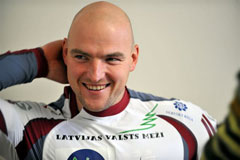
Jānis Miņins

Jānis Miņins pilots the Latvian bobsleigh team that is ranked second in the world. (Photo courtesy of the Latvian Bobsleigh Federation)

Latvia accepts Guantánamo detainee

Latvia has agreed to take in one of the U.S. prisoners now behind bars at the Guantánamo Bay Naval Base, the Ministry of Foreign Affairs has announced.

The person the Latvian government has agreed to take in is considered “clear for release,” meaning the individual is not seen as a threat to society, the ministry announced. The Cabinet of Ministers approved the action Feb. 2.

The decision follows a January 2009 executive order signed by U.S. President Barack Obama calling for the closure of the detention facility at Guantánamo. About 800 individuals had been detained at the base during the past seven years, according to the executive order. Many of the prisoners are being transferred to facilities in the United States, but others are being sent to third countries.

The person being sent to Latvia is from Central Asia, according to the Ministry of Foreign Affairs. The government has received a written application from the person, who has “indicated readiness and interest to be housed in Latvia, as well as to integrate, learn the language and observe Latvia’s laws,” according to the press release.

Latvia’s decision is in line with those of other European Union members who have supported the Obama administration’s decision to close Guantánamo. A number of U.S. and European political leaders had criticized the U.S. prison on the eastern end of Cuba, arguing that detainees were being denied due process under the law.

Andris Straumanis is a special correspondent for and a co-founder of Latvians Online. From 2000–2012 he was editor of the website.

Sold: A piece of diplomatic history at 17th and Webster

On Jan. 7, in a quiet neighbourhood on the northwest side of Washington, D.C., the Latvian government sold a small piece of land that once had a big impact on our country’s history. The brown brick two-story building on the corner of 17th and Webster may have served as Latvia’s first embassy in the United States for 14 years, but for many it will always be remembered in its first diplomatic incarnation, as the Legation of Latvia.

What exactly is a “legation” and why were Latvia and Lithuania the last countries in the world to have them? In the beginning of the last century, most foreign diplomatic missions were called “legations,” but after World War II it became fashionable to upgrade them to embassies. Unlike Latvia and Lithuania, which established legations in pre-war Washington, D.C., Estonia chose instead to open a general consulate in New York. Since all three countries came under Soviet occupation in 1940, none of them could upgrade their missions to embassies, and their designations remained frozen in place during the Cold War.

Thanks to the U.S. non-recognition policy, and despite endless protests from the Soviets, these three Baltic missions and their envoys-in-exile retained their official status, and had the same immunity and privileges of other diplomatic representations in the United States. They drove cars with diplomatic plates, conducted business with State Department officials, and were invited to meet the president in the White House once a year.

Prior to World War II, the Lithuanians managed to purchase a splendid building on 16th Street, coincidently, just down the block from the Polish legation. The Estonians rented an office in Manhattan’s Rockefeller Center. Both continued to use these same facilities after the Soviet occupation in 1940. The Latvians were renters in Washington until 1953, when they bought the modest brick two-story family house in a residential neighbourhood on the corner of 17th and Webster.

The Latvian diplomats who served in the Washington legation from the 1940s until the 1990s were all career diplomats who had served in other countries prior to the war and had refused to return to Soviet-ruled Latvia. Since the United Kingdom also allowed Latvia to retain a legation, those who didn’t go to London came to Washington. Many were accomplished scholars, and supplemented their limited diplomatic duties in exile by writing extensively about Latvian history and culture. Two of the best English-language histories of Latvia were written by Latvian diplomats in Washington: Alfrēds Bīlmanis (1887-1948) and Arnolds Spekke (1887–1972). Spekke headed the Washington legation from 1953 until 1971 and wrote many of his books in his corner office. From Washington, the diplomats also maintained close ties with the Latvian exile community. As head of the legation, Jūlijs Feldmanis (1889-1953) played a key role in the establishment of the American Latvian Association (1953), which grew to become the largest and most influential Latvian organization in the diaspora.

Anatols Dinbergs (1911-1993) took over the D.C. legation in 1971, during which time he also wrote his Ph.D. dissertation at Georgetown University. Heads of mission were formally called “charges d’affaires” in diplomatic circles, and Dinbergs held this title for 20 years. During the 1980s, Dinbergs, Stasys Lozoraitis of Lithuania and Ernst Jaakson of Estonia were well known in Washington, D.C., as the grand old men of Baltic diplomacy. They were the keepers of the keys, the guardians of Baltic sovereignty and true diplomats in every sense of the word.

When I joined the legation in January 1991 as its public affairs liaison, Dinbergs had two fully accredited diplomats on his staff: Valdemārs Kreicbergs (1912-1995) and Jānis Lūsis (1945). While Kreicbergs, like Dinbergs, Spekke and others, had been part of Latvia’s original diplomatic corps prior to the occupation, Lūsis was something of a diplomatic precedent. He was born in a refugee camp in Germany and had grown up in Canada. In the mid 1980s as the number of Latvia’s living pre-war diplomats dwindled, Dinbergs feared that the legation could be forced to close its doors after his tenure ended. So he convinced the U.S. State Department to allow him to appoint new diplomats to keep the legation functioning after his eventual departure. There was just one condition: they couldn’t be U.S. citizens. Lūsis, a Latvian with Canadian citizenship, joined the Washington legation in 1986. He served as first secretary of the Legation until 1991 and is the only person to become a fully accredited Latvian diplomat during the years of occupation. Lūsis later became counsellor at the Washington embassy, and served as Latvia’s ambassador in the U.K., Canada and Italy.

Lūsis is also one of only three people still alive who have worked at the building at 17th and Webster when it was still a Legation. In addition to myself, the third person is a remarkable woman named Luti Moran. If Dinbergs was the “head” of the Legation for two decades, Moran was its heart. She also happened to be a Filipina, although by the early 1980s many Latvians who called the legation and spoke to this charming secretary were convinced she was from the Latgale region in Latvia. Moran not only managed the day-to-day business of the legation and served as Dinberg’s personal secretary, she also became fluent enough in Latvian to carry on lengthy conversations with callers.

While legation diplomats maintained close ties with the Latvian-American community and its organizations, it had no contact whatsoever with Soviet-occupied Latvia. This changed with the rise of the pro-independence Popular Front movement in 1989, as glasnost allowed Latvian activists to visit Washington, D.C. For many, the legation was the end point of a sacred pilgrimage, for when they stepped through the doors of the house on 17th and Webster, they were setting foot for the first time on the fully independent and sovereign territory of the Republic of Latvia.

Every diplomatic mission answers to its foreign minister and home government, but during the Soviet occupation, the Latvian Legation had neither. Just before the occupation, the Latvian Cabinet of Ministers empowered Latvia’s chief diplomat in London, Kārlis Zariņš, to head all missions abroad and represent the Republic of Latvia if the government falls. After Zariņš’ death in 1963, this authority fell to the head of the legation in Washington, D.C. In June 1990, another precedent was set when Latvia’s newly elected Prime Minister Ivars Godmanis and Foreign Minister Jānis Jurkāns walked past the oval metal shield designating 17th and Webster as the Legation of Latvia, and passed through the white double doors that led to the office of the charges d’affaires, Anatols Dinbergs. For the first time since Latvia’s occupation, the head of its diplomatic corps was meeting face to face with his foreign minister.

The meeting was “unofficial” because Godmanis and Jurkāns represented what was still the (diplomatically unrecognized) Soviet Republic of Latvia, while Dinbergs represented the independent (but illegally occupied) Republic of Latvia. For this reason, Dinbergs was not able to accompany Godmanis and Jurkāns to the White House later that week when they met with President George Bush. But contacts had been established between 17th and Webster and Rīga, and while de facto would not become de jure for another 15 months, the diplomatic die had been cast.

By 1991, a steady stream of Popular Front and Latvian National Independence Movement leaders began to make regular visits. One of my key contacts was Sarmīte Ēlerte, who worked in the press office of the Popular Front, but was already creating the new daily newspaper Diena. Communication with Latvia largely took place through my computer, which had a telex connection to the Latvian Foreign Ministry (Internet was still many years away). In my second floor, back porch office, I got a blow-by-blow account of the Soviet “special police” attacks in Rīga during the Days of the Barricades from Ints Upmacis, who manned the Ministry’s telex until the Black Berets chased him and other staffers from their offices.

The Washington media had largely ignored the obscure diplomatic mission at 17th and Webster during the Cold War, but in 1991 it became a centre of attention and a major source of news about what was happening in Latvia. On September 2, 1991, Dinbergs’ corner office was packed with cameras, reporters and well-wishers, all with their eyes glued to a TV set that was broadcasting live coverage of a press conference in Kennebunkport, Maine. When President Bush announced that the United States had restored full diplomatic relations with the Latvian government in Rīga, we popped the champagne corks and Dinbergs became the lead story on the evening news. With that, the days of the Latvian “Legation” were numbered. Not long after, Dinbergs was appointed ambassador to the United States. And the brick house at 4325 17th Street N.W., which for 38 years had stood on the sovereign soil of the Republic of Latvia, became a full-fledged, honest-to-goodness embassy.

I spent the next eight years at the embassy at 17th and Webster, seven of those as ambassador. My first deputy chief of mission was my old telex-colleague from the Foreign Ministry, Upmacis, who later became Latvia’s ambassador to Portugal. Since 2000, Aivis Ronis, Māris Riekstiņš and Andrejs Pildegovicš have followed in Dinbergs’ footsteps as Latvian ambassadors to the United States. Riekstiņš (now Foreign Minister) was the last Latvian ambassador to work at 17th and Webster, for it was under his tenure that a new embassy building was purchased on Washington’s prestigious Embassy Row at 2306 Massachusetts Ave. on Sheridan Circle.

So despite its 14 years of service as Latvia’s Embassy in the United States, when I heard the news that the building at 17th and Webster had finally been sold, I thought of it one last time in the way I knew it most fondly: the Legation. For almost four decades it stood as a symbol of our sovereignty, and a testimony to the patriotism, stubbornness and dignity of our diplomatic corps. It may have been a small piece of Latvia, but it played a huge role in the history of our country.