While one of the fiercest—and at times most beautiful—winters has gripped Latvia and most of Europe during the past months, we have already seen the first preparations for what is likely to be a very hot spring and summer for Latvia politically, leading up to the Saeima elections in October.
Latvia is still heavily damaged by the economic downturn. Unemployment is heading towards 20 percent, there is little confidence in any foreseeable recovery, the economy is kept alive by international loans that will need to be repaid, and emigration seems to be growing. Despite this, the Valdis Dombrovskis-led government is patiently working away to meet its international obligations to its creditors, particularly the International Monetary Fund and European Commission, and to right the economy and government spending after the previous government’s self-promoted “fat years.” Yet Dombrovskis has to do this in a coalition government where every other party is positioning itself for the Saeima election to convince voters they were not to blame for the mess. This presents Dombrovskis with multiple problems.
The present coalition situation is tense, and presents each party and major player with a diabolical choice: basically, whether it is better for a party to seek to destroy this uncertain coalition, hoping to establish a better government it itself can lead and try to make a fist of the country’s problems, or whether there is no alternative but to be seen to be constructively working in the government until October, hoping that Dombrovskis does not take all the glory for any good policy, and that the parties can get the voters to forget the past. It is an invidious choice. Meanwhile, the parties outside the coalition are also positioning themselves and looking for partners. The first moves to destabilise the coalition have already come.
To briefly set the scene, Dombrovskis is from New Era (Jaunais laiks, or JL), the party that was so long kept out of government by the dominant party in recent years, the People’s Party (Tautas partija, or TP), whose long-term rule under Prime Minister Aigars Kalvītis is blamed for much of Latvia’s woes. Now the TP is in the Dombrovskis coalition, along with the Union of Greens and Farmers (Zaļo un Zemnieku savienība, or ZZS), the breakaway Civil Union (Pilsoniskā savienība, or PS) and the nationalist For Fatherland and Freedom Party (Tēvzemei un brīvībai / LNNK, or TB/LNNK). Each party has its own woes and has to evolve its strategies. For TP, ZZS and TB, which were also in the previous long-term coalition, it is the matter of how to recover their lost prestige due to their governing the country into its present economic crisis.
Yet the governing parties are not the only players. Outside the coalition is the Harmony Centre (Saskaņas centrs, or SC), the mostly Russian-oriented centrist party which did exceedingly well in the Rīga City Council elections last June and now rules there in coalition with headkicker Ainars Šlesers‘ First Party of Latvia (Latvijas pirmā partija, or LPP). They believe they can make a huge impact in the next Saeima election, and are forging alliances and biding their time.
TP took its chance at the end of January by opposing a crucial vote in the Saeima authorising the government to continue negotiations with its international creditors. In an evidently planned but feebly executed move, the TP claimed the Saeima was not given enough say over these negotiations. It looked as though the government might fall on this vote, but some TP members broke rank, the SC abstained and the LPP voted with the government, obviously not wanting to throw out this government at this stage. It was an ignominious outcome for the TP, especially in the light of party founder Andris Šķēle’s previous announcement that he is returning to politics: he must now be seen as having failed at this first attempt to make an impact. His star may well and truly have waned.
So the Jan. 21 vote was carried by the government, without its major coalition partner, but with the help of the opposition, which does not see any advantage in having the government fall before October. On the one hand this may signal that Dombrovskis is relatively safe, being able to head off the TP treachery, but on the other hand it shows how thin is the glue holding the coalition together.
TP may sulk but it is capable of further bastardry. As another example of its contant niggling, it refused to have one of its favourites sacked, the State Revenue Service head Dzintars Jakāns, after various disciplinary moves had been made against him for alleged corruption and incompetence. Once again threatening to leave the coalition, the TP forced a compromise that Jakāns would not be fired but moved to another position of lesser rank.
The antics of the TP do nothing to raise the regard in which the public holds politicians and the parliament (polls often show around 4 percent trust!), and even in terms of gaining populist publicity for opposing the government the party’s stance may have backfired.
The polls
The most recent political poll at the end of January gave notice that the elections in seemingly distant October are very much on people’s minds. SC gained the highest support (18.8 percent), indicating the Rīga result was no fluke, and it will be a very serious contender to be in the new government. But Domrovskis’ JL also gained, up from 5 percent to 9.9 percent, indicating there is growing support for his patient if rather gloomy style of governing. PS also gained, and there is now growing certainty that JL, PS and the other breakaway party Society for a Different Politics (Sabiedrība citai politikai) will form a coalition for the Saeima elections. Meanwhile, the once mighty TP stands at 3.5 percent and the LPP were struggling at 2 percent of the vote. Most significantly, however, there was a drop in the proportions of people declaring they would not vote or who had not yet made up their mind. For there not to be a Russia-oriented government with SC dominant in October, there will need to be a significant mobilisation of alienated voters who would support the centre or right Latvian parties—if only they could stop making war on each other!
We shall see increasingly tense lobbying among the parties to try to shore up their positions, find partners and convince the public to vote for them, and probably increasingly desperate measures if the polls don’t improve for several of Latvia’s traditional heavies. Will there be a spring offensive from the forces trying to unseat the government? The dominant question may well be who else—if anyone—is willing now to take responsibility for the country in the lead-up to the Saeima election.
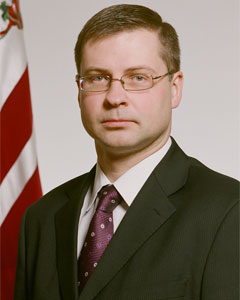
Valdis Dombrovskis, a member of the New Era party, is the prime minister of Latvia.


