Zatlers calls for Saeima’s dismissal; diaspora leaders support president

Valdis Zatlers

In a nationally broadcast message to the Latvian people, President Valdis Zatlers on May 28 called for the dismissal of the Saeima. (Photo by Toms Kalniņš, Chancery of the President of Latvia)

Just days before Latvia’s parliament is due to vote on who the country’s next head of state should be, President Valdis Zatlers has called for the dismissal of the Saeima.

Zatlers described the decision as radical and one that likely will ruin his chances for re-election.

In a nationally broadcast, 10-minute address the evening of May 28, Zatlers said from Rīga that a May 26 decision by the Saeima not to approve a search of businessman and MP Ainārs Šlesers’s homes “is like an alarm that points to a split between the legislative and judicial branches of government.”

Under the constitution, when the president calls for dismissal of the Saeima, a national referendum must be held on the issue. If voters support the president, parliament is dismissed and new elections are scheduled. If the voters fail to approve the referendum, the president must step down.

The Corruption Prevention and Combating Bureau (Korupcijas novēršanas un apkarošanas birojs, or KNAB) announced May 20 that it had begun criminal proceedings against a number of public officials alleging they have engaged in “laundering of criminally acquired assets, providing false statements in the declaration of public official, misuse of the position, receiving and giving of bribes, illegal participation in property transactions and violation of restrictions imposed on public officials,” according to a press release.

Although the KNAB did not name who the proceedings target, media reports revealed them to be Ventspils Mayor Aivars Lembergs; businessman, Saeima member and People’s Party (Tautas partija) Chairman Andris Šķele; and businessman, Saeima member and For a Good Latvia! (Par labu Latviju!) head Šlesers.

The KNAB announcement pointed to a currently elected member of the Saeima who is involved in the transport sector, especially the Freeport of Rīga Authority. Šlesers was formerly minister of transport and before election to the Saeima was chairman of the Freeport’s board of directors.

In an extraordinary meeting May 26, the Saeima rejected a request by the KNAB and the prosecutor general to search Šlesers’s homes. The measure was defeated with 7 votes against, 35 votes for and with 37 abstentions. Sixteen MPs were not present for the vote.

Zatlers, fresh from a brief trip to Poland where he and other Eastern and Central European leaders visited with U.S. President Barack Obama, met earlier on May 28 with both Prime Minister Valdis Dombrovskis and Saeima Speaker Solvita Āboltiņa, according to Latvian media reports.

Zatlers’s four-year term in office expires in July. He has declared his candidacy for a second term, but his re-election by the 100-member has been far from assured. MP Andris Bērziņš, a member of the Union of Greens and Farmers (Zaļo un Zemnieku savienība) and former head of Unibanka, announced his candidacy for the position on May 23.

The 10th Saeima was elected in October.

Diaspora leaders support president

Juris Mežinskis, chairman of the American Latvian Association (Amerikas latviešu apvienība, or ALA), told Latvians Online in an email that he personally supports the president’s initiative to dismiss the Saeima. The ALA during its annual congress earlier this month accepted a resolution backing the re-election of Zatlers.

The ALA has already contacted the Ministry of Foreign Affairs and will also contact the Central Election Commission in Rīga to ask that polling stations for the referendum be set up in as many locations in the United States as possible, Mežinskis said. During the October parliamentary elections, 15 polling stations operated in the U.S.

The World Federation of Free Latvians (Pasaules brīvo latviešu biedrība, or PBLA) also supports the re-election of Zatlers. The organization’s chairman, Mārtiņs Sausiņš, said in an email that he personally backs the president’s call to dismiss the Saeima. Sausiņš said he congratulates Zatlers for being a courageous statesman.

Alberts Upeslācis, chair of the council of the Latvian National Association in Canada (Latviešu nacionālā apvienība Kanādā), also applauded Zatlers. The president’s decision to stand up against Latvia’s oligarchs is comparable to the lone Chinese man who stood against tanks in Beijing’s Tiananmen Square, Upeslācis said in an email, referring to a famous image from the 1989 pro-democracy protest.

“It could turn out that it is Zatlers who begins the change in Latvia,” Upeslācis said, “because no serious politician has clearly and directly spoken out against the increasing influence of the oligarchs.” The people will vote for dissolution of the parliament, he added, but it is not possible to predict the outcome.

(Updated 29 May 2011)

Andris Straumanis is a special correspondent for and a co-founder of Latvians Online. From 2000–2012 he was editor of the website.

Lithuanian novel for young readers reveals horror of Stalin’s June 14

Between Shades of Gray

June 14, 1941, marks the Baltic equivalent to Adolf Hitler’s Holocaust—Josef Stalin’s deportation of Latvians, Lithuanians, Estonians and others to Siberian prison and labor camps. This story of exploitation, starvation, terror and death of hundreds of thousands is largely untold. Between Shades of Gray by Lithuanian-American writer Ruta Sepetys is an accessible account of a family’s experience of this atrocity.

The story is told by Lina Vilkas, a 15-year-old girl growing up in Kaunas. The knock on the door during the night of June 14 changes her life. Lina’s mother and younger brother have minutes to pack a few belongings, are transported to a train station, and are herded onto cattle cars for a long journey to Siberia. This is the beginning of their sentence for their crimes against the Soviet Union.

What crimes did this 15-year-old girl and her younger brother commit? What crimes did any of these “criminals” commit? There was no trial. There was no proof. The family name was simply on the “list”—as were so many other Lithuanians, Latvians, Estonians and others.

Stalin’s purge on that single night was an effective tool to terrify the citizens of the Soviet Union, especially those in occupied territories. One best behave! Any misstep could result in a penalty, often an official 25-year sentence to be served in a labor camp in Siberia. The reality of this sentence, however, was that it was often a death sentence in disguise.

Lina, the young narrator, shares her hope to be reunited with her father, who was arrested separately that same night. She tells us of the horrors and humiliation that was endured in the cattle cars. People were packed in like sardines in a can. The only relief came after someone’s death because the corpse was thrown out by the railroad tracks. The journey to Trim in Siberia was one of thousands of miles and many months.

Upon arrival, a new hell awaited the deportees: forced labor for a single portion of dry bread. The story of community and survival is horrific and told in graphic detail. Lina’s mother was asked to be a snitch with respect to the community. She refused, but certainly others agreed. There lies the beauty of Stalin’s campaign of terror: always a snitch—somewhere, anywhere.

The story is not new. One can find many books about deportation to Siberia written in the Latvian language, including Sandra Kalniete’s Ar balles kurpēm Sibīrijas sniegos. But the story has rarely been told in English and when it has—such as the translation of Kalniete’s masterful book, With Dance Shoes in Siberian Snows—it has seemed somewhat awkward and remote.

The beauty of Between Shades of Gray is that it is written in English for a contemporary audience. It has an immediacy and a quick tempo because the narrator tells her own story. There is no attempt to tell the entire story of Stalin’s prison and labor camps, which would be appropriate for nonfiction.

This book can be shared with anyone. I have sent it to my Latvian-born mother who knows the story well (and who raised me speaking Latvian as a first language). I will also share this book with my nephews in college, whose association with Latvia has been minimal, but who should know this story of their ancestors.

Between Shades of Gray was published in March by Philomel Books, a young reader’s division of Penguin Group. I am somewhat surprised by this because of the book’s graphic nature, even though the heroine is 15. When should children learn the details of man’s inhumanity to other men? When are the gruesome details of the Holocaust taught? They must, however, be shared at some point and this book provides the means to do so.

I learned of the book when mentioned as an “Editor’s Choice” of recent hardcovers in The New York Times. It deserves it.  Of 35 reader reviews on Amazon.com, 30 gave the book five stars and five gave it four.

Between Shades of Gray is a deeply felt story that will certainly touch many lives.

Details

Between Shades of Gray

Ruta Sepetys

New York:  Philomel Books,  2011

ISBN 9780399254123

On the Web

Between Shades of Gray

A promotional website for the book includes a nearly 12-minute video. EN

Ruta A. Sepetys

Learn more about the Michigan-born author of Between Shades of Gray on her website. EN

Where to buy

Purchase Between Shades of Gray from Amazon.com.

Note: Latvians Online receives a commission on purchases.

Full version of daily newspaper Diena now available for iPhone, iPad

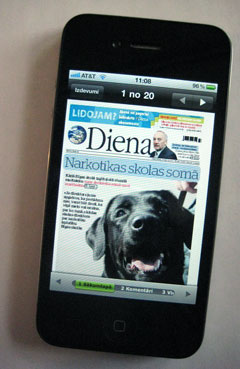
The Rīga daily newspaper Diena now offers an iPhone, iPad and iPod Touch application that lets readers around the world view full copies of the newspaper, says Inese Dābola, the publisher’s marketing and public relations director.

While the application is available for free through Apple Inc.’s iTunes Store or App Store, downloading the paper will cost readers. (Diena offers three free downloads so users can explore the application.)

The application allows readers to view Diena, the weekend magazine SestDiena, and the Izklaide entertainment supplement. Cost of a single copy of Diena is EUR 0.79, while a monthly subscription that includes all three publications is EUR 8.99.

The newspaper is the first in Latvia to provide an iPhone, iPad and iPod Touch version, Dābola noted in a May 24 press release.

The application does not provide current headlines or breaking news. For that, readers will need to refer the Diena’s website, www.diena.lv, or follow the newspaper’s Twitter timeline, twitter.com/DienaLv.

Like many other news applications, the Diena software allows readers to share stories by email, Twitter and Facebook. It also allows readers to print text-only or graphical versions of stories.

One criticism: Clicking on a headline opens a text version of a story, but the text is justified (squared off against both left and right margins). That leads to unneeded white space between words, which results in lower readability, especially on the iPhone and the iPod Touch.

The Diena application requires use of an iPhone, iPad or iPod Touch running iOS 3.2 or higher.

Diena on iPhone

The Rīga daily newspaper Diena now is available on the iPhone and two related devices, the iPad and the iPod Touch. (Photo by Andris Straumanis)

Andris Straumanis is a special correspondent for and a co-founder of Latvians Online. From 2000–2012 he was editor of the website.