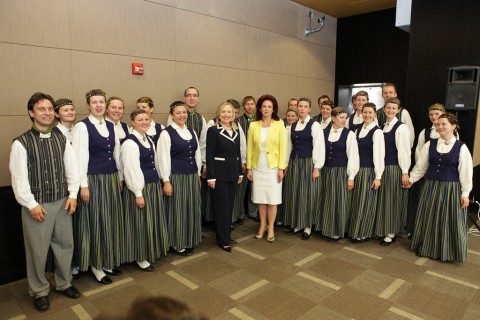
One of the most shocking pieces of news in the Latvian music world recently was the announcement that conductor and artistic director of the youth choir Kamēr… Māris Sirmais would be handing over the baton after twenty two years at the helm.
Generally accepted to have single-handedly brought the choir the international success that it has, Sirmais was instrumental in realizing almost all of the projects and concerts that the choir has taken part in. Though technically an amateur choir, the singers are expected to not only have exceptional musical skill, but also are expected to dedicate a sizable amount of their free time. I once read that in preparation for their World Sun Songs concerts a few years back, the choir would rehearse twenty hours a week! Very few could inspire a large number of people to give so much of themselves – but Sirmais was able to do it for almost a quarter century.
Along with international success, Kamēr… have also become known for working with Latvian composers to premiere their works. A case in point is perhaps the best known young Latvian composer Ēriks Ešenvalds, who in his relatively short career has made quite a name for himself, skillfully composing in a number of different genres, and even being named “Fellow Commoner in Creative Arts” at Trinity College Cambridge. Ešenvalds has had arguably his greatest success in the field of choir music composition, and the choir Kamēr… has been, I think, a significant catalyst in that success.
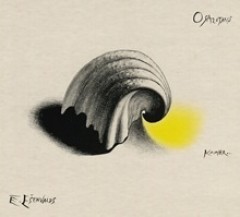
To celebrate the long-term collaboration between Ešenvalds and Kamēr…/Sirmais, a CD of the choir performing the works of Ešenvalds, O Salutaris, was released in late 2011.
I would first note that the recordings here are not all new recordings. In fact, if you already have the Kamēr… CDs Veltījumi and Mīlas madrigāli, you will already have a number of the performances contained on O Salutaris. However, if you are not familiar with Kamēr… or Ešenvalds, this is an excellent CD to begin with.
Ešenvalds is able to deftly balance the popular and the avant garde, the simple and intricate, the sacred and secular, as well as the modern and the classical in his works. A beloved song recently in Latvia has been Renārs Kaupers’ “Mazā bilžu rāmītī”, with words by Imants Ziedonis, a tender sentimental song about a small picture frame. The choir arrangement is just as appealing as the original interpretation of the song, with the guitar melody now being sung by the female voices.
Just about every Latvian composer arranges Latvian folk songs, and Ešenvalds is no exception – this CD contains his arrangement of ‘“Aizej, lietiņ!”, which was one of the highlights of the 2008 Song Festival in Rīga. The Midsummer-themed song, featuring traditional-style Latvian singing, is an almost meditative prayer for the sun to come out. Particularly notable are the solo performances by Ilze Rube and Zane Pērkone.
Ešenvalds has also made no secret of his affinity for spiritual and sacred works. “A Drop in the Ocean” is dedicated to Mother Teresa, there is an arrangement of the song “Amazing Grace” (lyrics by John Newton), and one of the highlights of this CD is the first recording of “O Salutaris Hostia” (adapted from Holy Scripture). The harmonies of the two soprano soloists – Terēze Upatniece and Gita Rebeka Dirveika – add an almost shimmering texture to this beautiful work.
The bulk of the CD is taken up by extracts from the Christmas work “Ziemassvētku leģenda”. On these extracts the choir takes a more supporting role, supplementing the performances of solo singers Renārs Kaupers of Prāta vētra, as well as ethno-musicologist Valdis Muktupāvels and Jānis Apeinis of the Latvian National Opera. The work is about the three Kings who make their way to Bethlehem.
The booklet contains Edgars Raginskis brief interview with Māris Sirmais, as well as Ešenvalds’ notes on all the songs in Latvian, English, German and Russian.
Though Māris Sirmais’ tenure with Kamēr… has come to a close, this final document (for now) is yet another testament to the abilities and skills of this one-of-a-kind conductor. The vivid and emotional performances contained in these recordings are evidence of both Ešenvalds’ compositional skill and Sirmais’ conducting wizardry. Now that long time conductor Jānis Liepiņš is the new artistic director for Kamēr…, there will be quite a burden on his shoulders to maintain the same artistic and musical quality that Kamēr… has had for decades now. O Salutaris is a document of a choir and a composer at the peak of their abilities.
Details
O, Salutaris
Youth choir Kamēr…
2011
Track listing:
1. O Salutaris Hostia
2. A Drop in the Ocean
3. Amazing Grace
4. Mazā bilžu rāmītī
5. Tāls ceļš
6. Aizej, lietiņ
Fragment from “Ziemassvētku leģenda”
7. Kaspars
8. Melhiors
9. Baltazars
10. Melhiora dancis
11. Eņģelis
12. Meditācija
Where to buy
Purchase O, Salutaris from Amazon.com.
Note: Latvians Online receives a commission on purchases.
Egils Kaljo is an American-born Latvian from the New York area . Kaljo began listening to Latvian music as soon as he was able to put a record on a record player, and still has old Bellacord 78 rpm records lying around somewhere.