Mystery of London’s Peter the Painter solved in British author’s book

The infamous “Siege of Sidney Street” of January 1911, in which a pair of armed Latvian anarchists held off British police and soldiers until they perished in a fire, left an enduring mystery: Who was Peter the Painter?

Anarchist historian Philip Ruff (Filips Rufs) has finally answered that question in the new book, Pa stāvu liesmu debesīs, published this week by Rīga-based Dienas Grāmata.

Peter the Painter was assumed to be the leader of a Latvian anarchist cell operating in London’s East End, but questions about his identity and whereabouts dogged British authorities and authors for decades, leading to both fiction and non-fiction accounts of his exploits. But as Ruff tells it, he was the first one to travel to Latvia to seek a definitive answer.

Peter the Painter was in fact Jānis Žākle, a well-known anarchist leader in Rīga who fled the city with his compatriots after a number of terroristic attacks in 1906 made them the focus of Czarist authorities.

In London, he was in charge of a small band of Latvians who in December 1910 attempted to break into a jewelry shop. Their effort failed when police were alerted to loud noises coming from the building next door. Rather than surrendering, the Latvians opened fire and killed three officers. One of their own also was fatally wounded.

The manhunt that ensued led to the Jan. 3, 1911, siege of 100 Sidney Street, where two of the gang were holed up. The gunfight lasted several hours until the house caught fire and the two men died. Among those on the scene was Winston Churchill, who at the time was Britain’s home secretary.

However, Peter the Painter remained at large. Ruff’s research into Žākle’s true identity as well as the social history of the Latvian anarchists began in the 1980s. It has taken him to various sources in Britain and Latvia. Ruff even learned the Latvian language so that he could perform his research, but his Latvian-born wife, Irēne Huls, has helped, too.

Ruff wrote the book in English. It was translated to Latvian by Lauris Gundars. The 288-page book is illustrated with photographs from British, Latvian and personal archives.
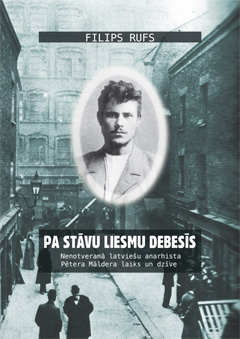
Pa stāvu liesmu debesīs

Philip Ruff’s book Pa stāvu liesmu debesīs resolves part of the mystery of Peter the Painter.
Andris Straumanis is a special correspondent for and a co-founder of Latvians Online. From 2000–2012 he was editor of the website.

Australian children’s music CD includes Latvian folksongs

image

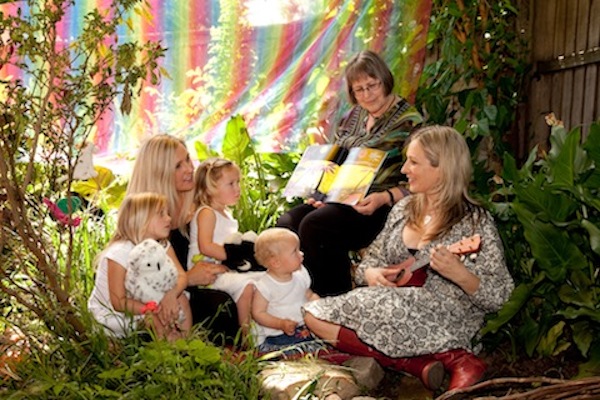
“Sing a Song” – mum Maija Upenieks with daughters Kaija and Nara and three granddaughters.

In March 2012 a delightful compact disc was launched in Wollongong, Australia, titled Celebrate the Seasons. It is the product of young Latvian/Australian musicians and educators with songs and dances from many lands for early childhood and primary school.

Included are two Latvian pieces “Gailītis” and “Plaukstiņpolka”, as well as the flavours of Australia, Torres Strait, Denmark, Poland, Japan, Spain, Holland and original songs by Kaija Upenieks. In this way it is very representative of the many cultures that co-exist in Australia and gives an insight into how the children of Latvian parents in the diaspora connect the two worlds.

There are 23 songs and dances altogether with vocals, accordion, violin, cello, double bass, ukulele, banjo, percussion and recorders selectively used on different tracks, adding to the specific ambience and diversity in style of the piece being represented, either as an instrumental or a song.

Kaija Upenieks began her early childhood program Sing a Song Dance Along in 2005 as an extension of a music program Music Time at Thirroul, established in 1984 by Kaija’s mother, Maija. Of the three now-adult daughters in the Upenieks family, Nara is the eldest, then comes Kaija, then Vēsma. As Kaija says, “Mum instilled in all of us the importance of connecting individuals and families through joyful musical experiences.” As children, the three girls participated in Latvian cultural events in Sydney, and both mother and father would drive one hour each way to attend these events in Sydney, and drive the girls to Latvian School on Saturdays. Sometimes this would happen as often as twice or three times a week.

As a result all three girls have a thorough musical background and perform on the CD, as do two of Nara’s young daughters. All three have qualifications in early childhood education, so Celebrate the Seasons takes into account the development of vital learning areas through interactive music and movement experiences in a playful way.

Latvian family friend Viktorija Mačēns (accordion and voice) joins in performances at various folk festivals with their world music group “Somesing Laik Zat”.  Other performers on the CD are members of different groups Kaija has been involved with. The musical arrangements set this CD apart, as it is music that pleases the discriminating ear.

The underlying philosophy of this musical family has been connecting through music and this has led to performing and giving workshops at festivals, primary schools and other events.

Celebrate the Seasons is a great tool for both parents and educators. For more information and distribution: www.liferhythmsmusic.com

image

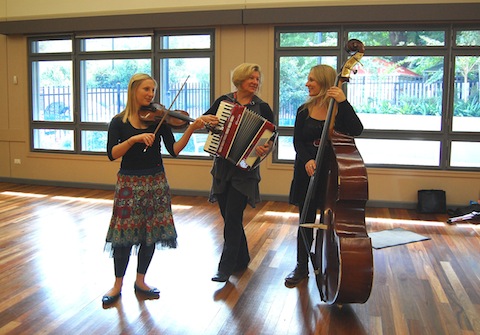
World music group “Somesing Laik Zat” – Vēsma Upenieks (violin), Viktorija Mačēns (accordion), Kaija Upenieks (cello).

Details

Sidrabs – Laima Jansone’s first solo kokle album

image

The kokle, a Latvian stringed instrument somewhat similar to the zither, has long been part of Latvian folk culture. The instrument has fitted into the stereotypical image of the Latvian folk maiden – in her folk costume, playing the kokle at the Song Festival (when she’s not milking the cows, of course).

Though it is an ancient instrument, and many might consider it a quaint bit of Latvian folklore, the kokle is very much a part of modern Latvian music. For example, there is Māris Muktupāvels of the post-folk group Iļģi, whose kokle playing is an integral part of the ensemble’s sound. Māris’ brother, ethnomusicologist Valdis, is also a renowned kokle performer, and has even written a book about the instrument. Biruta Ozoliņa performs the kokle in her ethno-jazz ensemble Patina. And that’s just to name a few.

Among those that are bringing this ancient instrument into the 21st century is the young musician Laima Jansone. Jansone has already performed with the Latvian Radio Choir – playing the kokle on a number of the songs on the Choir’s album Skaisti dziedi, released in 2008. Jansone has also performed with the vocal ensemble Latvian Voices, as well as Skyforger and Auļi. In 2011, Jansone released her first solo album – Sidrabs, a collection of solo kokle improvisations.

The improvisations are generally on a winter theme. Though they are improvisations, inspiration is drawn from Latvian folk songs and folklore – for example, the song “Sidrabs” quotes from the Latvian folk song “Sidrabiņa lietiņš lija”.
Judging from the song titles, the concepts presented are fairly simple – the works have titles like “Iela” (Street), “Upe” (River) and “Zāle” (Grass), but these are purely the sources of inspiration for the works – the actual performances are quite engrossing and compelling.

“Upe” features Jansone using the kokle as a percussion instrument, striking both the strings and the instrument itself, and then launching into a bravura performance that reminds the listener of a fast flowing river. “Piles”, as its corresponding video reinforces, gives the impression of a slowly melting icicle.

The album is also accompanied by a companion DVD, featuring the same tracks as the CD, each with an associated video, produced by Olafs Okonovs. The videos are, for the most part, fairly simple – for example, the video for “Iela” shows what seem to be headlights in the distance, the video for “Upe” has flowing water, etc. Interestingly, the video for “Atdzimšana” features a shadowy nude female form. Additionally, only Jansone’s fingers appear in the videos – this gives the viewer a better appreciation for how truly nimble and agile her playing is. The DVD is one that could be played in a spa or relaxation center. Otherwise the videos are a bit repetitive, and might not stand up to repeat viewing – except, of course, “Atdzimšana”.

Sidrabs is most certainly a worthy new entry in the Latvian kokle music genre – balancing both the ancient and the modern, the songs on the album provide a picturesque and beautiful winter landscape.  Laima Jansone’s performances are very melodic and almost entrancing at times. Though slightly on the shorter side (under 40 minutes), that brief period of time is riveting and engrossing, both for Jansone’s virtuoso playing as well as the dreamy winter moods it presents. Sidrabs is an exceptional achievement, and we can look forward to hearing the next chapter!

More on the Laima Jansone website.

Details

Sidrabs

Laima Jansone

Kalve Studija,  2011

Track listing:

1. Pirmais (First)

2. Sidrabs (Silver)

3. Iela (Street)

4. Upe (River)

5. Zāle (Grass)

6. Piles (Drops)

7. Ceļš (Road)

8. Putenis (Blizzard)

9. Atdzimšana (Rebirth)

Egils Kaljo is an American-born Latvian from the New York area . Kaljo began listening to Latvian music as soon as he was able to put a record on a record player, and still has old Bellacord 78 rpm records lying around somewhere.