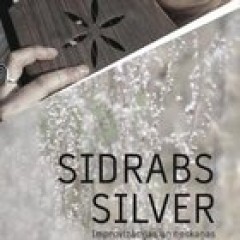
Sidrabs – Laima Jansone’s first solo kokle album

image

The kokle, a Latvian stringed instrument somewhat similar to the zither, has long been part of Latvian folk culture. The instrument has fitted into the stereotypical image of the Latvian folk maiden – in her folk costume, playing the kokle at the Song Festival (when she’s not milking the cows, of course).

Though it is an ancient instrument, and many might consider it a quaint bit of Latvian folklore, the kokle is very much a part of modern Latvian music. For example, there is Māris Muktupāvels of the post-folk group Iļģi, whose kokle playing is an integral part of the ensemble’s sound. Māris’ brother, ethnomusicologist Valdis, is also a renowned kokle performer, and has even written a book about the instrument. Biruta Ozoliņa performs the kokle in her ethno-jazz ensemble Patina. And that’s just to name a few.

Among those that are bringing this ancient instrument into the 21st century is the young musician Laima Jansone. Jansone has already performed with the Latvian Radio Choir – playing the kokle on a number of the songs on the Choir’s album Skaisti dziedi, released in 2008. Jansone has also performed with the vocal ensemble Latvian Voices, as well as Skyforger and Auļi. In 2011, Jansone released her first solo album – Sidrabs, a collection of solo kokle improvisations.

The improvisations are generally on a winter theme. Though they are improvisations, inspiration is drawn from Latvian folk songs and folklore – for example, the song “Sidrabs” quotes from the Latvian folk song “Sidrabiņa lietiņš lija”.
Judging from the song titles, the concepts presented are fairly simple – the works have titles like “Iela” (Street), “Upe” (River) and “Zāle” (Grass), but these are purely the sources of inspiration for the works – the actual performances are quite engrossing and compelling.

“Upe” features Jansone using the kokle as a percussion instrument, striking both the strings and the instrument itself, and then launching into a bravura performance that reminds the listener of a fast flowing river. “Piles”, as its corresponding video reinforces, gives the impression of a slowly melting icicle.

The album is also accompanied by a companion DVD, featuring the same tracks as the CD, each with an associated video, produced by Olafs Okonovs. The videos are, for the most part, fairly simple – for example, the video for “Iela” shows what seem to be headlights in the distance, the video for “Upe” has flowing water, etc. Interestingly, the video for “Atdzimšana” features a shadowy nude female form. Additionally, only Jansone’s fingers appear in the videos – this gives the viewer a better appreciation for how truly nimble and agile her playing is. The DVD is one that could be played in a spa or relaxation center. Otherwise the videos are a bit repetitive, and might not stand up to repeat viewing – except, of course, “Atdzimšana”.

Sidrabs is most certainly a worthy new entry in the Latvian kokle music genre – balancing both the ancient and the modern, the songs on the album provide a picturesque and beautiful winter landscape.  Laima Jansone’s performances are very melodic and almost entrancing at times. Though slightly on the shorter side (under 40 minutes), that brief period of time is riveting and engrossing, both for Jansone’s virtuoso playing as well as the dreamy winter moods it presents. Sidrabs is an exceptional achievement, and we can look forward to hearing the next chapter!

More on the Laima Jansone website.

Details

Sidrabs

Laima Jansone

Kalve Studija,  2011

Track listing:

1. Pirmais (First)

2. Sidrabs (Silver)

3. Iela (Street)

4. Upe (River)

5. Zāle (Grass)

6. Piles (Drops)

7. Ceļš (Road)

8. Putenis (Blizzard)

9. Atdzimšana (Rebirth)

Egils Kaljo is an American-born Latvian from the New York area . Kaljo began listening to Latvian music as soon as he was able to put a record on a record player, and still has old Bellacord 78 rpm records lying around somewhere.

Latvia’s BMXers ask Radeviča to carry flag

Even though two time Olympic gold medalist Māris Štrombergs was asked to be Latvia’s flagbearer at the closing ceremonies, Štrombergs and Latvia’s BMXers decided that the honour should go to Ineta Radēviča who had missed a bronze medal in the long jump by just 1cm.

In a press release Latvia’s Olympic Committee reported that after making their decision, the BMXers sought out Radēviča who, overcome with emotion, agreed. She was quoted saying that this was the best thing that’s happened to her in London.

On the last day of competition there were no surprises and Latvia’s medal count stayed at one gold and one bronze. As of late Saturday, Latvia was 48th in the official medal standings where golds count more than silvers and silvers more than bronze. Meanwhile Lithuania pulled in a sprint canoeing silver on the last day of competition to up their count to four medals including a gold and finished tied at 40th while Estonia trailed at 61st with a silver and a bronze.

Latvia’s last hopefuls, pentathlete Denis Čerkovskis ended up 19th, wrestler Armands Zvirbulis did not make it past the quarter-finals, sprint kayakers Krists Straume and Aleksejs Rumjancevs placed 3rd in the B final which put them in 11th place overall while racer walker Igors Kazakevičs came in 45th over 50km.

Viewers of the Games no doubt noticed that there were faces and names that one would not normally associate with the country whose colours the athletes were carrying. Not surprising in this day of mass global movement and dual citizenship. One such athlete was Sanita Pušpūre, a 30 year old Latvian now from Cork in Ireland. Pušpūre competed for Ireland in the women’s single sculls which is a rowing discipline. She finished 1st in the C final putting her 13th overall. Pušpūre has competed internationally for Latvia but qualified for the Olympics for Ireland. Traditional sports such as Gaelic football, hurling and rugby are popular with the Irish leaving the field wide open for recent immigrants in others.

Latvia maintained its medal streak at the London games. They have come home with at least one medal from each Summer Olympics since the 1932 at Los Angeles when legendary walker Jānis Daliņš took the silver in the 50km race. That of course does not include games held while Latvia was occupied. Moreover, high profile wins this year in BMX cycling and Beach Volleyball mean that the name Latvia was seen and heard by millions around the world.

‘The Machine’ wins gold for Latvia

Twenty five year old Māris Štrombergs from Latvia, nicknamed “The Machine”, repeated his Beijing 2008 victory and took the gold medal in the men’s Bicycle Motocross (a.k.a BMX) at London finishing in 37.576 seconds. He is the first ever athlete from Latvia to win two Olympic gold medals. BMX was introduced to the Olympics in 2008 and Štrombergs has been the sport’s only Olympic gold medalist.

Strombergs is 25 and was born in Valmiera but now lives in California. He took up biking at the age of 6 and between races is known to visit elementary schools to promote a healthy diet and life-style.

After winning in Beijing, Štrombergs struggled on the racing circuit. In 2010 he suffered major injuries that required surgery and took him out of action for six months. He had not impressed in the lead-up at London and finished 3rd in his semi-final heat. But the veteran racer put it together when it counted and led throughout the final run staying ahead of the Australian silver medal winner. Colombia took the bronze.

Meanwhile Latvia’s 24 year old BMXer Edžus Treimanis placed 5th in his semi-final run while 20 year old Rihards Veide came in 7th. Although neither advanced, Latvia made a strong statement placing three of the final sixteen riders. Latvia’s sole women’s BMXer, 21 year old Sandra Aleksejeva, finished 7th in her semi-final heat and did not advance.