Latvia: Land of Pirates?

One of the great challenges of Latvia’s foreign policy makers, its ambassadors, and its cultural activists is to improve the image of the country in the eyes of outsiders. However, within the international music and software businesses Latvia’s image in recent months has become tarnished. Despite several years of anti-piracy promotions and police crackdowns, just three months ago, Latvia was named among the countries where pirating of recorded music is the highest. And in September, claiming that 90 percent of software in use in Latvia is pirated, Microsoft Inc. announced a marketing campaign aimed at encouraging consumers to purchase legal copies of its products.

During the past several years, late August through early September in Latvia has been the time for a big anti-piracy push. Led by LaMPA, the Latvian Music Producers Association, music producers, artists, and media have united in an effort to raise the public’s awareness about music piracy. At times, these efforts have been coupled with well-publicized police raids on vendors in open-air markets in Rīga.

This year was no different. LaMPA organized a slogan contest for signs to be used at a September 1 protest outside the parliament building (the contest promotion included a rather melodramatic warning to consumers, reminding them that by purchasing pirated music they were supporting “murder for hire”). Radio stations played no music for one hour on September 1, while music stores opened later than usual and the three leading TV channels played no music videos. The same day, state revenue agents announced the results of a raid in a market, netting 1,600 compact discs containing pirated music and software.

But Latvia’s piracy rate remains high and, if figures are to be believed, is increasing. According to the International Federation of the Phonographic Industry (IFPI), more that 50 percent of the compact discs and cassettes sold in the Latvian market are pirated. That now puts Latvia in the company of such other pirate havens as Ukraine, Russia, Bulgaria and Estonia.

Worldwide in 1998, pirated music sales represented a third of all sales, or USD 4.5 billion. Although the situation looks bad, one reason for the apparent increase in pirate sales in Latvia is that the acknowledgement and reporting of the problem has increased, says Elita Milgrāve, director of the music publishing company MICREC and head of LaMPA. “The problem has always existed,” she tells SVEIKS.com, “but we have obtained more information about it and have more closely monitored it. Thus, we have been able to clarify the degree of piratism.”

One problem the anti-piracy movement has is the lack of hard data about the illegal business. “Everything is pirated!” complains Milgrāve. Organized distribution brings into Latvia illegal compact discs from Russia, Poland, the Czech Republic and other locations, while pirated cassettes are produced domestically. Provisional data suggest that in one year about 1 million pirated CDs came into Latvia just through the Grenctale border point. In all, authorities figure that Latvia loses about LVL 5 million annually in tax revenue because of pirated recordings, Milgrāve says. Sales of pirated recordings tend not to include the work of Latvian artists, but nonetheless hurt the local music business by robbing music publishers of revenue that could be directed toward Latvian artists’ projects.

Perhaps one reason for the current success of music pirates in Latvia is that they provide an affordable product to consumers who otherwise might not be able to afford to shop for legal recordings in legitimate stores. A pirated CD might cost about LVL 2.50 to 3.00, while legal CDs might cost two to four times more. But Milgrāve argues that’s not a justification. “If I can afford one original pair of jeans,” she says, “I buy those rather than going to the market to buy three pairs of knock-offs. I know that those are illegal, that I’m being cheated. I know they aren’t quality products.” The same principles apply to recorded music, Milgrāve adds, pointing out that there’s also a moral question involving one’s support of a favorite artist.

Milgrāve notes that sellers of pirated recordings usually have disappeared underground when the annual anti-piracy activities pick up. However, in recent weeks the efforts of revenue police and other authorities appear to have been sustained, thanks in part to recent changes in state laws and agreements between the music publishing industry and law enforcement officials. Of course, it’s too early to tell whether the effort will pay off in the long run and will enable Latvia to salvage its image in the music publishing industry.

(Editor’s note: This article orginally appeared on SVEIKS.com.)
Andris Straumanis is a special correspondent for and a co-founder of Latvians Online. From 2000–2012 he was editor of the website.

Connoisseurs won’t find this folk album boring

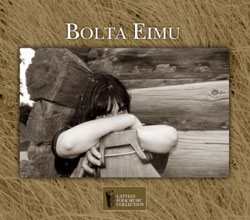
Bolta eimu

This is the third recording in the Latvian Folk Music Collection by UPE Recording Co., and, like the first two (Pagānu gadagrāmata and Latviešu danči), is a very nice one indeed. Biruta Ozoliņa sings songs of her native Latgale (the eastern part of Latvia), accompanied by the kokle, which is a stringed folk instrument similar to a zither, played throughout the eastern Baltic region.

This recording is very traditional compared to the first in the series, Pagānu gadagrāmata, except for a couple of modern-sounding chords here and there.

Ozoliņa is best known as a former member of the folk group Iļģi, and in this group her high, light voice nicely complemented Ilga Reizniece’s distinctive lower and fuller voice. Alone on this recording, though, something almost seems to be missing. The liner notes say that Ozoliņa no longer performs, but now only sings alone and for herself. If you sing for yourself, you will, of course, sing the songs that you like. There’s no question about what type of songs Ozoliņa likes! They are all calm and gentle, with beautiful melodies. Bolta eimu is a very contemplative recording. It is not a performance, but rather a meditation. Some more critical ears might even call it background music.

Because the songs’ lyrics (all except one, “Zvīdzi zvīdzi sērmais zirdzeņ”) are from a young woman’s point of view—dealing with various aspects of courtship and marriage—they fit nicely with Ozoliņa’s voice. Her voice is amazingly clean, clear, light, simple and almost fragile. The songs are also very simple, and in this simplicity, I believe, is all the beauty of Latvian folk music.

All of the songs are in the Latgalian dialect, which might take some getting used to if you speak Latvian. Latvian speakers who have little experience with it may find some of the words hard to understand. For those who don’t speak Latvian, the one-line English translations in the liner notes may make the songs sound overly simple or trivial. Unfortunately, this is all too common a problem in translating folk songs in general. As a result, the translations cannot convey the complexities and poetry of the traditional texts—the cultural context, symbolism, mythological parallels, and deeper meanings of many texts are lost.

My husband’s only comment about this compact disc was that it all sounded the same. He says that about most of my folk recordings, but for once I had to agree with him. Maybe what’s missing is variety. All of the tracks sound very similar. One song, “Zyna Dīvs, zyna Laima,” is sung a capella, but in my opinion there could have been more, since Ozoliņa’s voice stands well enough on its own. In another song she uses a considerably lower tone, which is also a nice change. The four tracks recorded in 1998-99 (“Jau sauleite aizalaide,” “Apleik kolne saule tak,” “Treis mōzeņas mežā gōja,” and “Muns bōleņš karā gōja,” with the rest from 1987-92) have a slightly different sound to them, but not enough to be called “variety.”

My own taste in Latvian folk songs leans toward the calmer, more melancholic melodies, and there are plenty on this recording. (In Latvian music, a minor key does not necessarily indicate a sad song. This seems to be common in Eastern European folk music.) I don’t mind a whole recording of the same type of music—especially because I like it—but I know people who will complain.

Some might find the lack of variety in Bolta eimu boring, but for connoisseurs of the calm, melancholic melodies and Latgalian dialect this is a wonderful recording. As for me, it is a treat to have a whole CD devoted to Ozoliņa and “her” type of songs.

Details

Bolta eimu

Biruta Ozoliņa

Upe Records,  1999

UPE CD 013

Classic Pērkons still thunders on CD

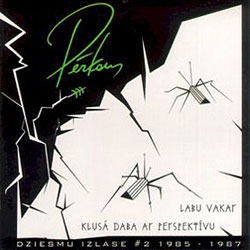
One of the all-time classic Latvian rock groups must be Pērkons, which has been releasing albums for more than 15 years. Thankfully for all of the many Pērkons fans, MICREC has released two compact discs with many of the group’s top songs. The most recent is Dziesmu izlase #2, 1985-1987.

In the summer of 1990, I had the good fortune to be able to participate in a Latvian music camp in Canada. The camp was organized by the renowned Latvian-American musician and composer Dace Aperāne, and Latvian musicians came from all over the world to participate. Among the musicians invited was Juris Kulakovs, the keyboardist and music composer for the famous Latvian rock group Pērkons.

Working with such a respected musician was quite the thrill. I wasn’t too familiar with the music of Pērkons at the time, having only heard one song, “Zaļā dziesma,” off the classic Mikrofons 88 collection. The song still today remains one of my favorite Perkons songs, and one of my favorite songs by any Latvian group.

During the closing show of the music camp, all the campgoers joined in and performed “Gandrīz tautas dziesma” with orchestra and choir! Quite an experience.

Around that time, Pērkons had released two of its albums—Labu vakar and Klusā daba ar perspektīvu—in the United States in cassette format and I was able to pick up a copy during the music camp. Though the sound quality of the recording wasn’t the best, and there were a few mistakes in the song listings, this was a tape I would continually listen to ever since.

During a trip to Latvia in the fall of 1998, I picked up the official Latvian cassette release of the two albums—this time with much better sound quality and the correct track listing. And all over again I began to listen to this tape all the time.

And now this collection of songs finally makes the transition to CD format—and what better format to hear these Latvian rock music classics in?

The CD is the second in the Dziesmu izlase series from Pērkons. The first CD, Dziesmu izlase #1, released in 1994, represented the years 1981 and 1982, and this CD represents the years 1985 to 1987. (Editor’s note: MICREC tells SVEIKS.com that “with luck” a third CD might be issued to complete the collection.)

Two songs were lost in the transition to CD—I’m assuming because of the space limitations of the CD format—“Sastrēgumstunda” and “Kā pasakā.” This is unfortunate, because “Sastrēgumstunda” is a favorite of mine.

Dziesmu izlase #2 contains Latvian songwriting and musicianship at its finest. Memorable songs include:

  • “Gandrīz tautas dziesma” with faux folk song lyrics.
  • The aforementioned “Zaļā dziesma,” a song dedicated and written for Greenpeace, showcasing the beautiful soprano voice of Ieva Akuratere.
  • The catchy humor of “Baletomānija,” featuring Kulakovs on his only lead vocal performance, and also Akuratere making a very off-key performance!
  • “Cik pulkstens,” which details the end of a relationship when two people are unable to express their feelings for each other.

Other favorites include “Mana dienišķā dziesma,” “Labu vakar” and “Slidotava”.

Many of the songs are very catchy and the group displays a growing maturity in its songwriting style and lyrics. A few of the longer songs drag a bit. “Lampas un zvaigznes” goes on for a bit longer than it should, and “Neatvadīsimies” is a bit repetitive, but these are just minor criticisms of this excellent CD.

Bonus points for including in the CD packaging all of the lyrics as well as previously unreleased photos of the band. But you have to wonder who was offering the band fashion advice in the photo on the inside back cover!

All in all, a great CD from a great band. Grade: 5 (the highest grade available in Latvian school – for those who might not know!).

(Editor’s note: This article orginally appeared on SVEIKS.com.)
Details

Dziesmu izlase #2, 1985-1987

Pērkons

MICREC,  1996

Egils Kaljo is an American-born Latvian from the New York area . Kaljo began listening to Latvian music as soon as he was able to put a record on a record player, and still has old Bellacord 78 rpm records lying around somewhere.