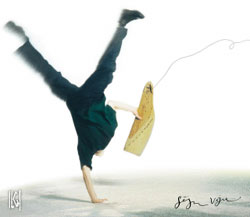
Post-folk wind blows a bit hard

Sēju vēju

Sēju vēju (meaning “tie the wind” or “sow the wind”) begins forcefully, like the wind, and with a strong and energetic beat that continues through the first several songs. Thankfully, it doesn’t last. To be honest, I soon found the heavy drumming tiring, and much enjoyed the change to a few calmer songs about half way through the recording.

For example, “Es ar meitu dancot gāju” has the familiar, soothing strum of the kokle (the national instrument of Latvia and much of northeastern Europe). “Pūti, pūti, vēja māte” is also a treat: an a capella performance by Ilga Reizniece. But, it’s too bad “Pūti, pūti” is so very short and immediately followed by that familiar driving beat again. Luckily, the next song, “Uz Daugavas es dzīvoju”, is a wonderful men’s ballad with a guitar accompaniment—another treat that just makes you melt.

The members of the group have changed once again, but the signature of the Iļģi sound—Reizniece’s distinctive voice—remains. One also hears the men’s voices quite a bit and, even though they sometimes overdo the “macho” element, they are a welcome addition. The bass guitar and drums are more prominent on Sēju vēju than on previous recordings, but Ilgi still rely on a variety of traditional instruments. Folk music conservatives may not like the “Indian yell,” as one folk music authority called it, that starts off the compact disc, nor the other whoops, yells and trills. They are not what one would consider reserved, northern or Latvian sounds.

The texts of the songs are all Latvian dainas, which are ancient verses passed down orally over hundreds, even thousands of years. Even though dainas are usually about agrarian life, they are timeless, and have obviously adapted very well to modern music, as one can hear on Sēju vēju. There is a motif of strength, energy and activity to the lyrics: they are about the wind, the ocean, young men, horses, searches for brides—all very fitting lyrics for the abundance of men’s voices that one hears on this recording, the powerful upbeat music, and, as the liner notes hint, the pace of modern life in general. The translations on the whole are good, though I found some to be lacking in detail or depth of explanation, as is usual in all translations.

Iļģi used to be considered a traditional folklore group, but they have come a long way from their original sound. This CD is definitely not for those with a narrow view of what Latvian folk music is. In fact, I wouldn’t really consider this folk music. It’s “world music” that really rocks. Sure, the traditional influence in the texts and melodies is very strong. But this is definitely rocky, with a touch of the bagpipes and a reminder of a barn dance here and there. I’ll even admit that the first couple of times around the CD was a bit too heavy for me.

But…I do support what Iļģi are doing. I really like and appreciate this experimenting, mixing of, and playing with traditional and modern musics. On a recording from 1993 Iļģi eloquently called it a “conversation between ourselves, in the presence of others who lived and sang here hundreds and thousands of years ago;” “the manifestation of creativity stimulated by traditional music,” and “the evolution, rather than the destruction, of the folk song.” The Celts have been doing this sort of thing for years, the Scandinavians are now into it, and, with such a rich traditional culture from which to take inspiration, it’s about time for the Latvians to pick up on it, too. Iļģi were ahead of their time and began their self-defined “post-folklore” many years ago, and with each new recording they seem to go a bit further.

If you don’t mind the heavy beat, Sēju vēju is another fine album from by far the best known world music group in Latvia. It has some really great songs—“Seši jauni bandenieki,” “Aiz upītes meitas dzied,” “Seši mozi bundzenīki,” and (my favorite) “Uz Daugavas es dzīvoju.” All in all, this CD is very catchy, and it’s beginning to grow on me! I’m finding myself humming melodies from it all day long. But, I will stress that it’s not for folklore purists.

(Editor’s note: This article originally appeared on SVEIKS.com.)

Details

Sēju vēju

Iļģi

Upe Records,  2000

UPE CD 016

Tenor epidemic spreads to Latvia

“Tenor is not a voice. Tenor is a disease!” Reputedly first uttered by an exasperated voice teacher, this tongue-in-cheek observation has been invoked over the years in response to the flamboyant reputations and popular adulation for celebrity tenors such as Enrico Caruso, Mario Lanza and, more recently, Pavarotti.

The vocal pyrotechnics of high voices seem to hold a particular fascination for listeners, as evidenced by the continuing popularity of the original “Three Tenors,” Luciano Pavarotti, Placido Domingo and Jose Carreras. Bestselling compact discs and sold-out concerts abound, and repeated broadcasts of the latter seem to have become a staple of public television fund-raising as well.

The “disease” has become an epidemic, with countless vocalists rushing in to take advantage of the frenzy. A female counterpart, “The Three Sopranos,” is touring and recording successfully. But looking beyond the marketing hoopla this phenomenon has generated, many fine singers have benefitted from the attendant publicity and received welcome exposure to a wider audience.

Latvia has produced its share of world-class voices. While no longer household names, Karl Jorn and Hermann Jadlowker are well known to vocal afficianados and appeared on the world’s great operatic stages years ago. More recently, Jānis Zābers continued this distinguished tradition and is the best-known Latvian tenor of recent times. His international reputation endures thanks in part to his many recordings from the LP era. A memorial fund established last year focuses on preserving this legacy as well as sponsoring vocal competitions, scholarships and concerts. Commemorating what would have been Zābers’ 65th birthday this year (he died tragically young in 1973), the fund has issued this new recording featuring three current leading Latvian tenors.

Nauris Puntulis, Guntars Ruņģis and Miervaldis Jenčs all possess pleasing, powerful voices, and while their grouping in this format is undoubtedly intended to capitalize on the current tenor craze, their splendid talent, enthusiasm and fine vocal technique should not be overlooked. There is no personal information about them in the CD booklet, but biographies posted on the World Wide Web indicate they are in their late 30s and have had extensive training and experience in a variety of operatic roles.

Here they sing a program of Neapolitan songs and arias, many of them staples of the tenor repertoire and said to have been dear to Zabers. Each tenor sings one solo, serving to display the unique character of his voice. Jenčs’ slightly husky timbre is heard to good effect in Cesare Bixio’s song “Parlami d’amore, Mariu!”; Another Bixio song, “Serenata malinconica,” is complemented by Puntulis’ somewhat darker, deeper voice. Ruņģis’ bright, clear voice could be characterized as somewhat Pavarotti-ish, and his powerful, focused, ringing tone is heard to thrilling effect in Verdi’s famous aria “La donna e mobile.”

In the other 11 selections, singers alternate between verses or appear together in various combinations, in the familiar style of the original “Three Tenors.” The quality of their individual voices is clearly distinguishable but blends pleasantly. Perennial favorites such as “Funiculi, funicula,” “Torna a Surriento,” and “Santa Lucia” resound with appropriate swagger, soulfulness and nostalgia. “O sole mio” appears as the now-familiar show-stopper, with all three tenors making their expected sequential entrances on the final refrain, with splendid effect.

Sadly, the fund’s budget apparently did not allow for an orchestral accompaniment. Perhaps the lush, rich orchestral backgrounds accorded to Pavarotti, Domingo and Carreras have raised unreasonable expectations, but the synthesized accompaniments to several of the songs on this disc frequently sound jarring and unpleasant. At times the timbres are too obviously electronic in origin and seem distractingly garish. Though admirably clear, the lack of true instrumental perspective sounds particularly artificial when heard over headphones and the unnaturally reverberant acoustic doesn’t help.

Still, the music and the voices should be the primary concern. While a few of the songs may be less familiar, they are well-chosen and their enjoyable variety should appeal to all but the most jaded listener. With talented and committed vocalism such as this, the tenor epidemic needs no cure!

(Editor’s note: This article originally appeared on SVEIKS.com.)

Details

Piacer d’Amor

Trīs tenori

Jāņa Zābera Piemiņas fonds,  1999

JZPF CD 001

Latvian-American lawyer charged in killings

A Latvian-American immigration lawyer has been charged in a killing spree that left five people dead April 28 in Pittsburgh, according to Pennsylvania media reports.

Richard Baumhammers, 34, was arrested in Ambridge, near Pittsburgh, after allegedly killing a Jewish woman, an Indian grocer, two Asian-American restaurant employees and a black man. Baumhammers has been charged with one murder in Beaver County, according to the Beaver County Times. Other murder charges are pending in Allegheny County, where four people died.

Prosecutors also are considering filing hate crime charges against Baumhammers, which may bring a stiffer sentence if Baumhammers is convicted.

Stories carried by the Pittsburgh Post-Gazette and other media noted that Baumhammers’ parents immigrated to the United States after World War II and that his father is a successful dentist in the Pittsburgh area.

Andris Straumanis is a special correspondent for and a co-founder of Latvians Online. From 2000–2012 he was editor of the website.