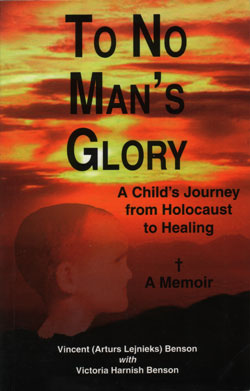
Child’s story reveals humanity’s disgrace

To No Man's Glory

One of our dogs had worms when she was a puppy. I still recoil at the memory of the long, white worms mixed in with her excrement—and at having to gather up some for a veterinarian’s analysis.

Arturs, the little boy who is the subject of Vincent and Victoria Benson’s To No Man’s Glory, also had worms. He had to pull them from his rectum with his fingers.

This is just one of many disgraces Arturs Lejnieks, a young Jewish orphan, had to face as he and his group of refugees wandered around Latvia during World War II in an attempt to escape death at the hands of the enemy, whoever that might be at any given moment. Young Arturs later became Vincent Benson, the adopted son of an Iowa farm couple.

To No Man’s Glory takes the reader along with Arturs as he in 1941 leaves an orphanage in Majori with his beloved Auntie and embarks on several years of constant running from those who would wish them dead. The child doesn’t understand his Jewishness, nor does he understand why people would want to kill him because he is a Jew. But he learns there are many who cannot be trusted: Germans, Russians, Latvians. As the bumper sticker says: "Mean people suck."

After he and his Auntie survive several close calls in Latvia, they wind up in Germany as Displaced Persons. From there, Arturs is shipped off to America where he is placed in Iowa with an ungrateful adoptive father but a loving adoptive mother. Only after he converts to Christianity does Arturs, now known as Vincent Benson, find the strength to forgive all those who have hurt or betrayed him in Latvia, in Germany, in America.

This is, obviously, a story of survival. It is not a happy book, even with an ending that sees Vincent Benson finally have some normalcy in his life. It is a matter-of-fact book, with horrid wartime scenes that require little embellishment to paint powerful images. It also is a revealing book: Vincent Benson doesn’t shield himself or the reader from the nastiness of everyday life, even in the relative security of postbellum, midwestern America.

What is especially troubling about the story is that despite being a Jew—and being persecuted for being one—Vincent Benson never really had the chance to be one. German soldiers wanted to kill him for being a Jew before he even knew what being Jewish meant. As a Displaced Person there was precious little time to learn about his heritage. In Iowa, his adoptive father pushed him to forget his past and become a good Lutheran. Taken together, that is perhaps the greatest disgrace experienced by Vincent Benson.

Although it has the markings of a self-published book, To No Man’s Glory is well done. Victoria Benson presents herself as a competent writer who has taken her husband’s story and shaped it into prose.

Illustrations are few, mostly some small snapshots of the Lejnieks family taken during better times in prewar Latvia. But one group of pictures, taken from an assignment book Arturs used while a student in a DP school, deserved to be displayed much larger. These include drawings by the child, depicting war and other scenes that were etched into his memory.

The Bensons obviously researched events beyond simply relying on the decades-old memories of Vincent. In the first part of the book, brief introductions to some chapters provide historical context in terms of Nazi Germany’s plans for the "Final Solution." But what is lacking is a clear understanding of where in Latvia many of the events unfold. Yes, we know where Rīga is, but where are the roads young Arturs and Auntie travelled? Where are the forests in which they hid? Where are the mass graves they saw? Of course, it may be difficult to resurrect geographical context from childhood memories, but even a general fix on where events occurred would be of great benefit to the reader.

To No Man’s Glory joins the still small but growing literature on the Latvian experience during and after World War II (see Aurora and A Woman in Amber for other examples). Call it victim literature, call it refugee literature. Whatever its name, it’s an important story that must be told.

Details

To No Man’s Glory: A Child’s Journey From Holocaust to Healing

Vincent (Arturs Lejnieks) Benson with Victoria Harnish Benson

Medford, Oregon:  Silver Dove Publishing,  2000

ISBN 0967656605

Andris Straumanis is a special correspondent for and a co-founder of Latvians Online. From 2000–2012 he was editor of the website.

So much schlager, so little time

Šlāger music is quite the phenomenon in Latvia. I’m always amazed how in some of the music stores there are racks and racks of compact discs and tapes that represent this music. And every time I go there, it seems that there is more and more of it—new šlāgeraptaujas (šlāger compilations) seem to come out every month. Quite impressive for a style of music that gets sneered at by snobbier music fans, and gets derided in a variety of ways, like “It all sounds the same,” “That’s music only my grandmother would listen to,” etc.

Personally, I don’t mind the stuff. It is simple, but catchy, and most of the songs are the type you can start singing along before the song is even done.

But of course, the issue is that there is so much šlāger, so little time. So whom to listen to? There are so many groups (and I will admit that many of them do sound the same in the end) that it is hard to figure out which recordings in particular to purchase, and which of the many, many šlāger groups are worth listening to.

A group whose songs I often heard over the years is Zeļļi (roughly translated to “chaps” or “fellows”). The band is made up of Raitis Treijs (voice), Jānis Vējiņš (keyboards), Ivars Birkāns (on saxaphone, one of the unique sounds in Zeļļi), and Pēteris Vējiņš (guitar and voice). Though similar to many other šlāger groups, they had some truly memorable songs. Judging from the 1995 release Mikrofona 20 labākās dziesmas, Zeļļi had a number of hits. These include “Krustceles,” a hit in 1993. Another hit was “Vel tu nāc,” a song from 1994. My favorite song by them is “Vedej, pasteidzies”, which I had originally heard on the 1991 album Ratiņa aptauja, also put out by MICREC.

So with Dziesmas Tev un man, I was expecting an album full of Zeļļi classics.

Much to my surprise, I was disappointed by what I heard.

As with the Labvēlīgais tips and Bumerangs best-of collections, these recordings are new recordings of old songs. I can understand the reasoning for re-recording old versions of songs, maybe to record them better (because technology has improved over the years) or maybe because the members of the band have become better musicians. The Tips and Bumerangs collections are still fully in the spirit of the originals, and the changes aren’t too startling for someone who has heard the old versions of the songs. However, in Zeļļi’s case, the new songs are sometimes markedly different than what I remembered.

An example of that is “Vedej, pasteidzies,” a song about a guy who is rushing to get home to his beloved, but arrives just in time to see her get married to someone else. The version on the Ratiņa record was a simple yet catchy folk song. The version on the new CD has been given a dance beat, with an over-loud drum track. I think this totally ruined the mood of the song. Somehow I don’t see this getting played in a dance club anyway!

The new version of “Krustceles” is not much different than the version I had heard on the 20 labākās dziesmas album. The original was a slower, more relaxed song about relationships (including the great line “Ne jau visi atkusi nes pavasari, ne jau katra aizraušanās mīlu līdzi nes”—Not every thaw brings spring, not every diversion brings love). The major, upsetting difference is that the original had a great saxaphone solo to close out the song, but this re-recording completely omits that. Just when I thought the saxaphone would start, the song ends! I was most saddened by its absence.

But there are plenty of worthwhile moments on the album, even though it seems that every song was designed to be “danceable.” “Rudzupukes,” “Lilijas” and “Skaudība” are all examples of what šlāger is all about: songs that upon first listen make you think you’ve known them your entire life. Also, the new version of “Vel tu nāc” is one of the few songs on here that is better than the original.

There’s a Latvian version of the song “Blowing in the Wind” called “Atbildi zina tikai vējš.” It’s the same as the English version. However, they don’t even credit Bob Dylan as the writer of the song (for shame!).

Unfortunately, the second half of the album falls into the same šlāger music trap: It all begins to sound the same. The second half mostly has slow ballads that seem to fade into each other without any way to distinguish between all of them. Even after repeated listenings, I can’t immediately distinguish some of the songs.

I really, really did want to like this record, as I think Zeļļi are a very talented band with a number of great songs, but this album is not the best representation for them. I’d suggest seeking out the 20 Labākās dziesmas album (which, to my knowledge, is long out of print) or some early šlāgeraptaujas with the original versions of these songs.

And again, no lyrics! I am completely aware that sometimes it is simply an issue of cost that the lyrics are not attached. But if this is your first CD release, and you want your fans to really appreciate your words and your songs, please attach the lyrics for the songs.

Ardent šlāger fans will probably love this record, as it is completely predictable and contains no shocks or surprises, which is to be expected from šlāger music and not entirely a bad thing at all. However, anyone who expects to be even slightly challenged by the music they listen to will be disappointed. Though Zeļļi are a cut above the “average” šlāger band, this album does not show that as well as it could have.

Details

Dziesmas Tev un man

Zeļļi

Gailītis-G,  1999

Egils Kaljo is an American-born Latvian from the New York area . Kaljo began listening to Latvian music as soon as he was able to put a record on a record player, and still has old Bellacord 78 rpm records lying around somewhere.

Prezidente: Aizdegsim katrs savu sveci

Augsti godātie valstssvētku viesi, mīļie tautieši! Es sveicu Jūs visus šai Latvijas republikas proklamēšanas 82. gada dienā un kopā ar visu tautu novēlu saules mūžu Latvijai.

Mēs stāvam uz jaunā gadsimta sliekšņa vēsturisko notikumu gaidās, kas jau pēc dažiem gadiem ļaus Latvijai kļūt gan par Eiropas Savienības, gan par NATO alianses dalībvalsti. Šos mērķus esam sev izvirzījuši tamdēļ, ka tie ļaus mums baudīt visas tās priekšrocības, ko jau tagad bauda tās valstis, kas ir šo starptautisko veidojumu locekles. Esam uzņēmušies sakārtot un pilnveidot savu likumdošanu, valsts pārvaldi, saimniecību un sabiedrisko kārtību līdz tādam līmenim, kas atbilstu visiem nepieciešamiem eiropiskiem un starptautiskiem standartiem. Tikai šādi, paši augstākie standarti, būs pietiekami labi mums pašiem.

Mēs neesam otrās vai trešās šķiras pasaules pilsoņi. Mēs neesam ne cilvēces pabērni, ne civilizācijas izstumteņi. Mēs neesam ne izsūtamie, ne peramie zēni citiem. Mēs esam brīvas valsts brīvi pilsoņi, spējīgi paši stāvēt uz savām kājām, ar taisnu muguru, ar drošu prātu, ar skaidru skatu par to, kas mēs esam un kurp mēs ejam.

Mēs, Latvijas iedzīvotāji un pilsoņi, vēlamies dzīvot cilvēka cienīgu dzīvi brīvā, neatkarīgā, demokrātiskā, atvērtā un tiesiskā valstī, jo savā vēsturē esam piedzīvojuši gana daudz apspiestības, netaisnības, tirānijas un asiņaina vājprāta varas. Mūsu ciešanu mērs ir pilns, un tagad mēs gribam dzīvot labāku dzīvi. Mēs esam to pelnījuši. Mēs esam gatavi strādāt un cīnīties ar visiem spēkiem, lai tādu sev nodrošinātu.

Pēc ilgiem nebrīves gadiem atkal paši esam kungi savā dzimtajā zemē. Nu pienācis laiks celt mūsu labklājību un gādāt par iztiku, izglītību, drošību un veselību visiem valsts iedzīvotājiem. Laiks radīt plaukstošu vidi uzņēmējiem, darba vietas strādniekiem, un iespējas izkopt un pielietot savas dotības zinātniekiem, māksliniekiem un sportistiem. Vēl daudzviet mēs atpaliekam, bet ilgi mēs vairs nedrīkstam to darīt. Mums atliek vēl pāris gadu, lai parādītu, ko mēs spējam, lai pierādītu, ka mēs neatpaliekam no citiem. Mums atliek pāris gadu, lai nodrošinātu, ka netiksim pieskaitīti bezcerīgi atpalikušo valstu saimei, bet gan panāksim un varbūt pat apdzīsim dažu labu citu attīstītu valsti.

Latvijas vārdā es vēlos šodien pateikties visiem tiem, kas ir lojāli pret šo valsti, kas to atbalsta un stiprina ar centīgu sava darba darīšanu, ar krietnu savu uzdevumu veikšanu, ar godīgu savu pienākumu pildīšanu. Jūs esat mūsu zemes sāls. Jūs esat mūsu valstiskuma balsti. Jūs esat mūsu nākotnes pamats. Es pateicos visiem tiem, kas ciena un mīl savu zemi, jo tā ir mūsu māte, kas mūs ir izauklējusi. Ne mums, viņas bērniem prasīt, vai viņa mūsu mīlestību būtu pelnījusi, bet gan mums katram pierādīt, ka mēs esam pelnījuši saukties par viņas bērniem.

Es vēlos pateikties visiem tiem, kas par Latviju lūdz Dievu un savās sirdīs glabā domas par to, cik tā var būt diža, cēla un skaista. Lūgsim visi kopā par savu zemi un tautu, lai pār to atspīd Dieva žēlastība un svētība un lai Visuma spēki mums palīdz visur tur, kur mūsu cilvēcīgie spēki ir par vājiem.

Mēs visi zinām, kādu mēs vēlētos redzēt savu valsti. Mūsu mērķis ir panākt vienu likumu visiem un cilvēka cieņai atbilstošus dzīves apstākļus visiem. Vēl tas nav sasniegts, bet mums tas ir jāsasniedz, un tas ir mūsu spēkos. Mēs spēsim to paveikt, bet tikai tad, kad būsim pietiekami pārliecināti, ka ir iespējams dzīvot citādi, nekā līdz šim, ka ir iespējams lietas mainīt, un pie tam mainīt tās ļoti ātrā un straujā, pat nežēlīgi straujā tempā.

Mūsu ienaidnieks šobrīd esam mēs paši, jeb, pareizāk sakot, tas ir tumsības gars, kas barojas no mūsu vājībām un kam mēs atļaujam kā melnai miglai gulēt pār mūsu zemi. Mums ir jāsaprot, pret ko mums jācīnās un kāpēc, ja gribam, lai valsts ātrāk uzplauktu un attīstītos. Mums ir jācīnās pret tumsas spēkiem, kuru vārds ir bezatbildība, visatļautība un patvaļa. Tumsas rindās karo visi tie, kas nedomā ne par savu pienākumu, ne par savu tuvāko, ne arī par valsti, bet tikai un vienīgi paši par sevi un par savu tiešo labumu. Viņi dzīvo it kā būtu vieni paši uz pasaules. Viņi dzīvo it kā nekad nebūtu rītdienas. Bet tikpat daudz, cik pret viņiem, mums katram ir jācīnās pašam ar sevi, lai neļautu sevi pakļaut tiem tumsas spēkiem, kuru vārds ir apātija, cinisms, vienaldzība un depresija. Nav vieglāka upura tautas ienaidniekiem par demoralizētu un bezcerībā ieslīgušu tautu.

Es izprotu to sašutumu, ko šobrīd izjūt daudzi par notikumiem, kuru dēļ kopībai nodarīts kaitējums, šķiet, ka nav saņēmis tam piemēroto sodu. Mūsu pienākums ir darīt visu, lai sakārtotu savus likumus un gādātu par to pienācīgu izpildīšanu. Taču katra reize, kad tas neizdodas, nav attaisnojums, lai atmestu visam ar roku un deklarētu, ka valsts nekam neder. Taisni otrādi—tas nozīmē, ka ir jāpieliek vēl lielākas pūles, lai panāktu taisnību, lai arī cik ilgi un cik grūti par to būtu jācīnās.

Mūsu pienākums ir gādāt, lai mūsu valsts pilnveidotos un attīstītos. Par valsts struktūrām ir jārūpējas tikpat, cik mēs rūpējamies par saviem bērniem. Valsts ir jākopj ar to pašu gādību un mīlestību, ar kādu mēs kopjam savas mājas un ģimenes dārziņus.

Neatkarīgā Latvijas valsts ir sasniegums, ko tagad vairs nevar mums atņemt. Mūsu karogs plīvo citu zemju karogiem blakus, mūsu himna atskan uzvaru un svētku brīžos. Tās ir mūsu pazīšanās zīmes un daļa no mūsu identitātes. Latvijas brīvība ir vērtība, kas par dārgu cenu atkal atgūta, ar ciešanām un ar asinīm, un tā tagad ir nodota mūsu rokās. Latvijas valstiskums, ko esam atguvuši, ir dārgums, kas mums ir uzticēts. Tas ir mūsu pašu ziņā ko ar to darām.

Mūsu zeme attīstās, mūsu zeme veidojas, mūsu zemē no gada uz gadu ir samanāms progress. Vēl daudz kas ir darāms, bet mēs spējam to veikt. Tie nav pārcilvēcīgi Herakla diždarbi, kas mums ir jāpaveic, bet gan normāla, apstākļiem atbilstoša un saprātīga rīcība. Mēs jau negribam doties uz Mēnesi. Mēs tikai ilgojamies pēc normālas dzīves. No tiem, kas nes atbildību, mēs neprasām paranormālas spējas, tikai normālu atdevi un godīgi padarītu darbu.

Laimīgā kārtā, ir daudz ļaužu Latvijā, kas ne tikvien padara to, kas nepieciešams, bet iet vēl daudz tālāk. Mūsu zemē ir tik daudz talantu, tik daudz spēju, tik daudz dotību, tik daudz izdomas, tik daudz radošā gara un oriģinalitātes. Tās ir mūsu īstās dabas bagātības, tas ir tās vērtības, ko mēs varam Eiropai un pasaulei sniegt.

Mēs varam patiesi būt lepni ar saviem cilvēkiem un saviem sasniegumiem. Mēs varam lepoties ar visiem tiem latviešiem, kas ir sasnieguši izcilību tik daudzos un dažādos laukos. Nav svarīgi, kādas izcelsmes tautībai tie pieder, vai kāda būtu viņu dzimtā valoda: latviešu, krievu, vai kāda cita. Visi vienādi tie ir Latvijas dēli un meitas, kas godam nes mūsu valsts vārdu kā pašu mājās, tā pasaulē. Latvijai ir vajadzīgs katrs, kas spēj to mīlēt un cienīt, katrs kas ir gatavs būt tai lojāls un uzticīgs. Šeit nedrīkstam pieļaut nekādus ierobežojumus un nekādus aizspriedumus. Kā Latvijas Valsts prezidente, es šodien aicinu katru, kam šī zeme ir dārga, nākt Latvijas pilsoņu pulkā, ja viņš vēl šobrīd ir nepilsonis. Strādāsim visi kopā, jo tad mēs sasniegsim vairāk nekā katrs atsevišķi.

Šīs tumšās un drēgnās novembra dienas, kad svinam Latvijas valstiskumu, mums atgādina, ka ar tumsu var cīnīties, radot gaismu tās vietā. Mūsu sūtība nav lādēt tumsu, bet aizdegt svecīti tumsībā. Aizdegsim katrs savu sveci, tad Latvija būs pilna gaismas.

Gaisma var uzvarēt tumsu, ja mēs to vēlamies un tam ticam. Es ticu Latvijas tautai, es ticu Latvijas valstij, es ticu Latvijas nākotnei.

Dievs, svētī Latviju!