Tenor epidemic spreads to Latvia

“Tenor is not a voice. Tenor is a disease!” Reputedly first uttered by an exasperated voice teacher, this tongue-in-cheek observation has been invoked over the years in response to the flamboyant reputations and popular adulation for celebrity tenors such as Enrico Caruso, Mario Lanza and, more recently, Pavarotti.

The vocal pyrotechnics of high voices seem to hold a particular fascination for listeners, as evidenced by the continuing popularity of the original “Three Tenors,” Luciano Pavarotti, Placido Domingo and Jose Carreras. Bestselling compact discs and sold-out concerts abound, and repeated broadcasts of the latter seem to have become a staple of public television fund-raising as well.

The “disease” has become an epidemic, with countless vocalists rushing in to take advantage of the frenzy. A female counterpart, “The Three Sopranos,” is touring and recording successfully. But looking beyond the marketing hoopla this phenomenon has generated, many fine singers have benefitted from the attendant publicity and received welcome exposure to a wider audience.

Latvia has produced its share of world-class voices. While no longer household names, Karl Jorn and Hermann Jadlowker are well known to vocal afficianados and appeared on the world’s great operatic stages years ago. More recently, Jānis Zābers continued this distinguished tradition and is the best-known Latvian tenor of recent times. His international reputation endures thanks in part to his many recordings from the LP era. A memorial fund established last year focuses on preserving this legacy as well as sponsoring vocal competitions, scholarships and concerts. Commemorating what would have been Zābers’ 65th birthday this year (he died tragically young in 1973), the fund has issued this new recording featuring three current leading Latvian tenors.

Nauris Puntulis, Guntars Ruņģis and Miervaldis Jenčs all possess pleasing, powerful voices, and while their grouping in this format is undoubtedly intended to capitalize on the current tenor craze, their splendid talent, enthusiasm and fine vocal technique should not be overlooked. There is no personal information about them in the CD booklet, but biographies posted on the World Wide Web indicate they are in their late 30s and have had extensive training and experience in a variety of operatic roles.

Here they sing a program of Neapolitan songs and arias, many of them staples of the tenor repertoire and said to have been dear to Zabers. Each tenor sings one solo, serving to display the unique character of his voice. Jenčs’ slightly husky timbre is heard to good effect in Cesare Bixio’s song “Parlami d’amore, Mariu!”; Another Bixio song, “Serenata malinconica,” is complemented by Puntulis’ somewhat darker, deeper voice. Ruņģis’ bright, clear voice could be characterized as somewhat Pavarotti-ish, and his powerful, focused, ringing tone is heard to thrilling effect in Verdi’s famous aria “La donna e mobile.”

In the other 11 selections, singers alternate between verses or appear together in various combinations, in the familiar style of the original “Three Tenors.” The quality of their individual voices is clearly distinguishable but blends pleasantly. Perennial favorites such as “Funiculi, funicula,” “Torna a Surriento,” and “Santa Lucia” resound with appropriate swagger, soulfulness and nostalgia. “O sole mio” appears as the now-familiar show-stopper, with all three tenors making their expected sequential entrances on the final refrain, with splendid effect.

Sadly, the fund’s budget apparently did not allow for an orchestral accompaniment. Perhaps the lush, rich orchestral backgrounds accorded to Pavarotti, Domingo and Carreras have raised unreasonable expectations, but the synthesized accompaniments to several of the songs on this disc frequently sound jarring and unpleasant. At times the timbres are too obviously electronic in origin and seem distractingly garish. Though admirably clear, the lack of true instrumental perspective sounds particularly artificial when heard over headphones and the unnaturally reverberant acoustic doesn’t help.

Still, the music and the voices should be the primary concern. While a few of the songs may be less familiar, they are well-chosen and their enjoyable variety should appeal to all but the most jaded listener. With talented and committed vocalism such as this, the tenor epidemic needs no cure!

(Editor’s note: This article originally appeared on SVEIKS.com.)

Details

Piacer d’Amor

Trīs tenori

Jāņa Zābera Piemiņas fonds,  1999

JZPF CD 001
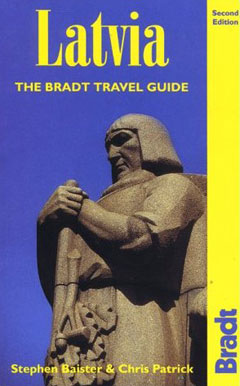
A travel guide to call your friend

Latvia: The Bradt Travel Guide

When you pick up the Bradt Travel Guide and give it a peek, some strong points immediately present themselves. Its clear organization and rich, easily accessible information make it a jewel. But like many worthy friends, it has some quirks and tendencies that need to be noted and which are overcome or easily ignored. The two minor flaws are that most scales and values are given in British terms, and a there are a few Latvian spelling and grammar errors. While sparse with photographs, it includes some nice teasers—but this is more a matter of preference of what one really needs in a guide, in my opinion. That being noted, I can now easily bubble on about all of the great advantages this book brings to the reader and traveler.

When touring or visiting, the most prized possession is not the money belt or the destination but a good guide book. The expectations that are created from such books can enhance or detract from the travel’s planning and spontaneity. The normal fare of previewed restaurants and hotels populate the book, yet what makes this book stand out is the rich layer of cultural, historic and artistic information. It gives a succinct overview of Latvia’s complicated history along with fair generalizations about its people. The authors were even able to convey how nature is cherished by Latvians and is part of the nation’s rich culture. This is no mean feat.

Having lived in Rīga for almost two years, a friend and I would challenge each other to see who could find an unknown yet quality restaurant in the Old City. We enjoyed learning about the stories and history of Rīga during these forays. I found even these hard-earned gems were listed in the Bradt guie, giving it a high mark by my reckoning. In the same category as quick reference lists found throughout the guide, there are clear concise maps for trails, road and train.

Besides dedicating a good portion of the book specifically to describing Latvia’s history, economy, people, politics and culture, each of these elements show up again throughout the guide. The authors find highlights for each region’s cities and their surrounding countryside. With this book pointing the way, a visit to some of the smaller towns will provide respites and delightful glimpses of nature. Naturally, some travelers will decide to go more into the country of a region, and each chapter of the guide will have some pertinent story or account to share.

What makes this book better than most is its insights into Latvia’s gnarled, twisting and complex history. It doesn’t try to make that history simple, but it certainly simplifies the learning curve that such a culture deserves.

From small essays that require mulling over, to quick reference lists and maps, this guide has all that a traveler going to Latvia would need. It guides us to a bit of Latvia that only Latvians themselves experience and know. Whether one is just starting to become acquainted with Latvia or already is familiar with the country, this book is well worth its price.

(Editor’s note: This review originally appeared on the SVEIKS.com site.)

Details

Latvia: The Bradt Travel Guide

Stephen Baister and Chris Patrick

London:  Bradt Publications,  1999

ISBN 1898323909

Romantic duets showcase Vaice and Mok

Romantic

For their debut recording, Romantic Duets, two gifted and young singers, soprano Sonora Vaice of the Latvian National Opera, and tenor Warren Mok, frequent guest artist of the LNO, have recorded eight duets from six renowned Italian operas: Donizetti’s Lucia di Lammermoor and L’elisir d’amore, Verdi’s Rigoletto and La Traviata, as well as Puccini’s La Boheme and Madame Butterfly.

The tone color of Vaice’s bright yet passionate voice is elegantly matched by Mok’s clear and ardent singing. The excellent sonics have a vibrant quality well-suited to the soloists’ separate and combined vocal textures, which while easily encompassing both dramatic and lyrical operatic styles, in most of the tracks on this disc, tend to emphasize the former. Under the fine direction of maestro Normunds Vaicis, the Latvian National Opera Symphony Orchestra performs with great finesse, creating a pleasing dynamic balance with the timbre of the singers’ voices.

First on the disc are the three Donizetti duets: “Lucia, perdona…Sulla tomba che rinserra,” “Una parola, o Adina…Chiedi all’aura lusinghiera” and “Caro, Elisir, sei mio?…Esulti pur la barbara.” All make a striking impression, with both singers performing their virtuoso parts with dazzling ease and fervor.

My favorite performances on this release were those of the Verdi duets: “Signor ne principe…E il sol dell’ anima,” “Libiamo, libiamo ne’lieti calici” and “Amato Alfredo…Parigi, o cara, noi lasceremo…Ah non piu…a un tempio…,” since in all three the singers’ phrasing has a very natural and appealing flow. It should be noted that in 1992, Vaice made her operatic debut with the LNO as Gilda in Rigoletto. As heard on this disc, the interpretation of Gilda and Duca’s duet is dynamically and emotionally engaging, while Alfredo and Violeta’s duet from Act 1 is especially memorable for its lyricism.

To their performances of Puccini’s supremely masterful duets: “O soave fanciulla” and “Vieni la sera,” Vaice and Mok bring a fresh interpretation that is often technically and emotionally electrifying.

After listening to this recording, it is easy to understand why Christa Ludwig has described Vaice as “a great musician” and why, in writing about one of Warren Mok’s performances, the English Guardian newspaper has written: “His technique is rock solid, with beautiful, even timbre…”

To my knowledge, the particular compilation of duets chosen for this recording has not been reproduced on recent operatic releases, and so provides a welcome complement to the collections of operatic duets currently available. This charming recording, produced by the notable Latvian recording company, UPE, is certain to make a valuable addition to all opera lovers’ libraries.

(Editor’s note: This article originally appeared on SVEIKS.com.)

Details

Romantic Duets

Sonora Vaice and Warren Mok

UPE Recording Co.,  1999

UPE CLASSICS UC001