Done with Latvia, Berzins tries murder

Death in the Glebe

On the second day of spring a body is found, rolled up in a blood-soaked rug and stuffed behind the boiler of a run-down apartment building. It is identified as the body of Ida Tepper, an eccentric and vain woman who spent the previous day on frivolous pursuits: "If Ida Tepper weren’t so rich, she’d be locked up," her hairstylist said when she arrived for her appointment. Ida Tepper felt no presentiment of disaster; in fact, she was buoyed by the sense of a new life beginning. And, in a way, it was.

Death in the Glebe is set in a fashionable area of Ottawa. Inhabitants of the Glebe, we are told, are willing to pay exhorbitant rents to live there, even in mansions-become-tenements like Hardon Hall, where the body is discovered. The tenants of Hardon Hall are an unsavoury lot. From the top floor, where "slum landlord extraordinaire" Kevin Hardon abuses drugs and his wife, to the basement, where various street people and petty criminals hide from the light, the layers of Canadian society are stacked in order of importance.

None of these characters are sentimentalized—if anything, they are so unsavoury as to be off-putting. Readers of Ilze Berzins’ previous book, the autobiographical Happy Girl, will recognize the moral relativism that does not render any of her characters fully sympathetic. All of them, from Jerry, the seedy caretaker, to Robert, Ida Tepper’s resentful gigolo, have their own agendas; several have reason to wish Ida dead. The women are more favourably portrayed than the men, though they tend toward victimhood of one kind or another. The most likeable character is a pet-loving artist named Doreen, who attracts the romantic interest of one of the detectives assigned to the case. Doreen’s boyfriend has recently left her for another woman; devastated, she takes refuge in her painting, concluding that Art and the company of dogs are more sustaining than human relations.

Death in the Glebe follows the conventions of the murder mystery, though the solution of the puzzle is disappointing in its dependence upon a botched autopsy and the inability of the police to locate a bloody murder scene in the very building in which it was committed. It is depressing enough to imagine that such things may happen with regularity in the real world; it is one of the hopeful conventions of detective novels that they do not. The outcome, which is inventive, should not hang on such unsatisfying devices.

Justice, if it can be said to be done, is approximate, and a broad strain of social satire runs through Death in the Glebe. "Money creates justice," Detective Barry Mullins says soon after the discovery of the body. He knows that the murder of a wealthy woman will remain central until the perpetrator is found, while the unsolved murders of the powerless will be forgotten. There is no expectation of justice for crimes committed against the socially insignificant. Petty criminals can slide away out of sight, confident that the police will not find it worthwhile to pursue them. Special barbs are reserved for cults that prey upon the needs and neuroses of their followers, seemingly impervious to police intervention.

The episodic structure of Death in the Glebe is similar to that of television crime shows and, while this gives the story a certain momentum, it can be disorienting until the many characters are sorted out. In spite of its deficiencies, the story progresses with unflagging energy, and the broad and sometimes maliciously drawn characters do eventually overcome their own sketchiness. The book succeeds best in being wildly personal, as the thoughts and prejudices of the author are never far from the surface.

This is a portrait of a society in which money and status determine all. Only money can afford protection to women, and single women without it are particularly vulnerable. Even those with money and position, like the unfortunate Ida Tepper, may find themselves vulnerable in unexpected ways.

(Editor’s note: This article originally appeared on the SVEIKS.com site.)

Details

Death in the Glebe

Ilze Berzins

Halifax, Nova Scotia:  Albert Street Press,  1999

ISBN 0-9686502-1-X
Sanskrit, Latvian combine for a hit

Let me say right off I’m a bit biased in this review, for a couple reasons. First, ever since I performed at a Hindu New Year event two years ago, I’ve been pumping people up around me with the idea that Indian music and culture is the next big undercurrent in the mainstream music scene. Second, Aigars Grāvers is heading this musical project, and having been a big fan of Jumprava, I was curious to see what else this man could accomplish.

Welcome to Rama Dance and Sāga. It’s a beautiful musical relationship of dance, Latvian folk tunes and Vedic Sanskrit. In publicity about the band and the album, it is said that the “main idea of this project is an ancient Indo-European culture projection in contemporary modern sight.” I think it’s more than that, folks! Rama Dance’s meshing of Vedic Sanskrit with Latvian folk songs and modern dance music is so complementary I have to use the word “symbiotic” to accurately describe the musical interaction in this album. They belong together. It works!

In addition to Grāvers, among those performing on the album are the poet and singer Nataradža, Mārtiņš Burkevics, Kristīne Karele, Olga Rajecka, Olafs Vilks, Arnolds Kārklis, Baiba Kranāte (one of Latvian Independent Television’s “Trīs Baibas”), Armans, Viesturs Irbe, fellow Jumprava member Aigars Grauba, Guntars Endzelis, Valdis Indrišonoks and Rolands Ūdris (lead singer for The Hobos).

Grāvers and Nataradža head the project. Although not all tracks could stand on their own as individual radio hit songs, they work together very nicely as an overall soundscape and experience. The organization of the tracks appears intentional and well executed. This is an album where you really have to listen to all the tracks to get a better impression of what they’re trying to project.

The album begins with “Intro,” a great musical collage of multiple vocal overlays and a dark-toned backing track. I liked having to carefully listen to the conversation in-between the Sanskrit and backing vocals to hear the entire discussion of the musical project. I pictured myself in a deep, heavily fogged forest witnessing this conversation from a distance between these folks as they sat around a campfire.

“Daugaviņa” moves from the introduction into Nataradža soloing an old folk song in the same haunting overtones. Tension builds beneath his dark voice. I’ll leave the rest a mystery for you to discover.

In “Rama Dance”—backed by quick drums typical of the drums ‘n’ bass genre—Nataradža and Grāvers recite Sanskrit over tastefully done rich string synth sounds.

“Melnā dziesma” is a wonderful blend of traditional Latvian musical folk instruments, modern lyrics and dance music. The transition from traditional to modern arrangement is seamlessly executed.
Then comes “Tāda zeme.” Whoa! I fell back into the 1980s! Laid back funk ‘n’ groove that reminded me of the days of Band Aid to help stop world hunger. That’s not an insult; those days are very close to my heart. I actually could see this track being a good backing track for a movie. Rajecka’s voice is sweet and smooth. She was a great choice to lead the vocals on this track. I love the thick harmonies at the end of the song.

“Viens” is a New Age or electronica-type piece (I hate using the word “electronica,” but people know it). Nice piano work. Simple and captivating with the sampling overlays performed by Ūdris. And there’s an interesting choices of samples: The passing transport truck caught me off guard.

From “Viens” we transition directly into “Mio Deo,” a rock/pop spiritual piece. The song didn’t move me, but it fit well.

“Narasinga” is a techno dance tune with text taken from the Vaisnavu prayer books. I didn’t grab onto this piece entirely: I couldn’t tell whether it was the techno back beat or the accordion rhythm over the top that bothered me. Probably the techno back beat.

“Tulasī” is what “Narasinga” could have been. Great arrangement, although I longed for the Trent Reznor-ish distorted lead vocals and heavy guitar lines. Granted, that could have conflicted in the imagery reflected by the lyrics, but I still felt it could have gone in that direction. The keyboard effects with sitar lines were well placed.

My favourite song of the whole album is “Jēziņ.” It’s an addictive tune! If this hasn’t played as a No. 1 hit on Latvian radio, I’d be surprised. Latgallian really meshes well with Indian vocal rhythm patterns. What a groove! Love it.

“Bailes” is a screamer! I bet performing this piece must be a euphoric experience for whomever screams that text in the middle of the song. There are so many “bad” screaming pieces that just hurt to listen to. This is not one of them. I’ve never heard one in Latvian before, but talk about a crowd pleaser piece! Mosh pit!

The final song, “Rāmava,” is a beautiful rock tune with beautiful guitar work. The harmonies are full and ethereal. It’s nice, laid back ending to the entire album.

In an age when Latvia is working hard at falling into step with the international English language movement both in business and personal practice (never mind the Internet), this album is very refreshing in that it displays the beauty of multiple non-English languages and their place in our music and our lives.

Conclusion? It’s a must buy.

(Editor’s note: This review originally appeared on the SVEIKS.com site.)

Details

Sāga

Rama Dance

Platforma Records,  2000

PRCD 038

Post-folk wind blows a bit hard

Sēju vēju

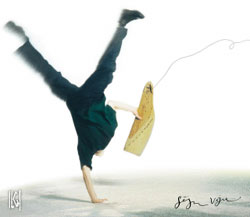
Sēju vēju (meaning “tie the wind” or “sow the wind”) begins forcefully, like the wind, and with a strong and energetic beat that continues through the first several songs. Thankfully, it doesn’t last. To be honest, I soon found the heavy drumming tiring, and much enjoyed the change to a few calmer songs about half way through the recording.

For example, “Es ar meitu dancot gāju” has the familiar, soothing strum of the kokle (the national instrument of Latvia and much of northeastern Europe). “Pūti, pūti, vēja māte” is also a treat: an a capella performance by Ilga Reizniece. But, it’s too bad “Pūti, pūti” is so very short and immediately followed by that familiar driving beat again. Luckily, the next song, “Uz Daugavas es dzīvoju”, is a wonderful men’s ballad with a guitar accompaniment—another treat that just makes you melt.

The members of the group have changed once again, but the signature of the Iļģi sound—Reizniece’s distinctive voice—remains. One also hears the men’s voices quite a bit and, even though they sometimes overdo the “macho” element, they are a welcome addition. The bass guitar and drums are more prominent on Sēju vēju than on previous recordings, but Ilgi still rely on a variety of traditional instruments. Folk music conservatives may not like the “Indian yell,” as one folk music authority called it, that starts off the compact disc, nor the other whoops, yells and trills. They are not what one would consider reserved, northern or Latvian sounds.

The texts of the songs are all Latvian dainas, which are ancient verses passed down orally over hundreds, even thousands of years. Even though dainas are usually about agrarian life, they are timeless, and have obviously adapted very well to modern music, as one can hear on Sēju vēju. There is a motif of strength, energy and activity to the lyrics: they are about the wind, the ocean, young men, horses, searches for brides—all very fitting lyrics for the abundance of men’s voices that one hears on this recording, the powerful upbeat music, and, as the liner notes hint, the pace of modern life in general. The translations on the whole are good, though I found some to be lacking in detail or depth of explanation, as is usual in all translations.

Iļģi used to be considered a traditional folklore group, but they have come a long way from their original sound. This CD is definitely not for those with a narrow view of what Latvian folk music is. In fact, I wouldn’t really consider this folk music. It’s “world music” that really rocks. Sure, the traditional influence in the texts and melodies is very strong. But this is definitely rocky, with a touch of the bagpipes and a reminder of a barn dance here and there. I’ll even admit that the first couple of times around the CD was a bit too heavy for me.

But…I do support what Iļģi are doing. I really like and appreciate this experimenting, mixing of, and playing with traditional and modern musics. On a recording from 1993 Iļģi eloquently called it a “conversation between ourselves, in the presence of others who lived and sang here hundreds and thousands of years ago;” “the manifestation of creativity stimulated by traditional music,” and “the evolution, rather than the destruction, of the folk song.” The Celts have been doing this sort of thing for years, the Scandinavians are now into it, and, with such a rich traditional culture from which to take inspiration, it’s about time for the Latvians to pick up on it, too. Iļģi were ahead of their time and began their self-defined “post-folklore” many years ago, and with each new recording they seem to go a bit further.

If you don’t mind the heavy beat, Sēju vēju is another fine album from by far the best known world music group in Latvia. It has some really great songs—“Seši jauni bandenieki,” “Aiz upītes meitas dzied,” “Seši mozi bundzenīki,” and (my favorite) “Uz Daugavas es dzīvoju.” All in all, this CD is very catchy, and it’s beginning to grow on me! I’m finding myself humming melodies from it all day long. But, I will stress that it’s not for folklore purists.

(Editor’s note: This article originally appeared on SVEIKS.com.)

Details

Sēju vēju

Iļģi

Upe Records,  2000

UPE CD 016