More songs about ordinary people and things

Mūzika iereibušiem cilvēkiem

Labvēlīgais Tips has established itself as one of the premier Latvian rock acts. The group has carved out a niche thanks to its unique blend of accomplished musicianship and sense of humor. But the group’s songs about ordinary people and ordinary things, in my opinion, are mainly what have given Labvēlīgais Tips its longevity and sustained popularity.

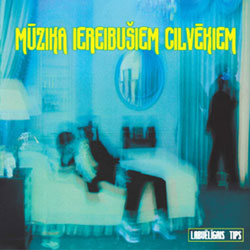
In a break from tradition, April 1, 2002, did not see a new Labvēlīgais Tips album. Having released seven recordings over the past years, and always on April 1, for whatever reason the group decided to take a bit more time with its eighth, releasing the album Mūzika iereibušiem cilvēkiem in late 2002.

If that was the case, then I am glad that the group put a bit more time into this one. Mūzika iereibušiem cilvēkiem is a great album, full of classic Tips tunes.

The album starts off with the uptempo “Trakais,” an ode to crazy people and, apparently, a satirical poke at much of the goings on in the Latvian government. Lead singer Andris Freidenfelds intones in his least sincere, nasally best, “Es līdz šim latviešu tautai neko sliktu neesmu izdarījis un turpmāk apsolos arī nedarīt!” (“Until now I haven’t done anything wrong to the Latvian people, and in the future promise not to do anything wrong!”). It’s a very catchy song and an instant Tips classic.

Songs about ordinary things often times have extraordinary results in the world of Labvēlīgais Tips. A perfect example of that is my favorite tune on the compact disc, “Par riekstiem,” a song about, well, nuts! Singing such dreadfully serious lyrics as “Par riekstiem, es dziedu šo dziesmu svarīgo” (“I sing this important song about nuts”) makes the listener burst out laughing. A “hidden” track on the CD is a demo of this song, and Freidenfelds himself starts cracking up halfway through and cannot finish it!

Another favorite is “Gunvaldis un Nataly,” a song about Gunvaldis, who sadly must spend his name day alone. He longs for his neighbor, Nataly, but realizes that unfortunately he will just get drunk and fall asleep by himself.

The song “11.septembris” is not actually about the events of that day, but is more of an “enjoy life while you can” kind of song. My favorite line is, “Ja griesti ir, tad grīda būs” (“If the ceiling is there, then the floor will be there, too”).

As is usual for Labvēlīgais Tips, the packaging of the album is pretty minimal. No lyrics are provided (they would be helpful when trying to decode some of these songs), but you do get a picture of the band members with what look like paper plates on their ears and fake bunny rabbit teeth.

As with most every Labvēlīgais Tips release, many of the songs might be impenetrable to Latvians who not have spent an extended time in Latvia. But don’t let that scare you away. I still really enjoyed this CD, even though I have never lived in Latvia and haven’t the foggiest what some of the songs are about.

Mūzika iereibušiem cilvēkiem is a welcome addition to the Labvēlīgais Tips discography, a return to form by one of Latvia’s most enduring and popular groups. Containing a number of classic songs, this CD shows that the band is still going strong.

Details

Mūzika iereibušiem cilvēkiem

Labvēlīgais Tips

MICREC,  2002

MRCD 190
Egils Kaljo is an American-born Latvian from the New York area . Kaljo began listening to Latvian music as soon as he was able to put a record on a record player, and still has old Bellacord 78 rpm records lying around somewhere.

Māsas proves girls can play

Māsas

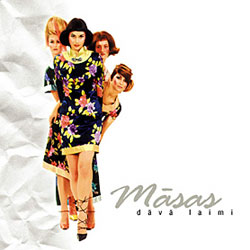
The all-female rock band is a scarce species, but in the past few years one has emerged in Latvia. They are the quaintly named Māsas and their debut album, Dāvā laimi, was released by MICREC in 2001.

The name Māsas is appropriate because the four-member band contains two sets of sisters. Līga Celma is on vocals and guitar, and her sister Daina Celma is on vocals and keyboards. Kristīne Dortāne sings and plays bass, while her sister Ingūna Dortāne sings and plays the drums.

I had heard the song “Dāvā laimi” on the compilation SuperIzlase 2, released in 2001 by MICREC. It is a very catchy, poppy song, and I really liked the lyrics by Līga Celma: “Dāvā laimi, nelaime nāks pati” (“Give the gift of luck, bad luck will come on its own”).

Having only heard that song prior to purchasing this compact disc, I was expecting a recording of mainly pop songs. I was pleasantly surprised to find that this was not the case. The music performed by Māsas is hard to classify. The album contains many different styles, giving it an eclectic feel. This range of styles, as well as strengths in songwriting and performing, makes this CD enjoyable and also stand up after repeated listenings.

Some of the songs even have a jazzy flavor. I especially like “Stacija,” a very pretty song about waiting with a loved one for a train. Another song I liked is “Laidīsimies prom,” a more up-tempo tune.

Another enjoyable aspect of Māsas is their sense of humor. This is evident not only in the photos in the CD booklet (showing the members of the band dressed up in some rather absurd fashions, not to mention a bit too much makeup) but in the songs as well. To close out the album, there’s “Intervija ar skumjo govi,” a song about a sad cow. The song even starts out with band members mooing.

The packaging contains the lyrics to all the songs, which was very nice to have.

Make no mistake about it—this is a band here, not just a collection of four female singers. Songwriting and musicianship are top-notch, leading to an enjoyable CD in Dāvā laimi. Adeptly switching between many different styles over the course of the album, Māsas have created a great collection of songs. For those who still might hold the outdated notion that “girls can’t play,” look no further than this album. Māsas can play with the best of them!

Details

Dāvā laimi

Māsas

MICREC,  2001

MRCD 160

Egils Kaljo is an American-born Latvian from the New York area . Kaljo began listening to Latvian music as soon as he was able to put a record on a record player, and still has old Bellacord 78 rpm records lying around somewhere.

Compilation provides glimpse of early Līvi

Description of image

Even though they are one of the biggest Latvian rock acts, Līvi’s back catalogue has long been out of print. Albums such as Iedomu pilsēta and the self-titled Līvi are available only on vinyl, if at all. And as with many other Latvian artists, not all the group’s early songs were released on proper albums, but appear on multi-group collections such as the old yearly releases from Mikrofons.

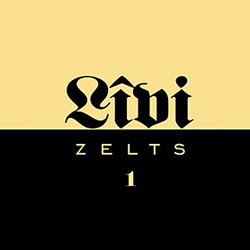
Fortunately, Līvi’s older songs are no longer just on scratchy records. The 2002 compact disc release, Līvi Zelts 1, is a compilation of songs from earlier in the group’s career.

This is not the first Līvi compilation. The first was Karogi, a 1994 recording that was one of the first CDs of Latvian music released in Latvia. However, that compilation was incomplete, skipping over the group’s earliest history—the Ēriks Ķiģelis years. Līvi Zelts 1 is a more thorough overview and a welcome historical document of one of the most important Latvian rock groups.

The 18-track album includes one new song. “Vairogi” is a march-like song with lyrics that return to the group’s 1980s patriotic style. The song doesn’t really grab my attention, what with its spoken verses. It’s also a bit out of place, as it is a new piece on a compilation of songs that are all 15 or more years old.

The true “gold” on the album are the songs from the Ķiģelis years, which to my knowledge are released for the first time on CD. A number of these songs were re-recorded for the Līvi album Bailes par ziņģēm, but on this CD you get to hear the songs as they were originally recorded.

Presumably due to the limitations at the time they were recorded, some of the songs have a somewhat rough quality, even scratchy at times. But don’t let that discourage you. Though they may sound a bit outdated, these songs can still be treasured today. One example is the song “Bailes par ziņģi.” The audio quality is less than excellent, but the song itself stands up to the test of time.

One of the most popular of Līvi’s earlier songs is “Zīlīte,” which I first heard on the Mikrofons 82 record. A critic in the music magazine Mūzikas saule called this a “modern Latvian folk song” and I cannot think of a better term. It is certainly one of the classics of modern Latvian rock music.

Also on Līvi Zelts 1 are a few songs from the 1986 album Iedomu pilsēta and the 1988 self-titled album (by which time Ķiģelis had tragically died). A favorite from the self-titled album is “Dzelsgriezējs.” That album also contained one of Ķiģelis’s last compositions, the beautiful “Kad saule riet.”

Perhaps the group’s biggest hit, “Dzimtā valoda,” also is included on this compilation. “Dzimtā valoda” was the most popular song in Latvia in 1985, in part because it is a very patriotic song. Lyrics such as “Vienā valodā raud visi ļaudis” (all the people cry in one language) likely struck a nerve in final years of Soviet Latvia.

The major disappointment in this collection is the packaging. It takes the concept of “let the music speak for itself” to the extreme. What I would have thought to have been a golden opportunity to provide some historical notes and pictures of Līvi throughout the years is wasted on the minimalistic packaging. There isn’t even a booklet, just a list of songs and that is it.

Particularly frustrating is the fact that there is no mention of who was in the band when each of these songs was recorded. Līvi have gone through many lineup changes throughout the years. In some songs it is Igo (Rodrigo Fomins) singing, in others it is Ķiģelis, in others it is Aivars Brīze, and in others I have no idea who! It would have also been nice to have the lyrics.

Packaging aside, this collection of songs from Līvi’s early years is invaluable for any student of Latvian rock music. Great thanks has to be given to MICREC for releasing many songs that until now had been lost in its vaults. Hopefully this signals the start of releasing all of Līvi’s music onto CD. The group has many unreleased tracks and songs that were not on any proper album. Presumably calling this album Līvi Zelts 1 indicates the possibility of a Zelts 2. This CD not just contains some of the greatest Latvian rock music ever written, but also shows the rise of Līvi and how they became one of the most important and beloved bands in Latvia.

Details

Līvi Zelts 1

Līvi

MICREC,  2002

MRCD 194

Egils Kaljo is an American-born Latvian from the New York area . Kaljo began listening to Latvian music as soon as he was able to put a record on a record player, and still has old Bellacord 78 rpm records lying around somewhere.