Iļģi teams with the next generation of singers

Rāmi un ne

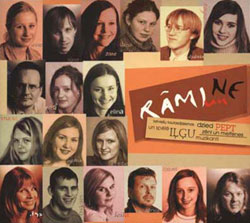
Every year children and teenagers gather at the “Pulkā eimu, pulkā teku” festival in Latvia to gain experience in presenting folk songs that they’ve learned. Last year the handful of singers chosen as “Great Singers” during the festival’s competition were awarded the opportunity to collaborate with the well-known world music group Iļģi. The compact disc Rāmi un ne is the result of that collaboration. Listen well, because here is the next generation of Latvian folk singers.

On the CD 13 teenagers sing 15 songs on 25 tracks. Some of the songs are fairly well known—“Aiz upītes es uzaugu,” “Ai zaļā līdaciņa, ” “Rozēm kaisu istabiņu”—but others are less common. But they will all appeal to almost any listener. They are easy to listen to and even easy to sing along with.

Which leads to an explanation of the additional 10 tracks on the CD. Karaoke anyone?

In the liner notes Māra Mellēna, an initiator of PEPT, writes, “If you have an apple and I have an apple, we can swap them, but in the end we each still have only one apple; we cannot gain more apples by swapping. If you have a song and I have a song, and if we swap them, then we each now have two songs.”

The aim of PEPT is to encourage youngsters to learn the songs of their regions. The way one does this is by first listening to others sing. In the same way, one aim of this CD is for the audience to listen again and again, and then to try singing for themselves. To that end, the CD provides the accompaniments to 10 of the songs, as well as the texts to all of them, so you can sing your heart out and learn a few new songs in the process.

Why Rāmi un ne? All I can come up with is that the CD title is purely descriptive. Rāmi means calm, quiet, thoughtful. Some of the rāmi songs on the CD are “Divi siermi kumeļeņi,” “Man pazuda kumeliņis” and “Man sajāja rāmas tautas.” Other songs are not rāmi, but rather more happy and bouncy, such as “Klipu klapu kaimiņ Janka,” “Ai kad es būtu zinājuse,” and “Aiz kalniem.”

“Purvu brydu na jobulu” is a well-done melding of traditional singing technique and text with a modern accompaniment, involving drums and electric guitar. All of the other accompaniments tend towards acoustic guitar, kokle and violin, with some quiet accordion. On the whole the young singers have surprisingly strong and sure voices.

Often it seems that Latvian folk songs are losing ground to rock, pop, hip-hop, television, computer games and car engines. Through events such as PEPT we see that folk songs, and along with them Latvian identity in general, are still alive somewhere under all of that modern noise. Even if you’re not into the karaoke-style singing part, the songs and accompaniments of Rāmi un ne are pleasant to listen to, and PEPT is definitely a cause worth supporting.

Details

Rāmi un ne

Iļģi un PEPT

Lauska,  2004

On the Web

Pulkā eimu, pulkā teku

Information about the “Pulkā eimu, pulkā teku” festival is available from the Ethnic Culture Center at the University of Latvia. LV
Retrospective focuses on master of French horn

Many pages have been written about how difficult the French horn is to play. Due to its tiny mouthpiece, it takes serious determination to be able to play the thing. Because it is so difficult to play well, it also makes it a less popular musical instrument. However, in the hands of a capable player, the French horn can be one of the most beautiful of instruments—though true masters of the French horn are few and far between.

One of those masters must be Latvian French horn player Arvīds Klišāns, who has been making his mark in the music world for the last half-century. Listeners who have heard the compact discs Latvian Millennium Classics or Latviešu klasikas dārgumi will have already heard Klišāns’ playing on the Andrejs Jurjāns piece “Bakarola.” Arvīds Klišāns Rīgas Domā, a full compact disc of his work released in 2003, is an apt document of one of Latvia’s many great talents.

This CD is a compilation of recordings of Klišāns at the Rīga Dome cathedral. All the pieces are duets with the famous organ (played by well known Latvian organists Aivars Kalējs, Oļģerts Cintiņš and Tālivaldis Deksnis). The recordings span the years from 1980-1998, and are taken from the archives of Latvian Radio. The organ and French horn combination, while unusual, offers some unique possibilities for the performers and the listeners, and leads to some very beautiful arrangements.

A range of different composers are heard on the CD. From the Baroque era there is “Andante” by George Handel. From the Mozart family, there is a concerto for French horn by Leopold Mozart and “Larghetto” by Wolfgang Amadeus Mozart. And, for those seeking something a bit more modern, there is the “Missa muta” by Bernhard Krol.

The CD also contains a biography of the artist (both in Latvian and in English) by Vilnis Strautiņš that details his amazing career. Klišāns’ repertoire is quite diverse and he performs frequently. He also performs benefit concerts in churches, helping to modernize and refurbish them.

The recording is an excellent retrospective of the performances of Klišāns with organ throughout the years. So many instrumental talents have come from Latvia, and this CD shows that Klišāns is one of them. The beautiful interplay between the organ and the French horn is one of the main reasons to listen to this disc, as a French horn in the hands of a master like Klišāns is a wonder to hear.

Details

Arvīds Klišāns Rīgas Domā

Arvīds Klišāns

Rīgas skaņu ierakstu studija,  2003

RS 041

Egils Kaljo is an American-born Latvian from the New York area . Kaljo began listening to Latvian music as soon as he was able to put a record on a record player, and still has old Bellacord 78 rpm records lying around somewhere.

Two Latvian stars create romantic album

Klusums starp mums

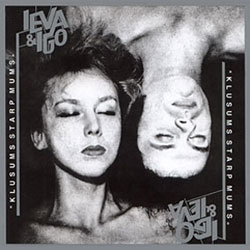
What would be more natural than to put two major musical stars of the Latvian Reawakening period together on one record? Quite possibly the best known and most recognizable male and female voices from the late 1980s, Ieva Akurātere and Igo (Rodrigo Fomins), came together in 1990 to sing songs with lyrics by Igo and music by Aivars Hermanis. The result, Klusums starp mums, was originally released on vinyl in 1991 and was re-released on compact disc in 2003 as part of MICREC’s “Latviešu populārās mūzikas klasika” series.

I had picked up this record back in 1991 simply because both artists were familiar. My perception back then was that while the performance itself was of high quality, the songs were a bit lackluster. I listened to the album a few times, then filed it away somewhere amongst my parents’ large record collection. I am not sure if I listened to it again after that.

As it turns out, what I think now is not much different than what I thought then. Production and performance are first rate, but the songs aren’t strong enough to warrant regular repeat listening.

Besides Akurātere and Igo, performing on the album are Aivars Hermanis on guitars, keyboards and percussion, Eduards Glotovs on bass, and Oļegs Upenieks on percussion.

The CD is labeled as “the sexiest Latvian music album” and I will not disagree with that statement (mainly due to the minimal competition for that title among Latvian releases.) The label also gives the general idea of the album—romantic songs about love and intimacy and such things. The entire album has a very “subdued” feeling, most likely intentional, as many of the songs have Akurātere and Igo practically whispering into their respective microphones.

The CD doesn’t just have songs, but also some unusual interludes, mainly dialogue between Akurātere and Igo that seems to me a bit out of place.

Hermanis’ guitar playing is quite tasteful in a number of places, including on the song “Ēnas zīmē mūsu stāvus,” in which he plays a number of nice acoustic runs.

Probably my favorite song on the album is the final one, “Par klusumu.” The combination of Akurātere and Igo works best here. With barely more than just an acoustic guitar, the vocal melodies allow the singers to shine, and the result is a very pretty song.

I didn’t like the record the first time around because I expected something a bit different (Akurātere at the time was with Pērkons and Igo with Remix, both well-known Latvian rock bands). Perhaps I expected something more in that vein. For whatever reason, even now when I know what to expect these songs don’t really stay with me after listening.

The liner notes (which include all lyrics, as well as an essay by music publicist Daiga Mazvērsīte) state that this record was a bestseller at the time of its initial release. That shows you what I know. This is a very relaxed record. It works well as a romantic album. The record is not quite up there with, say, Marvin Gaye, but it holds its own.

If nothing else, this record once again proves the vocal talents of both Akurātere and Igo, as well as the talents of Hermanis. The remastering also sounds great. Thanks also must be given to MICREC for continuing to re-release classic and significant albums in Latvian music history—and not just those by Raimonds Pauls! Hopefully they will get to Akurātere’s solo album, too.

If you are looking for some light, romantic music that just happens to be in Latvian, look no further.

Details

Klusums starp mums

Ieva & Igo

MICREC,  2003

MRCD 224

Egils Kaljo is an American-born Latvian from the New York area . Kaljo began listening to Latvian music as soon as he was able to put a record on a record player, and still has old Bellacord 78 rpm records lying around somewhere.