
In latest work, Berzins crafts a better thriller

Kolka

Unlike in her previous mystery novels, the protagonist in Ilze Berzins’ latest book, Kolka, is not even a wannabe crime-solver. Instead, Birdie Finch is a woman tormented by dark dreams who finds herself dragged into an equally dark reality. And, it turns out, she is at the center of a very competent psychological thriller.

Finch is taking time off from her job at Canada Post to take care of her late mother’s house in the Bank Street district of Ottawa, Canada. The reader gets the impression that she spends her days swinging between brightness and melancholy, tending to her garden, dabbling in recreating the work of great artists, and looking forward to the regular visits from her friend, Alma Kemp.

The mystery begins in earnest in Chapter 4 when Kemp, a bubbly woman in her 70s, disappears. Only a few pages later, the disappearance turns sinister when Birdie, working in her garden, uncovers a plastic bag containing the fingers of Alma’s hand.

Kolka, released in November, is the sixth mystery novel and the seventh book overall by Berzins, a Latvian-Canadian artist and author. Her autobiographical Happy Girl (1997) was followed by a series of mysteries that have taken the reader from Ottawa to Rīga and back.

Unlike her previous two novels, Riga Mortis (2002) and Riga Blanca (2004), the Latvian connection in Kolka is more mythical than real. Most of the story physically takes place in a small corner of Ottawa. Finch has never visited Latvia, but knows of the northwestern Horn of Kolka (Kolkas rags) from the descriptions provided by a Swede named Jacob Carlsson. Birdie and Jacob had connected on some level, we learn in the course of the story, and now Birdie dreams of Kolka, a place that symbolizes both life and death, “this place without beginning or without end,” as Berzins writes on the final page.

Kolka is a technically better-produced book. Compared to Berzins’ earlier works, which at times seem to have been rushed into print, Kolka is logically tighter and crafted more thoughtfully. Berzins does a nice job of closing circles: “Fingers in the freezer” is the ditty Birdie hears in her mind as she comes awake at the start of Chapter 7, “Fingers in the freezer” is the psychological barrier to going to the kitchen to get a cup of coffee at the close of Chapter 8. And the typographical errors that have dogged those earlier works are all but gone.

But something is missing. Kolka lacks a certain spunk of those earlier stories such as Death in the Glebe. However, that’s not a criticism. If I had not read her earlier work, I would still consider Kolka a good effort. Perhaps it’s just that I’ve come to expect a certain hurriedness to Berzins’ books. Kolka is a refreshingly measured story—and that’s ultimately better for it. The conclusion particularly seems to fit, rather than being an appendage.

Readers who have never read any of Berzins’ novels might do well to start with Kolka rather than her earlier work. For those who have been disappointed by some of that earlier work, a visit to Kolka will be refreshing.

Details

Kolka

Ilze Berzins

Ottawa:  Albert Street Press,  2004

ISBN 0-968650-26-0

On the Web

Ilze Berzins

The author’s home page includes information on how to order Kolka and her other books. EN
Andris Straumanis is a special correspondent for and a co-founder of Latvians Online. From 2000–2012 he was editor of the website.

How to save money on a Latvian film

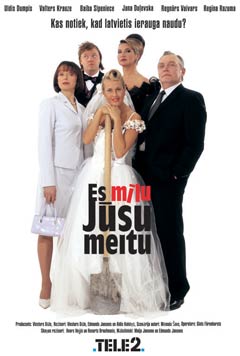
Es mīlu Jūsu meitu

It’s funny how 75 minutes sitting in front of the television can change one’s perspective. When I stopped in a downtown Rīga shop to buy a copy of Es mīlu Jūsu meitu, I thought the 5 lats I paid was a bargain. After watching the film, I am grateful I only lost 5 lats on the purchase.

The film, released last year, was billed as the first Latvian feature film in DVD format. It’s produced by the same folks who put together the popular “Mēmais šovs” comedy program on Latvian Independent Television (Latvijas Neatkarīgā televīzija). While “Mēmais šovs” at times is very funny—sometimes painfully so—the film fails in so many ways that, well, it’s not funny.

The premise of the film had potential. Matīss (played by Regnārs Vaivars), a country bumpkin, decides to pitch life on the farm and move to Rīga. He falls in love with the somewhat naive Sintija (Jana Duļevska), the daughter of a well-to-do family. They decide to get married. Matīss’ future father-in-law Georgs (Uldis Dumpis) gives him LVL 10,000 for the wedding and Matīss, in an effort at frugality, hires a couple of wedding planners who also organize funerals under the company name SIA Svētie mirkļi. The wedding planners are played by Baiba Sipeniece and Valters Krauze, two of the regulars on “Memais šovs.”

Instead of the chic but inexpensive wedding Matīss wants, he gets one full of absurd variations of Latvian traditions, plus plenty of misunderstandings and accidents. Matīss takes the wedding planners to court, accusing them of a series of misdeeds including attempted murder. That’s where the story takes off, as the audience is presented a series of flashbacks to witness what happened.

That’s also where the film begins to suffer. The various scenes of absurdity seem to be penned by high school sophomores who delight in pratfalls and other violence. Watch enough “Mēmais šovs” and you will understand.  For me, a large part of the problem with the film is Sipeniece and Krauze. In small doses they can be funny, but more often I find them annoying.

Here’s the spoiler: The whole affair is actually a plan by Georgs to test the true intentions of his son-in-law.

Some of what we see in this film might be viewed as commentary on Latvian stereotypes, but it could have been handled with much greater nuance.

The DVD provides multiple languages, including awful English subtitles.

Don’t be like me. If you spot Es mīlu Jūsu meitu in a shop, keep walking and save your money.

Details

Es mīlu Jūsu meitu

Viesturs Dūle, Edmunds Jansons and Aldis Kalniņš, directors

Memais šovs,  2004

Notes: Comedy, in color, 75 minutes. In Latvian (options include dubbing in Russian and subtitles in Latvian, English, Russian, Lithuania and Estonian). Directors: Viesturs Dūle, Edmunds Jansons and Aldis Kalniņš. Principal actors: Uldis Dumpis, Valters Krauze, Baiba Sipeniece, Jana Duļevska, Regnārs Vaivars and Regīna Razuma.

Andris Straumanis is a special correspondent for and a co-founder of Latvians Online. From 2000–2012 he was editor of the website.

Prāta Vētra in Helsinki lacked luster

Prāta Vētra

Prāta Vētra opened for R.E.M. when the American band played in Helsinki.

At precisely 8 p.m. on Jan. 29 in Helsinki’s Hartwall Areena,  world-renowned rock group R.E.M. bassist Mike Mills introduced the Latvian popular music group Prāta Vētra (known in English as BrainStorm). This was the group’s last performance together with R.E.M., on a concert tour through several Eastern European cities, including Rīga.

I travelled to Helsinki to find out two things: How does BrainStorm sound without its original bass player Mūmiņš (Gundars Mauševics, who was killed in a May 2003 automobile accident) and how does the Latvian band stack up against a world famous rock group?

Unfortunately, at the start of the concert only a few hundred listeners had entered the hall. This was due to two circumstances. First, concertgoers were not permitted to take drinks into the hall, so many took advantage of drinking beer in the outer hallways of the arena. Second, the Finnish public was there to see R.E.M.

Our boys from Latvia seemed rather pale and tired as they started their set. (The preceding concert in Saint Petersburg was cancelled because transportation was delayed at the border between Estonia and Russia.) Only by the end of the set was BrainStorm warmed up.

I thought frontman Renārs Kaupers was just going through the usually ritual dance motions without any real emotion or feeling. The public wasn’t convinced about the performance, but did applaud politely after every song. The reaction of the public was probably a big surprise for BrainStorm, who were warmly received by the home crowd a few nights earlier in Rīga.

The group members seemed to be caught up in themselves and shared little if any contact with one another. Guest bassist Ingars Vilums didn’t even take a glimpse at the bored drummer Kaspars Roga. I wonder if Vilums has found his real place in the group yet. Māris Miķelsons was as usual on the ball and performed his keyboard and accordian parts with precision. Guitarist Jānis Jubalts played well for the most part, but started the song “Kitten Who Did Not Want to Give Up” at a dreadfully slow pace.

The sound as usual was less than perfect for an opening act and it seemed as if soundman Tālis Timrots was prevented from pressing certain sound and volume buttons. The fact that the songs were sung in English didn’t appease me. Even though Kaupers has improved his English immensely over the past 10 years, his English lyrics don’t stand up to his lyrics in Latvian. This was not the best BrainStorm show I have seen. I was disappointed, expecting more from Latvia’s top pop band.

After BrainStorm finished its 35-minute set, a 30-minute intermission followed. During that time 12,000 spectators filled the hall eagerly awaiting R.E.M. From the very first beat, singer Mike Stipe danced and pranced, singing with full force. Bassist Mike Mills played well and sang great harmonies. Even though Peter Buck played horribly and at times completely wrong notes, second guitarist Scott McCaughey covered up for his mistakes. Guest drummer Bill Riefen didn’t shine much, but then again R.E.M’s material wouldn’t let him. Guest keyboardist Ken Stringfellow was steady all night. Still the group performance relied mostly on Stipe. Throughout the entire concert, he controlled the group and the audience as a cult fugure. As Stipe conducted, audience members rhythmically waved their hands in unison, singing along to hits like “Losing my Religion” and “Man on the Moon.”

After the concert I asked R.E.M. guitarist McCaughey what he likes about BrainStorm.

”Renārs is a great frontman,” he answered. That is exactly how I feel. Without Kaupers, BrainStorm would not have enjoyed the success it has so far. Undoubtedly Brainstorm has been where no other Latvian group has been before, but borrowing a line from one of its songs, ”What’s next?”.

BrainStorm should get out on tour of the European and American club circuit. It just doesn’t cut it to release an album or a video and naively hope that somebody is going to notice. You have to tour and then tour some more. Bruce Springsteen played between 250 and 300 concerts a year before he became famous. This is really the only way for BrainStorm to ever hope of achieving the same. The band might just be content with being popular in Eastern Europe.

Then again, it could wait for Stipe and R.E.M. to call for help again…

Details

In concert in Hartwall Areena

Prāta Vētra

Helsinki, Finland:  2005

Raitis Freimanis lives in Stockholm, Sweden, and is a founding member of the Latvian-Canadian band Skandāls.