Hospitāļu iela offers something fresh to Latvian pop

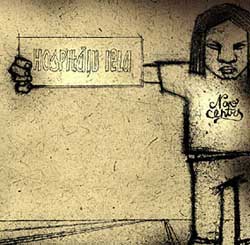
Nav centrs

It is once again time to get some new blood, some new ideas into Latvian popular music. It is no coincidence that most of the reviews that I write are about Latvian groups that have been around for decades (such as Līvi or Jumprava), or about new groups made up of musicians who have been around a long time (such as Fomins & Kleins). Even groups that are considered “younger” aren’t necessarily “young” any more. Prāta Vētra has been playing for more than a decade now, and Tumsa already has five albums under its belt, so it can’t be considered the “new guard” either.

Of course, there are plenty of new groups, but many of them aren’t offering any new takes on any styles, as they are often very derivative (this would apply to many of the hard rock and heavy metal bands today) or simply recycling or copying what has been done before (this applying to many of the schlager bands and pop stars, something that could be said about this type of music anywhere in the world).

But all is not lost. Far from it. Last year in fact had two very significant debut albums: Strēlniece (The Archer) by the group re:public, featuring the mega-hit title track, and Pilnmēness (Full Moon) by Hospitāļu iela, featuring hits “Par pogu” (About a Button) and “Sinepes (par Raimi)” (Mustard (About Raimis)). Re:public would fall into the straight-ahead rock category, but Hospitāļu iela has a rather distinct style that is hard to describe, containing elements of pop, rock and reggae, with a violin thrown in for good measure, not to mention creative lyrics that exhibit an at times dry sense of humor. Pilnmēness was also presented with the “Pop Album of the Year” and “Best Debut” award at the 2005 Latvian Music Awards. Pilnmēness is also notable as one of the producers of the album was one of the pioneers of Latvian electronic music, Ingus Baušķenieks.

I thought Pilnmēness was a good album, featuring the above-mentioned tracks, as well as songs like “Par kiosku” (About a Kiosk) and “Putni prom” (Birds Away), so when the group’s latest album, Nav centrs (Not the Center) came out earlier this year, I picked it up.

Taking its name from a poem by Klāvs Elsbergs, Hospitāļu iela was founded in 1997 by leader, singer, guitarist and principal songwriter Edgars Šubrovskis, according to the MICREC recording house. However, at that time nothing got off the ground and the group went through many changes in its lineup. An album, Ir maiga nakts (It is a Gentle Night) was released independently in 1999. The group finally settled down and began work on is first proper major label release in 2001, which was finished in 2003 and released in 2004 on the MICREC label Raibā taureņa ieraksti.

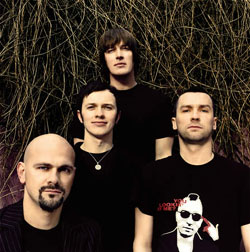
The group now is made up of Šubrovskis, Dina Skreitule (violin), Maija Ušča (bass guitar), Toms Circenis (drums), Laima Ivule (vocals, keyboards), Jēkabs Kacens (djembo), Biāna Pette (accordion) and Reinis Ozoliņš (contrabass). With a lineup like that, once can certainly expect an eclectic mix of music styles and sounds, particularly the reggae plus violin sound, as well as the dynamic between the vocals of Šubrovskis and Ivule, which gives Hospitāļu iela a distinct sound.

Nav centrs sees the group continuing down its own experimental path, and has some songs that will help cement the group’s reputation as not just a creative, unique force in Latvian music, but as strong songwriters as well.

I like the Hospitāļu iela songs that are more up-tempo, so one of my favorites on the album is “Par dimantiem” (About Diamonds). Following after a number of slower songs, the song sees the group performing with a nervous energy. Also I liked “Paspēlēties” (Playing), which is more of a duet between Ivule and Šubrovskis, not to mention being one of the group’s “cheerful” songs.

To be honest, I’ve never been a big fan of reggae. Not that I think it is bad, it just has never captivated me as it seems to captivate others. I will never deny the talent of someone like Bob Marley, but I guess I never “got” it. However, from time to time I do enjoy a song in that style, for example the very reggae “Nesaki nevienam” (Don’t Tell Anyone).

At 60 minutes and 17 songs (well, more like 16, as one track, “Izejam ārā” (Let’s Go Outside), is only 19 seconds), the record does seem a bit over-long. It begins and ends strongly, but the middle remains a bit foggy to me.

Nav centrs is overall an enjoyable record, certainly something fresh and unique, and it certainly is encouraging that interesting things are happening in Latvian popular music. Both Pilnmēness and Nav centrs have some great songs on them, so both records are recommended to those who are looking for something a bit different.

Details

Nav centrs

Hospitāļu iela

Raibā taureņa ieraksti,  2005

RTCD 002
Egils Kaljo is an American-born Latvian from the New York area . Kaljo began listening to Latvian music as soon as he was able to put a record on a record player, and still has old Bellacord 78 rpm records lying around somewhere.

Jumprava remains at top of its game

Inkarmo

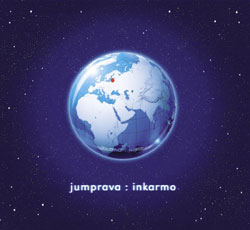
Jumprava, one of the old guard of Latvian rock music, celebrated its 20th anniversary this year with a big concert at the Dzintari Concert Hall in Jūrmala. Shortly before the concert, the band released its latest album, Inkarmo. According to the group, “inkarmo” means “the place and time we find ourselves in at this moment.” This is illustrated by the album’s cover, which features a map of the world with a small red dot to indicate Latvia.

Jumprava’s prior two releases, 1998’s Laika atšķirību romance and 2001’s Trajektorija, were among the band’s best albums. Though Jumprava’s most popular works remain old standards like “Vēlreiz” and “Ziemeļmeita,” I actually prefer their newer songs. And I think that Inkarmo continues where the band left off with Trajektorija—another very strong album of Jumprava’s blend of electronic and acoustic music with thoughtful lyrics, smoothly going from laid back and pensive songs to highly emotional and energetic songs without missing a beat.

The group’s lineup has not changed: Aigars Grāvers, Aigars Grauba, Aigars Krēsla and Ainārs Ašmanis.

The album starts out in a particularly odd way, with the low-key song “Elpas cena” (The Price of a Breath). It’s a very quiet song that sounds more like it would have fit better on one of the Rama Dance albums (Grāvers’ side project, melding Latvian and Indian music). Also interesting is that the music’s author is Krēsla, and not Grāvers as I originally thought when I listened to the song. This song’s refrain includes lines about a lonely yak in Tibet, certainly a topic rarely mentioned in popular music.

The album does have a number of mellower moments, including the songs “Man pietiek ar to” (That is Enough for Me) and the lullaby “Miega dziesma mazajai meitenei” (A Sleepy Song for a Young Girl), both composed by Krēsla. “Miega dziesma,” featuring lead vocals by Grauba, is a sweet, quiet song—uncharacteristic for Jumprava, but still effective.

But that, of course, does not mean the album is not without its up-tempo songs, such as “Laimīgs” (Happy) and “Liekos dīvains” (Seem Strange), which includes one of my favorite lines from any Jumprava song: “Ja es Tev liekos dīvains, tad kāds Tu liecies man?’ (If I seem strange to you, how do you seem to me?)

Jumprava also continues the dabbling in techno music that was started on the Trajektorija album. This is most notable in “Stacijā” (At the Station), a song about a chance encounter at a train station. Honestly, I’m not a fan of this song, though I do like the almost-techno title track, “Inkarmo.”

Production of the album is almost too perfect, and as a result it sounds too polished, almost sterile. One of the reasons Jumprava became so popular was its experimentation with non-traditional arrangements and melodies, much different than what was popular in the 1980s and 1990s.

It could be said that this album is a bit too safe. But this is a minor complaint. One of the drawbacks of music made almost entirely with synthesizers is that at times it will sound mechanical. Don’t let that frighten you, because the songwriting on Inkarmo is top-notch.

Almost all the lyrics on the album are written by outsiders. Rolands Ūdris (a.k.a. Ūdrītis), lead singer of The Hobos, wrote the words to “Inkarmo.” Also writing lyrics were Ingus Bērziņš, Viktors Duks and Aija Strazdiņa. Curiously, no lyrics were provided by frequent collaborator and poet Nataradža.

The booklet accompanying the compact disc contains all the lyrics, but very little else. The CD is presented in Digipak form (a cardboard case) as opposed to the regular plastic jewel box. To be honest, I prefer the regular CD cases, as the cardboard cases tend to get worn out after a while and cannot be replaced.

Inkarmo is a worthy addition to the Jumprava canon. In a time when many bands (Latvian and otherwise) with a strong back catalogue are content to rest on their laurels and release sub-par albums, Jumprava still is at the top of its game, challenging itself musically and pleasing old fans as well as bringing in new fans. At the close of the anniversary concert in the Dzintari hall, the band seemed taken aback by the sight of 3,000 fans, all on their feet and screaming for the group’s return to the stage. But such is the strength of Jumprava, and it shows no signs of diminishing.

Details

Inkarmo

Juprava

Platforma Records,  2005

PRCD 164

Egils Kaljo is an American-born Latvian from the New York area . Kaljo began listening to Latvian music as soon as he was able to put a record on a record player, and still has old Bellacord 78 rpm records lying around somewhere.

Prātā Vētra plays to 40,000 in Mežaparks

Prāta Vētra

An estimated 40,000 fans saw Prāta Vētra in concert in Mežaparks.

To call Prāta Vētra a Latvian phenomenon would be an understatement. In a time when other groups struggle to attract listeners to concerts and sell very few albums (partly due to piracy, partly due to listener apathy), Prāta Vētra (or, outside of Latvia, BrainStorm) defies expectations and sells many compact discs and attracts hordes of people of all ages to their concerts.

It has to be seen to be believed. The Prāta Vētra juggernaut rolled into Rīga on Aug. 21. The open-air venue at Mežaparks was filled with listeners eagerly awaiting the concert. Reports are that more than 40,000 people attended. After the concert ended, the flow of people reminded me of that episode of “MacGyver” where he battled army ants—just this ocean of humanity all hoping to make it to the tram or trolleybus or other method of transportation.

The last time I saw Prāta Vētra was in December 2000 at Ķīpsalas halle in Rīga. Though also a reasonably sized venue, there were significantly less people there, maybe a thousand or so. That concert, as well as the 2003 concert at the Skonto stadions (available for viewing on a highly recommended DVD) gave an idea of what makes this band so popular. Prāta Vētra has all the necessary tools to be successful: great songs, quality musicianship, a charismatic frontman in Renārs Kaupers, and—essential—an army of teenage girls ready to scream their lungs out (not to mention buy their records!).

After calling the information service 118 to find out what time Prāta Vētra would be on stage and being told 9 p.m., I headed off to Mežaparks. Around 9 p.m. the second opening band, Double Faced Eels, took the stage. The Eels are a punk-pop band and have a current hit, “Zilais valis” (“Blue Whale”). I’m not too familiar with the band’s music, but they played well and were having a good time, so the time spent with them was enjoyable. I missed the first opening act, Mofo. Influenced by British pop, Mofo has recorded several singles and expects to release its first album this fall.
At this point, I was standing near the stage. But as 10 p.m. approached, it seemed like all 40,000 audience members wanted to get closer to the stage, so it got more and more packed to the point where I was unable to move. I had elbows digging into me from all sides. It seemed wise to extricate myself from this mass of people, so, sucking in my chest, I pushed my way out. I find it hard to believe that no one got seriously hurt at the concert, as it must have gotten even crazier near the stage when the band took the stage and everyone started jumping up and down. Some people had brought their little children—perhaps not the wisest course of action, but I guess everything turned out all right in the end.

Prāta Vētra opened with the title track of its most recent album, Četri krasti. The crowd became electrified and sang along with every word. For the next two hours, Prāta Vētra performed both old and new songs, and the audience was in a rapturous state the entire time.
Acknowledging the diversity of the audience, Kaupers addressed the audience in three different languages—Latvian, Russian and English.

I am not a fan of huge concerts like this. Besides the long lines at the bathroom, there is a certain loss of intimacy at these mass gatherings. The artists seem so distant, and usually the sound is muddy (especially in open air venues like Mežaparks). But the sound was better than expected. Vocals were clear and the instruments were distinguishable. However, with that number of people, the side effect is that often the audience is louder than the band. This was the case at more than a few moments during the concert, especially during the quieter songs like “Spogulīt, spogulīt…” Though it is nice that the band is able to bring record-breaking numbers of people together for a concert, I would much rather prefer that Prāta Vētra plays smaller venues.

Above all, the band was very, very polished. Everyone was in top form, knowing that they had 40,000 people to satisfy. In big shows like this, there is very little room for anything to go wrong, and as far as I saw nothing did. The performance was precise and professional.

The setlist was a balanced mix of new and old. I have found Prāta Vētra’s latest album, Četri krasti, to be one of the band’s weaker efforts, and do not like it as much as the band’s best albums (in my opinion, Kaķēns, kurš atteicās no jūrasskolas from 2001 and Dienās, kad lidlauks pārāk tāls from 2003). However, one of my favourite songs from the album, “Kur milzu kalni liekas mazi,” was not performed.

Because no concert review would be complete without complaints about the set list, I must beg the question as to why nothing was played from Viss ir tieši tā kā tu vēlies. No “Tavas mājas manā azotē” or “Romeo un Džuljeta”? In fact, quite a number of big hits were left out, for example, “Tu izvēlējies palikt,” “Starp divām saulēm,” “Brīvdienas nav manas laimīgas dienas” or “Īssavienojums.” I agree that the big hits sometimes need a bit of a rest or they get stale, but the band did find the time to play “Lidmašīnas”—a song that certainly can use a bit of rest.

However, the set list had many standout selections. Highlights of the concert were songs from Dienās, kad lidlauks pārāk tāls, including the driving “Pa pareizām” and the lyrically beautiful “Es gribu.” The song that received the loudest response was the Russian-language “Skoļzkie uļici” (“Slippery Streets”). Originally recorded with the Russian group Bi-2, the song is not on any Prāta Vētra album, but can be heard on MICREC’s 100% svaigs Nr. 6 compilation.

The group had set up a mini-stage, decorated to look like a living room, beyond the main stage in the crowd. From here the band went deep into its back catalogue, drawing a few numbers from the recently re-released album Veronika and elsewhere. In an odd segue, Prāta Vētra went from its first big hit, “Ziema,” to the Latvian folk song “Es nenācu šai vietā” (though thankfully the band only performed the first few of the dozen-some verses of the song). The highlight of this section of the concert, and a particularly pleasant surprise, was the performance of the Imants Kalniņš song “Elpo.”

Particularly touching was Prāta Vētra’s tribute to Mumiņš (Gundars Mauševics), the band’s bass guitarist who died in an automobile accident last year. A recording of the song “Spacemuminsh” was played while photographs and short movies of him were shown on a large screen.

The audience was overall very well behaved, though hopefully no one got crushed there in the mob in front of the stage. With all the people carrying beer around I’m surprised I wasn’t drenched by the end of the concert, but I did get smoke blown in my face from all directions. The benches in Mežaparks got the brunt of the abuse. Audience members were standing and jumping up and down on them, so quite a few are going to need replacing!

The subdued waltz-like “Māsa nakts” from Četri krasti closed out the evening. Perhaps after a two-hour, high-energy affair, this was an appropriate warmdown to end the evening on a mellow note. Then began the mad dash to the trams (sardines, anyone?) which supposedly were going to be free for all but ‘twas not the case.

Overall it was a very enjoyable evening. The lack of intimacy and the throngs of screaming fans did nothing to dispel the notion that Prāta Vētra is a truly great band. Even when before 40,000 people, it knows how to send everyone home happy and made this concert (as most every Prāta Vētra concert) a special event. Quibbles about the set list aside, with two hours of music how can you go wrong? Come back soon!

Details

In concert in Mežaparks

Prāta Vētra

Rīga, Latvia:  2005

Egils Kaljo is an American-born Latvian from the New York area . Kaljo began listening to Latvian music as soon as he was able to put a record on a record player, and still has old Bellacord 78 rpm records lying around somewhere.