Flutist pays homage to diaspora composers

Ilona Kudiņa

An oft-overlooked aspect of Latvian classical music is that produced by composers in the diaspora. The recent major recordings of Latvian classical music cover the most well-known composers such as Pēteris Vasks and Imants Kalniņš, however, almost always the composers represented spent most of their lives in Latvia.  So it is quite a pleasant surprise to find out about flutist Ilona Kudiņa’s On the Bridge (Uz tilta), a two-compact disc collection of chamber music by diaspora Latvian composers.

Due to the upheavals of the mid 20th century, many Latvian composers found themselves outside of Latvia, and remain there to this day. Many have achieved success and have composed many great works, but are rarely included in recent Latvian classical CD releases.

All the works on On the Bridge feature the flute because this project was organized and realized by Kudiņa. Kudiņa was born in Latvia, but after completing her studies at the Berklee College of Music in 2003 remained in the Boston area, teaching and performing. Since her broad repertoire includes works by diaspora Latvian composers, she had the idea of collecting many of these works and releasing a CD.

It is fortunate someone took the initiative to compile a collection like this. Besides the fact that many of these works are rarely heard and many of these works (and composers) are rarely represented on CDs, this is an excellent collection of compositions and performances. These days, when CDs featuring Latvian composers and performers are becoming more and more plentiful, this is one collection Latvian music fans as well as classical music fans should not pass up.

The collection begins with “Rhapsody for Flute and Piano” by Jānis Mediņš, who resided in Sweden after leaving Latvia. As if to announce that this collection is work of Latvian composers, the track contains allusions to Latvian folksongs, such as “Pūt, vējiņi!” and “Skaisti dziedi lakstīgala.” Piano on this work is performed by Ventis Zilberts.

As is to be expected, Latvian composers are often influenced by their environments, and often may compose works based on decidedly un-Latvian themes and ideas . For example, Latvian-Canadian composer Tālivaldis Ķeniņš’ “Fantasy – Variations on an Eskimo Lullaby Theme,” is a work for flute and viola (performed here by Arigo Strals). Another example would be Latvian-Australian Edgars Kariks’ “Suite of Three Works for Flute,” particularly the second work, “Vocalise of the Blessed Spirit,” which was influenced by the composer’s birthplace of New Guinea.

Of course, there are works that are influenced by Latvia, as well as vocal works in Latvian. For example Latvian-American Dace Aperāns’ “Pienenei, kas uzziedējusi novembrī” (“For a Dandelion Blooming in November”), which is based on lyrics by poet Knuts Skujenieks. This work, for flute, piano (Zilberts) and voice (Antra Bigača), was written in 1968 when Skujenieks had been sentenced to a prison camp for his “anti-Soviet activity,” the dandelion being a symbol of the desire for freedom.

Other composers featured in the collection include Arnolds Šturms (United States), Albert Jērums (Great Britain), Andris Vītoliņš (Sweden, currently in Latvia), Helmer Pavasars (Great Britain), Pēteris Aldiņš (United States), Mārtiņš Aldiņš (United States) and Imants Mežaraups (United States, currently in Latvia)—giving the listener a broad panorama of diaspora Latvian composers, both past and present.

The two CD collection comes with a very informative booklet, including short biographies of all the composers represented, as well as descriptions of all the works included. Oddly, there is no biographical information of the principal artist, Kudiņa herself.

This is a vital collection of works by composers, who, though being part of the Latvian diaspora, are no less important than the composers who remained in Latvia. Admirable in her goals, compelling in her performances, as well as establishing herself as one of the premiere Latvian flautists, Kudiņa has put together a collection that will resonate with not just Latvian classical music fans, but all fans of the chamber music genre. From Australia to Europe to North America, Latvian composers have been making their mark in the world of classical music, combining local and Latvian influences to weave a tapestry of color and sound, and this collection is proof positive of the success of their endeavors and should not be missed.

Details

On the Bridge (Uz tilta)

Ilona Kudiņa

Ilona Kudiņa,  2006

On the Web

Ilona Kudiņa

The artist’s Web site provides her biography and examples of her performances. EN
Egils Kaljo is an American-born Latvian from the New York area . Kaljo began listening to Latvian music as soon as he was able to put a record on a record player, and still has old Bellacord 78 rpm records lying around somewhere.

Laimas muzykanti turns up the volume

Orkla bolss

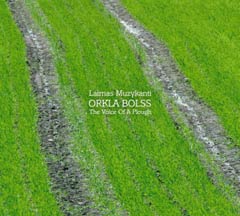
Laimas muzykanti began as a group of musicians to accompany the Daugavpils folk dance group Laima. Its long-standing director, Artūrs Uškāns, has guided the group through its 10-plus-year evolution to what is now essentially two groups in one: the “small” group that plays traditional instruments and performs at folklore festivals and for folk dance groups, and the “large” group that plugs itself in and plays ethno-rock. Laimas muzykanti’s new compact disc, Orkla bolss, offers some of both, although the lasting impression is of the heavier side.

Orkla bolss, which translates as “the voice of the plow,” begins with a catchy and mildly Cajun-inspired beer song, “Oi dīveņi.” The next song, “Jauna meita,” is heavier and even includes a guitar solo. “Laiviņīka mosa” begins quietly, but eventually picks up the pace, while the following song is a stunningly simple, yet beautiful, a capella rendition of a mythological text. By the fifth track the musicians are back to ethno-rock, this time with the well-known tune “Auga, auga rūžeņa.” Even though the song’s melodramatic ending borders on overdone, the lively chord changes and transitions are very fun. The songs seem to keep getting better and better!

Orkla bolss loses its originality and edge, though, with “Sieļejis daņcs,” a beer-swilling, Pippi-Longstocking-braids-and-freckles caricature of folklore. The three tracks that follow are somewhat better, but all continue with the same oom-pa-pa beat. Have a listen for yourself, though, to decide whether the criticism is justified.

By track nine (“Ceiruļs”), and definitely by track 10 (”Čigons”), the musicians are thankfully back to ethno-rock. The CD ends with the quiet, but very well done, “Pīzacieļu reitā agri.”

Laimas muzykanti has all of the standard rock instrumentation—drums, electric guitar and bass—and knows how to use it. But the accordion, kokle and flutes lend a definite ethnic sound, as does, of course, the fact that they sing traditional texts in Latgalian. Most of the melodies sound traditional as well. Laimas muzykanti brings to mind a Latvian version of the Oyster Band or Steeleye Span, folk-rock bands from England.

Despite the couple of songs in the middle of the CD, Orkla bolss is a fresh sound among recent Latvian recordings. (At the very least, it’s a pleasure to listen to the young women’s voices.) May Laimas muzykanti continue what it is doing!

(Editor’s note: A version of this review appeared in Jauno Laiks, a bimonthly supplement to the Latvian-American newspaper Laiks.)

Details

Orkla bolss

Laimas muzykanti

UPE Recording Co.,  2007

UPEAMCD 005

On the Web

Laimas muzykanti

The Daugavpils-based Laimas muzykanti offers background on the band, news, lyrics and other resources on its Web site. LV

Where to buy

Purchase Orkla bolss from BalticMall.

Note: Latvians Online receives a commission on purchases.

Funeral music CD isn’t all that somber

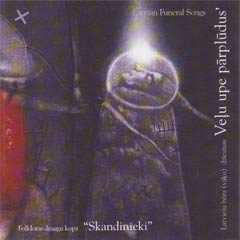
Veļu upe pārplūdus'

I recently spoke with a friend whose father had just passed away. She told me about returning to her hometown and about her struggles to convince her own mother that it would not be “improper” to include one Latvian folk song as a part of the memorial service. All of this took place right here in Latvia, among normal Latvians, and goes to show how far removed from their own traditional culture many have become.

And so I am very glad that Skandinieki—the best-known Latvian folklore ensemble—has released a recording of wake and funeral songs. The compact disc, called Veļu upe pārplūdus’ (The River of Spirits is Overflowing), contains 24 songs and dances from all parts of Latvia. The collection is a good representation of the hundreds of songs devoted to death and funerals. Please don’t dismiss this CD just because it’s funeral music. This is very important listening material! Plus, it’s not as somber as you might expect.

The texts may be sad, but they are also profound and comfortingly clear-sighted. Interestingly, many Latvian dainas (folk verses) describe death, wakes and funerals from the perspective of the deceased. The deceased may tell those who have remained behind how to prepare for the burial, how to decorate the cemetery, or how to sing and dance at the funeral feast. Yes, dance! An essential part of a Latvian funeral is ritual dance. One of these rituals is the stamping out of the deceased’s footsteps (pēdu izmīšana), so that their spirit may rest easily and not return to the land of the living. An example of this practice is included on the CD, “Nominu, nodeju māmiņas pēdas.” Another funeral dance or game is “Sieviņ brauca mežās,” in which a blindfolded participant must guess who his fellow dancers are.

Other songs of note on the CD are “Dedzan man skalu” about the death of a fisherman and “Vakar māti glabājām” and “Kas tevi šaukie,” both sung in rarely heard dialects. “Zin, Dieviņi, kālabati,” “Jūdzat bēŗus, jūdzat raudus,” “Divejādi saule tek” and “Dzīvoš’ ilgi, nedzīvoš’” are fairly familiar melodies and texts, but the rest of the CD will probably be completely new material for many listeners. The melodies alone of “Viena pati balta puķe” and “Te ganiņi ganījuši” are beautiful enough to make your heart break. “Eim’ pašas māsiņas” is another dance. “Visi ciema kukainīši” is not only upbeat and in a major key, but it even pokes gentle fun at the legions of insects that are awaiting the singer’s death. Talk about a healthy attitude towards death! Near the end of the CD is a Liv wailing song, which does not at all fit in with the reserved manner of Latvian funeral songs. It’s sung so convincingly, though, that it’s fascinating to listen to—almost to the point of being uncomfortable.

Some of the songs on Veļu upe pārplūdus’ have kokle, ģīga or violin accompaniment, but the arrangements are all very simple and the main focus of the CD is definitely on the voices, melodies and texts. Skandinieki is a large group and consequently tends to have a pleasant choral sound. Ten different singers are featured on the CD, with the voices of the directors Helmī and Julgī Stalte being particularly powerful and full of character. Again, don’t be frightened off by the seriousness of these songs. If you allow them, they will give you great comfort and strength, even if you are not in mourning.

By the way, my friend’s mother later grudgingly admitted to her that the inclusion of the folk song in her father’s memorial service had been appropriate…and even very beautiful and moving.

Details

Veļu upe pārplūdus’

Skandinieki

Rīgas skaņu ierakstu studija,  2006

RS058