Meteņi: A last fling before Latvian spring

The eastern Baltic coast was one of the last areas in Europe to be converted to Christianity.  Because of this, many of the pre-Christian traditions are still alive and have not syncretized with Christianity as much as they have in other parts of the world. For example, Jāņi, the ancient summer solstice celebration, is a national holiday in present-day Latvia, when much of the population heads out of the cities to spend the shortest night of the year around huge bonfires. Jāņi may well be the biggest celebration of the year, even ahead of Christmas.

The Latvians were an agricultural people, and therefore not only most of their celebrations, but their whole calendar, was based on the movement of the sun, the changing of the seasons and various agricultural events such as planting time and harvest. Holidays fell on the summer and winter solstices (Jāņi and Ziemassvētki), when days were at their longest and shortest, respectively, and the spring and fall equinoxes (Lieldienas and Apjumības/Miķeļi), when day and night were equal. Holidays also marked the half-way points between solstices and equinoxes: Meteņi on Feb. 10, Ūsiņi on May 10, Māras on Aug. 10, and Mārtiņi on Nov. 10. Traditions and rituals associated with the various times of year tended to be done to ensure success in daily life, work and harvests.

This is the time of year—around Feb. 10—when the Latvians celebrated Meteņi, the end of winter and beginning of spring.  Although nowadays Meteņi is not a big celebration, there are still many people who remember and observe it much the way Latvians did several hundred years ago.

Because it was not possible to do much work outside in winter, people turned to indoor work and visiting relatives and neighbors during the very cold weather. Spinning, weaving and sewing bees were a common way for the women to pass the time; children played word games and riddles with the grandparents; men fixed harnesses, whittled and prepared kindling wood. By the time of Meteņi, even though it’s still cold and there’s snow on the ground, spring can be felt in the air. Therefore, the Meteņi celebration is a joyous one. The days are becoming longer and sunnier, and it’s time to start thinking about the warmer season and spring work.

People particularly liked to visit friends and relatives at this time, and it was said that the farther one drove to visit, the longer one’s flax would grow and the better the cattle would thrive the following summer. It was also thought that lengthy sled rides down hills ensured an abundant flax and grain harvest, as well as general success in everything. In fact, sledding is considered the most characteristic and significant activity associated with Meteņi, and is done by adults and children alike.

Of course, what would a celebration be without food? After a day of sledding, everyone would sit down to a large meal with their guests. Earlier in the winter, say at Mārtiņi or Ziemassvētki, there was usually plenty of food in every house. But by Meteņi, stores were growing smaller. Therefore, it is no surprise that the foods associated with Meteņi are not all that rich, and they store well over the winter. Common for this time of year are barley porridges, dried peas and beans, zirņu pikas (gray peas and mashed potatoes molded into little balls), savory pies, sauerkraut, breads, beer and sausages. Pig’s head was a delicacy. Grūdenis, a Meteņi specialty, is smoked pork boiled into a porridge of barley grits and potatoes.

The rest of the evening was spent dancing, singing, talking, laughing and visiting. Sometimes loud hollering and pounding on the door and windows were heard—ķekatas had come to pay a visit! Ķekatas, people dressed up in costumes, have several different regional names, the best-known being budeļi, skutelnieki and čigāni. Although said to bring blessings and fertility to their hosts and their farmsteads, ķekatas were rarely polite. They boisterously roamed from one neighbor’s house to the next, barging in with loud songs and dances, demanding food and drink, often playing jokes on the people inside, and sometimes even frightening the children. A host who refused entry to the ķekatas or refused to feed them was ridiculed (think of trick-or-treat). Ķekatas expressed through songs the praises and criticisms of the hosts’ personalities (“apdziedāšana”). They constantly searched for faults. Ķekatas checked to see if the host’s house was clean enough, if the food tasted good, if all the chores had been done—and made fun of the owners if they didn’t live up to their standards.

It was even considered all right for the ķekatas to steal something small from the house. After all, it would have been the owner’s fault, because he or she had not been keeping a close eye on belongings! Some have explained the custom of stealing as deriving from necessity in this time of need. (And the tradition of costumes, then, conveniently hid the identity of the stealer, which was necessary for the continuation of neighborly relations the rest of the year.)

Latvian ķekatas’ costumes usually depict animals (wolf, goat, bear, horse, rabbit, heron, etc.), humans (the tall lady, the short man, a man dressed as a woman and vice versa, bear-tamer, gypsy, etc.) or common objects (bundle of straw, head of cabbage, moon, etc.). Less often does one see someone costumed as death, but usually the costumes do not depict gory or horrific monsters, as is common in Halloween celebrations. The main goal is to just hide your identity.

“Going ķekatās,” as it is called in Latvian, was a major part of the whole winter season and of all its celebrations—Mārtiņi, Meteņi, and especially Ziemassvētki. Meteņi was the last opportunity of the year to go ķekatās, because this was purely a winter form of entertainment. The English counterpart to the ķekatas is the mummers, while the Americanized version of the Celtic tradition is Halloween. The Meteņi time of year also corresponds to the Mardi Gras and Carnival season, with all of its revelry, trickery and costumes.
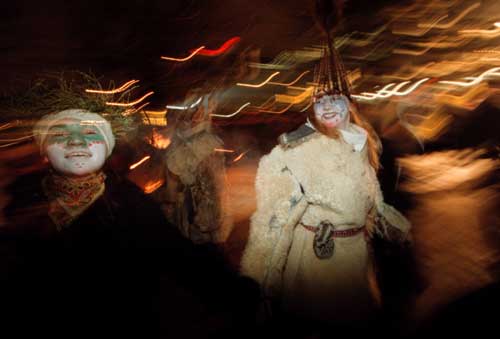
Ķekatas

Participants, dressed as ķekatas, enjoy a lively and colorful Meteņi celebration recently at Rīga’s Bastejkalns. (Photo by Uldis Briedis, Diena)

Latvians split on choice for president

Time was when a Latvian voting for president of the United States had a clear choice: pick the Republican. Not that everyone followed the party line, of course, but the post-World War II generation of Latvians in America generally have been a conservative group. And their conventional wisdom had been that the Republican candidate would be tougher on the Soviet Union.

But times have changed. Take the Nov. 7 election, which has left America in a quandary, awaiting vote recounts and the resolution of legal battles in Florida and several other states. We recently asked for a sampling of post-election opinion from some of our regular readers. What we learned surprised us.

Of those Latvian-Americans who voted for Republican candidate Gov. George W. Bush, many pointed to his party pedigree, his perceived honesty and his plans for Social Security as reasons they picked him over his main challenger. Meanwhile, those who favored Democratic candidate Vice President Al Gore cited his experience in Washington, D.C., his perceived intelligence and his stance on environmental and economic issues.

But although many of our respondents said their ethnic heritage is important, most said domestic U.S. issues outweighed concerns about the next president’s potential impact on Latvia.

Keep in mind that this is just a sampling of opinion, not a scientific survey. We received responses from 64 readers in the United States as well as a handful from other countries. Of U.S. readers, 30 supported Bush, 25 voted for Gore and nine cast ballots for Green Party candidate and consumer advocate Ralph Nader.

Why they voted for Bush

Ivars Ikstrums of Sammamish, Wash., was among those Latvian-Americans who voted for Bush. He cited several reasons for picking the Republican over the Democrat, including what he sees as the Clinton Adminstration’s lack of honesty and integrity.

“Clinton has introduced an ‘anything goes’ attitude into American society, the likes of which we’ve never seen before,” Ikstrums added. “Gore will continue that. This has got to be stopped.”

While Ikstrums pointed to his disagreement with what he expects would be Gore’s continuation of Clinton’s foreign policy, George Zuments of Arvada, Colo., found himself agreeing with Bush because of domestic issues.

“As a small company owner, several things were important,” Zuments said. “I did not want larger government programs and more entitlement programs.Tax cuts were important.

“The ‘surplus’ is a result of too much government income vs. expenditures,” Zuments added, noting the federal tax revenue that has increased in recent years during the country’s economic expansion.

Similarly, Eriks Lielbriedis of Grand Rapids, Mich., supported Bush because of his stand on issues such as limiting and decreasing taxes, decreasing the size of government and added accountability in public education.

For several respondents, the opportunity to change leadership in Washington was among the main factors influencing their vote for Bush. Said Hugh A. Kalns of Williamsburg, Va.: “We need someone with fresh blood that can restore America’s dignity in the world, someone that will make a good leader and someone that presents statesman-like appearance instead of preaching half-truth and jumping like a clown all over the stage.”

A resident of Richmond, Va., didn’t view Bush as the ideal candidate, but a far better choice than Gore.

“I cast my vote for George W. Bush because he is pro-free market,” said Eriks Gudvins, “whereas Gore wants nothing but the kind of nonsense that caused Latvia so much pain for so many years under Soviet occupation.

“I cannot comprehend why Americans are even tempted to vote for a man who so obviously is no friend to true freedom,” Gudvins continued. “Didn’t the pain and suffering of Eastern Europe, Russia and the rest of the world that was mutilated by communism show the pointlessness of any form of socialism or communism?”

It wasn’t Bush but his running mate, Dick Cheney, that swayed Ivars Bezdechi of San Diego, Calif.

“I grudgingly voted for George Bush because of his running Dick Cheney,” he said. “Dick Cheney understands military affairs and foreign affairs. He understands the reality that the ‘cold war’ is really not over and knows that Russia is not a friend of the world community.”

Why they voted for Gore

A psychologist in Quakertown, Pa., Aivars Straume was among those respondents who said they voted for Gore.

“He is intelligent, has a positive reputation with world leaders, I agree with his philosophies and proposals about health care, the budget surplus, taxes, Social Security and the environment,” Straume said of the Democractic candidate.

Bush, according to Zinta Aistars of Michigan, “is an intellectual lightweight like none I have seen in my lifetime.” Among key issues for her were the environment, Social Security and the death penalty.

“Bush’s approach is very cavalier and calloused,” Aistars said of the last issue. “Too many innocent people have been put to death, yet he treats this with a smirk. Which brings up his lack of respect to minorities—racial concerns, gays, etc. Oh, I could go on forever…”

Silvija Vecrumba of New York City also noted several issues with which she found agreement with Gore, although she said the vice president wasn’t a particularly strong candidate.

“Gore takes a strong stand on something that is one of my pet peeves—the American drug companies,” Vecrumba said. “Pharmaceutical companies have the highest profit margin of any other company in the U.S., yet they whine about the costs of research and development and lobby to have patents extended to keep costs high for consumers.”

Juris Odiņš of Denver, Colo., also was not 100 percent in the Gore camp.

“I voted for Al Gore not out of real enthusiasm, but primarily because George Bush is completely unsuited to be president,” he said. “Gore has solid governing and political experience, breadth of knowledge and intelligence. Bush gets by on personality, family contacts and monied supporters.”

Odiņš, however, did agree that Gore would do a better job of paying down the national debt and strengthening Medicare and Social Security.

In Grand Prairie, Texas, among those voters who did not help Bush carry his home state was Gay Gaisma and her husband. Gaisma found disagreement with the native son on several issues, including his stand on offering vouchers for parents wishing to send their children to private schools.

“Teachers’ salaries in Texas are amongst the lowest in the country,” she said. “Bush’s voucher plan and support for private schools would further erode the public education system. Comparing education achievements of the two (systems) is like comparing apples to oranges. Public schools have to accommodate every child while private schools pick and choose from wealthy and high-scoring academic enrollees.”

Why they voted for Nader

Many political observers have called them spoilers: those who voted for Nader and supposedly “stole” votes from Gore, potentially costing the vice president the election.

“I voted for Ralph Nader because I could not bring myself to play the ‘lesser of two evils’ game,” observed Silvija Klaviņš-Barshney of Chicago. “I consider both Bush and Gore horrible candidates, although Bush is worse. I was hoping that Nader would get 5 percent of the vote, so that he could run a real campaign in four years.”

Others, too, voted for Nader to give the third-party candidate a better chance in the future, although Kaspars Zeltkalns of Michigan also flaunted his “spoiler” privileges. “I felt that a Nader vote would at least help Bush, because I did not want Gore at all,” he said.

At least a few Latvian-Americans, however, supported the Green Party nominee because of genuine interest in his platform.

“The other candidates did not offer me a real choice,” said Dace Zoltners of Wisconsin. “Neither Gore nor Bush have a stellar record. Ralph Nader has been a proponent for the citizens of this country since the late sixties.”

NATO mostly a non-issue

A number of Baltic-American organizations have focused part of their lobbying efforts on convincing the U.S. government that it should support expansion of the North Atlantic Treaty Organization to include Estonia, Latvia and Lithuania. In the runup to the Nov. 7 election, they also tried to promote NATO expansion as an issue to watch in the presidential campaigns.

Our readers generally consider NATO expansion an important cause, but remained unconvinced that it was an overriding consideration in deciding whom to support for president. Said Bush supporter Valdis Siliņš of Minneapolis: “I cannot nor will I ever expect America’s leadership to actively promote Latvia’s NATO membership if it is not perceived as being in America’s best interests.”

Violeta Byrum of Coopersburg, Pa., agreed: “Issues affecting everyday life are going to have a higher priority even though I am passionate about the Baltic States being able to become members of NATO.”

And one reader in Washington state criticized Baltic-American organizations in their efforts to influence voters.

“I don’t trust the Russian Federation and think security for the Baltics and other ex-republics is important,” she said. “But I was really insulted by e-mails that suggest that because I am a Latvian-American that I have to vote for certain candidates and not others based solely on the issue of NATO enlargement.”

However, a minority of respondents suggested that the issue of NATO expansion played a strong role in their choice for president.

“This is extremely important to me and further supported my argument for Gore,” said Diana Robeznieks of Cleveland, who went on to compare the politics of the Republican candidate and his father, the ex-president. “I never cared for George Sr.‘s take on the Baltic States and I am fairly confident that George W. would end up being another Republican isolationist.”

Bush supporter Aldis Puriņš of Grand Rapids, Mich., saw danger in Gore’s policies and their potential impact on NATO.

“I truly believe that Gore would weaken our military even more, which translates to a weaker NATO,” he said. “I’m not sure that NATO can continue to exist without a strong U.S. presence.”

(Editor’s note: This article originally appeared on SVEIKS.com.)

Andris Straumanis is a special correspondent for and a co-founder of Latvians Online. From 2000–2012 he was editor of the website.

Gold, silver and bronze for Latvian athletes

With the silver medal won Sept. 29 by 50-kilometer walk competitor Aigars Fadejevs, Latvia now has a full complement of Olympic honors, including its first gold medal ever under the independent Latvian flag.

Latvia’s Modris Liepiņš also put in a respectable performance, finishing ninth in the event.

Surprise! It’s a gold medal!

Few of his competitors probably expected 22-year-old Igors Vihrovs would be a contender in the floor exercise event. But the Latvian gymnast surprised his fellow athletes and spectators alike Sept. 24 by winning the event and earning Latvia’s first gold medal in the Summer Olympics in Sydney, Australia.

Vihrovs earned a score of 9.812, just ahead of the 9.800 recorded for silver medalist Alexei Nemov of Russia. The bronze medal went to Bulgaria’s Iordan Iovtchev, who scored 9.787.

The Latvian gymnast’s victory was perhaps most surprising to Nemov—one of the world’s top all-around gymnasts—who had finished first in the qualifying round with a score of 58.361. Vihrovs was far behind in 26th place with a score of 56.186.

In 73-kilogram men’s judo competition, Vsevolods Zeļonijs, a 27-year-old athlete from Rīga, on Sept. 18 won Latvia’s first medal—a bronze—in this year’s Olympics. He shared third place with Anatoly Laryukov of Belarus. Zeļonijs beat Yong-Sin Choi of Korea in a match lasting 53 seconds.

Estonia, Lithuania also earn gold

Estonia won one gold medal and two bronze medals.

Erki Nool won the gold in the men’s decathlon despite a brief controversy over his performance in the discus. His three throws in the event were initially ruled fouls, but were later reinstated.

Two bronze medals were garnered by Estonia in judo. Indrek Pertelson earned one in men’s heavyweight (+100-kilogram) judo competition, while Aleksei Budolin won one in the men’s half-middleweight (81-kilogram) event.

Lithuania, meanwhile, won two gold and two bronze medals.

One gold was earned thanks to Daina Gudzineviciute’s record-making performance in women’s trap shooting. The other was won by Virgilijus Alekna in the men’s discus throw.

One bronze medal was earned by Diana Ziliute in the women’s cycling road race. Lithuania also has a bronze medal in rowing. Birute Sakickiene and Kristina Poplavskaja earned their reward in the women’s double sculls event.

An embarassment in rowing

Latvian rowing fans almost had someone to watch in the much-touted medal rounds on Saturday and Sunday. Andris Reinholds of Latvia ended up in eighth place overall, finishing second in the B Group finals in rowing’s single sculls event. Reinholds, a 29-year-old builder and engineer from Rīga, performed well throughout the several phases of sculls competition. In his finals race, he was ahead of his four challengers until halfway through the race when the Netherlands’ Gerard Egelmeers pulled ahead to finish first in a time of 6:55.29. Just over a second later, Reinholds nabbed second place in a time of 6:56.33.

But then, according to a Sept. 23 Reuters story posted on the Olympics’ official Web site, Reinholds tested positive for the steroid nandrolone. He was disqualified from the single sculls event. Reinholds was the fourth athlete to fail a drug test during these Olympics, according to the story.

Reinholds has appealed the test results and the Olympic committee’s decision to disqualify him, according to Baltic News Service. No decision on the appeal had been issued by Sept. 27.

Swimmers from Latvia had a tough time, with no athlete advancing beyond qualifying heats. However, on dry land, Jeļena Čelnova-Prokopčuka in the 5,000-meter run and 10,000-meter runs advanced to finals. Canoeist Jefimijs Klementjevs paddled his way to the finals and finished seventh overall.

One of the largest Latvian contingents participated in this year’s Summer Olympics. The games were scheduled Sept. 15 to Oct. 1. A total of 45 athletes, three fewer than in the 1996 Summer Olympics in Atlanta, make up the Latvian team.

Latvian athletes first competed in the Summer Olympics in 1912. During the last summer games, Ivans Klementjevs won a silver medal in the canoe event.

The Latvian athletes this year had incentive to work hard at winning a medal. Bringing home the gold will translate into a government award of LVL 100,000, according to a Baltic News Service report. A silver medal will be worth LVL 50,000 and a bronze, LVL 30,000.

Latvian hockey jerseys became quite popular after the national team’s victory over the Russian team earlier this year in St. Petersburg. Sports fans interested in Olympic souvenirs might have to turn their attention to the Bank of Latvia and the Latvian Post Office.

The central bank has issued two commemorative coins marking the 2000 games. A one-lat silver coin honors cycling, while a 10-lat gold coin honors the javelin event. Both coins were minted in Switzerland.

The post office, meanwhile, was scheduled to release a commemorative Olympics stamp on Sept. 2.

Athletes and results

Athletics (Track and field): Uģis Brūvelis, Jeļena Čelnova-Prokopčuka, Jolanta Dukure, Aigars Fadejevs, Valentīna Gotovska, Līga Kļaviņa, Inga Kožarenoka, Viktors Lācis, Irina Latve, Anita Liepiņa, Modris Liepiņš, Voldemārs Lūsis, Staņislavs Olijars, Māris Putenis, Ēriks Rags, Anita Trumpe and Irēna Žauna.

  • Men’s 20-kilometer walk: With a total time of 1:22:43, Fadejevs finished 14th out of a field of 48 competitors. Putenis was disqualified. The gold medal in the event went to Robert Korzeniowski of Poland, who finished in 1:18:59.
  • Men’s 50-kilometer walk: Fadejevs won the silver medal by finishing second with a time of 3:43:40. Robert Korzeniowski of Poland won the gold with a time of 3:42:22. Liepiņš placed ninth with a time of 3:48:36, while Brūvelis was 35th with a time of 4:11:41.
  • Men’s 110-meter hurdles: Olijars qualified for the second round by finishing second in his first heat in a time of 13.56. He advanced from the second round to the semi-finals by coming in third in his heat with a time of 13.34. In the semi-finals, Olijars finished sixth in his heat with a time of 13.50 and did not advance to the finals.
  • Men’s 800-meter run: Lācis finished third in his first heat in a time of 1:46.94 and has qualified for Race 3 of the semi-finals. But in the semi-finals, Lācis finished sixth in his race in a time of 1:47.24, failing to advance to the finals.
  • Men’s javelin throw: Rags’ best throw in his qualifying round was 75.75, placing him 12th, not enough to advance to the next round. A similar result was recorded by Lūsis, whose best throw of 80.08 placed him 11th in his qualifying round, also not far enough to advance.
  • Women’s 20-kilometer walk: In the finals of the event, Dukure finished 30th in a time of 1:36:54, while Liepiņa came in 37th in a time of 1:39:17. The gold medal went to China’s Liping Wang, who finished in 1:29:05.
  • Women’s 100-meter hurdles: In her qualifying heat, Trumpe finished seventh in a time of 13.77, not advancing to the next round.
  • Women’s 400-meter hurdles: In the first round, Žauna came in fifth in her heat in a time of 57.79 and did not qualify for the second round.
  • Women’s 800-meter run: Latve finished sixth in her qualifying round with a time of 2:06.05, not fast enough to advance to the next phase.
  • Women’s 5,000-meter run: In her first heat, Čelnova-Prokopčuka finished fourth with a time of 15:09.45, advancing to the finals. And in the finals, Celnova-Prokopcuka finished ninth in a time of 14:55.46. The gold medal went to Gabriela Szabo of Romania, who finished in 14:40.79, a new Olympic record.
  • Women’s 10,000-meter run: Čelnova-Prokopčuka advanced to the finals by placing eighth in Round 1, finishing in a time of 32:32.87. She was 26.68 seconds behind the leader, Ethiopia’s Derartu Tulu. In the finals, Čelnova-Prokopčuka finished 19th in a time of 32:17.72. The gold medal went to Tulu.
  • Women’s high jump: Kļaviņa had no mark in the qualifying round. She did not advance.
  • Women’s javelin throw: Kožarenoka’s best throw of 53.83 meters was not far enough to qualify her to advance in the competition.
  • Women’s long jump: In her qualifying round, Gotovska’s best jump was 6.47 meters, placing her 10th. She did not advance in the competition.

Canoe: Jefimijs Klementjevs.

  • Men’s 1,000-meter sprint: Klementjevs finished in fourth place in his qualifying heat with a time of 3:58.840. He advanced to the semi-finals, where he finished second in his run in a time of 4:01.300. In the finals, Klementjevs finished seventh in a time of 4:00.931. The gold medal went to Andreas Dittmer of Germany, who finished the race in 3:54.379.

Cycling: Raivis Belohvoščiks, Viesturs Bērziņš, Ainārs Ķiksis, Ivo Lakučs, Gvido Miezis, Andris Naudužs, Dainis Ozols, Arvis Piziks and Andris Reiss.

  • Men’s 1-kilometer time trial: Miezis finishes 16th in the event with a total time of 1:08.113. The gold medal went to Jason Queally of Great Britain, who finishes with a total time of 1:01.609.
  • Men’s individual time trial: Belohvoščiks finished 15th, 2:17 behind gold medal winner Viacheslav Ekimov of Russia, who finished with a time of 57:40. Ozols was 21st, 3:06 behind the leader.
  • Men’s Olympic sprint: The team of Bērziņš, Ķiksis and Lakučs failed to advance beyond the first round after being bested by the Australian team of Sean Eadie, Darryn Hill and Gary Neiwand. The Latvians’ overall time was 46.525, but the Australians finished in 44.745.
  • Men’s road cycling road race: Piziks finished 22nd, 1:38 behind the winner and gold medalist, Jan Ullrich of Germany, who finished in a time of 5:29:08. Reiss came in 81st, 12:53 behind the leader. Belohvoščiks, Naudušz and Ozols did not finish.
  • Men’s sprint: Bērziņš finished 10th overall. The gold medal in the competition went to Marty Nothstein of the United States, whose times in the final were 10.874 and 11.066.
  • Men’s track keirin: Ķiksis finished first, in a time of 11.210, in the repechage round. In the second round, he finished sixth and did not advance to the finals.

Fencing: Jūlija Vansoviča.

  • Women’s individual epée: One of the world’s top women fencer’s, Hungary’s Gyongyi Szalay, was ousted 15-13 in Round 2 by 30th seed Vansoviča, reported the Olympic News Service. However, another Hungarian, Timea Nagy, exacted revenge in Round 3, beating Vansoviča 15-10. Nagy was the eventual gold medal winner in the event.

Gymnastics: Igors Vihrovs.

  • Men’s floor exercise: Vihrovs, in a surprise finish, won the gold medal with a score of 9.812. The silver medal was won by Russia’s Alexei Nemov, who scored 9.800, while the bronze went to Bulgaria’s Iordan Iovtchev, who scored 9.787. In the qualifying subdivision Vihrovs had placed 26th with a score of 56.186, enough to advance him to the next phase.

Judo: Vsevolods Zeļonijs.

  • Men’s 73-kilogram lightweight: Zeļonijs beat Yong-Sin Choi of Korea in 53 seconds to win the bronze medal in the competition, sharing third place with Anatoly Laryukov of Belarus. The silver went to Tiago Camilo of Brazil, while the gold medal was awarded to Giuseppe Maddaloni of Italy.

Modern pentathalon: Deniss Čerkovskis and Jeļena Rubļevska.

  • Men: Čerkovskis finished 18th with a total score of 4,903. The medalists in the event were all Eastern Europeans: Russia’s Dmitry Svatkovsky took the gold; Gabor Balogh of Hungary, the silver; and Pavel Dovgal of Belarus, the bronze.
  • Women: Rubļevska finished in eighth place with a total score of 5,051. The gold medal went to Stephanie Cook of Great Britain. She had 5,318 total points.

Rowing: Andris Reinholds.

  • Men’s single sculls: Reinholds advanced to the B Group finals, finishing second in the race with a time of 6:56.33 and earning eighth place overall in the event. However, he tested positive for use of steroids, according to a Sept. 23 Reuters report.

Sailing: Žaklīna Litauniece and Vita Matīse.

  • Europe fleet: Litauniece finished in 27th place with 218 net points. The gold medal went to Great Britain’s Shirley Robertson, who had 37 net points.
  • Mistral fleet: Matise finished in 22nd place with 170 net points. The gold medal went to Alessandra Sensini of Italy, who had 15 net points.

Shooting: Afanasijs Kuzmins and Boriss Timofejevs.

  • 25-meter RF pistol: Kuzmins finished in eighth place in the finals, with a qualifying score of 585.0, a finals score of 96.3, and a total score of 681.3. The gold medal in the event went to Serguei Alifirenko of Russia, who had a qualifying score of 587.0, a finals score of 100.6, and a total score of 687.6.
  • Skeet: Timofejevs scored 122.0 and earned 12th place, but did not advance to the finals.

Swimming: Artūrs Jakovļevs, Margarita Kalmikova, Valerijs Kalmikovs and Agnese Ozoliņa.

  • Men’s 100-meter breaststroke: In Heat 4, Kalmikovs tied for first with Puerto Rico’s Arsenio Lopez Rosario in a time of 1:04.02. That put them 34th overall in the heats, not good enough to move to the semi-finals.
  • Men’s 100-meter butterfly:  Jakovļevs finished fourth in his qualifying heat with a time of 56.63, but that was not fast enough to advance to the next phase of competition.
  • Men’s 200-meter breaststroke: Kalmikovs finished third in his heat in a time of 2:16.21. but does not advance to the next phase.
  • Men’s 200-meter individual medley: In his qualifying heat, Kalmikovs finished second in 2:04.18, but did not advance to the semi-finals.
  • Women’s 50-meter freestyle: Ozoliņa finished second in her heat with a time of 27.28, but that was not fast enough to qualify in the event.
  • Women’s 100-meter freestyle: Ozoliņa finished last in her heat with a time of 59.28. She did not qualify to advance to the semi-finals.
  • Women’s 200-meter breaststroke: In her qualifying heat, Kalmikova came in fourth with a time of 2:35.69, too slow to advance to the semi-finals.

Weightlifting: Raimonds Bergmanis, Sergejs Lazovskis and Viktors Ščerbatihs.

  • 94-kilogram: Lazovskis finished in 18th place with a snatch score of 155.0, a clean and jerk score of 200.0, and a total score of 355.0. The gold medal in the event went to Akakios Kakiasvilis of Greece, who had a total score of 405.0.
  • 105+ kilogram: Ščerbatihs finished in seventh place with a snatch score of 202.5, a clean and jerk score of 250.0, and a total score of 452.5. The gold medal in the event went to Hossein Rezazadeh of Iran, who had a total score of 472.5, a new world record. Bergmanis did not compete.

Wrestling: Igors Samušonoks.

  • 85-kilogram: Samusoņoks was defeated 3-2 by Canada’s Justin Abdou and shut out 3-0 by Cuba’s Yoel Romero. Samusoņoks defeated Kazakhstan’s Magomed Kurugliyev 7-6.

(Editor’s note: Information for this article was compiled from various media sources. This article originally on SVEIKS.com.)

Andris Straumanis is a special correspondent for and a co-founder of Latvians Online. From 2000–2012 he was editor of the website.