During Jāņi, we’re in for a very long night

In Latvia it’s easy to do. The night there is only a few hours long. But here where I live, even though the night is definitely shorter this time of year, it’s still dark for a good seven hours. Add on to that the fact that Jāņi celebrations here usually begin soon after dinner and it makes for a really long night: “You mean I’m supposed to stay awake for the whole thing?!” I’ll admit, I haven’t been able to do it for several years now.

According to Latvian tradition, those who sleep on Midsummer night (Jāņi) are doomed to sleep the whole summer—in other words, be lazy. Still to this day Jāņi is the biggest celebration of the year for Latvians, leaving in its shadow even Christmas. Originally a fertility festival, Jāņi marks the longest day and the shortest night of the year: the summer solstice. Astronomically speaking, the solstice usually falls on the 21st of June, but Latvians tend to celebrate on the night from June 23rd to the 24th. The 24th is the “names day” of all men named Jānis, hence Jāņi. The celebration is often called Līgosvētki (the 23rd is the “names day” for Līga), although Jāņi (Jāņudiena, Jāņunakts) is the older and therefore more traditional name, even though the proper name Jānis itself is most likely not Latvian in origin.

Latvians traditionally spent an awful lot of time preparing for Jāņi: cleaning, cooking, finishing farmwork, fixing up the yard, weeding the garden, washing clothes, decorating, brewing beer, etc. Think how crazy Americans become after Thanksgiving.

Once Jāņi arrived people often went from farm to farm, visiting neighbors and friends, singing and bringing with them good luck for the fields and cattle. Grass supposedly grows better in those places where līgotāji (those who sing “līgo,”  the typical refrain of Jāņi songs) have gone. That’s why they tried to walk past all of the fields. The hosts offered caraway cheese, pīrāgi and beer. A barrel full of tar was set on a pole and lit. Next to that blazed the bonfire. The fires were kept burning all night long so they would bring a good harvest to the fields and good health to the people. It was thought that the fields would be prosperous as far as the light from the fires shone, and that’s why hills were the optimal place for a Jāņi celebration, because the light shone farther from the higher elevation.

People still light bonfires and barrels of tar, eat cheese, pīrāgi and beer, and spend the night dancing and singing, laughing and visiting. The songs still often become teasing, obnoxious and risque, but no one takes lasting offence—it is a friendly and socially acceptable way to air grievances about others: “Pēteris is a lazy good-for-nothing!” “Kārlis has a long nose!” “Uldis lost his wife tonight!” “The girls are foolish for not letting me kiss them!” “Mārīte is round as a barrel!” etc. Every once in a while a young couple might wander off, supposedly in search of the mythical fern blossom. Of course, ferns don’t bloom, but who says you can’t look for it anyway!

Because all of nature is in full bloom at this time of year, flowers and grasses play a big part in the festivities. Many people carry tall grasses in their arms. Everything, including cattle and keyholes, is decorated with garlands, flowers and grasses. Jāņi is the best time of year to collect medicinal herbs—they’re said to be strongest then. All of the men and boys wear huge wreaths of oak leaves on their heads (the oak is the male symbol), while all women and girls wear wreaths of flowers. Because at other times during the year wreaths were traditionally worn only by unmarried women (married women wore scarves), no one knows at Jāņi just who is married and who isn’t; this tradition undoubtedly reminds us that Jāņi originated as a fertility festival. Does the Latvian birthrate really jump in late March, nine months after Jāņi? So I’ve heard.

Friends ask why we keep those dried flowers and leaves hung on our front door all year long. Those are our Jāņi wreaths from last summer, and we will throw them on this year’s Jāņi bonfire in order to get rid of the past year’s troubles and to start this year anew.

Because solstices were considered magical times, girls would sometimes do small rituals right at midnight to try to find out whom and when they would marry. Dew collected early the next morning was considered medicinal for humans, would ensure plentiful milk if given to cows, and would even repel flies if rubbed on barn ceilings. Jāņi night was also a prime time for witches’ activities, both good and evil.

Jāņi songs are often everybody’s favorites. With more than 2,000 melody variations, there are more songs for Jāņi than any other Latvian holiday. They do not have set texts, but singers are expected to improvise texts as the festivities go along. The typical refrain is “līgo,” and the songs have a lot of repetition, so that everybody can join in the singing. It is appropriate to start singing Jāņi songs a few weeks before the festival, and maybe a week or so afterwards, but they are out of place any other time of year.

You’re sure to find a Jāņi celebration almost anywhere there are a handful of Latvians. Some resemble the traditional festivities, down to the teasing songs and decorated keyholes. Others, both in Latvia and elsewhere, are unfortunately more like keg parties and rock music festivals. But at least you can find the obligatory bonfire pretty much anywhere. And, of course, beer. Probably that mild yellow caraway cheese, too.

So, find out about the Jāņi celebrations in your area, and go out next week to celebrate this ancient holiday!
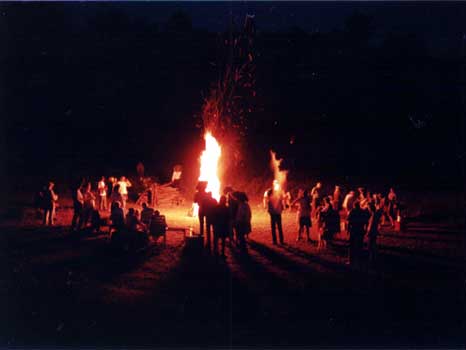
Midsummer bonfire

A bonfire is an essential part of a Jāņi celebration, whether in Latvia or in the diaspora, such as this one in Wisconsin in 1999. (Photo by Andris Straumanis)
Dievturi record album of seasonal songs

Slapping the back of a guitar didn’t sound right. Tapping on the back of a kokle didn’t sound right, either. But pounding on a door was perfect, providing a deep, resounding “boom!” to punctuate the Mārtiņi folksong, “Kas dimd, kas rīb?”

And that’s what listeners may hear when they play a new album of traditional Latvian seasonal songs. The album, supported by the Latvian Church Dievturi and recorded by a group of singers and musicians from the American Midwest, should be ready this autumn.

Dievturi and friends from Illinois, Minnesota and Wisconsin gathered during the Memorial Day weekend May 26-28 for their second recording session in five months at Dievsēta, a Latvian-owned property near the small, rural Wisconsin community of Warrens. Dievturība is a Latvian folk religion that finds its wisdom in the dainas, which are often expressed in song.

“For years the people at Dievsēta have been talking about making a recording of the seasonal songs that we sing at Dievsēta at the different celebrations year-round,” explained project coordinator Zinta Pone of Minneapolis.

Several dozen songs may appear on the album, which is to be available in both compact disc and cassette format. The album initially was meant as a resource for Latvian schools, but its appeal could well be broader.

“People are interested in knowing what songs to sing at different times of the year,” Pone said, “as they are teaching about other traditions for the holidays. The education element is still primary, but we are going to sell the album to the general public. It should be entertaining for everybody.”

About five to 10 songs for each of the traditional seasons are expected to be included in the album, Pone said. “We don’t know yet if it will all fit on one album,” she added.

“Maybe we will divide the year over two albums. There are many people who are not familiar with specific seasonal songs, and we feel it is important to have recordings available so that these songs are not forgotten.” The album is to include printed lyrics and descriptions of the seasonal celebrations.

The singers and musicians who have participated in the two recording sessions number about 20. Songs have been performed solo, by duets and by large groups. Traditional instruments such as kokle, drums, accordian and trīdeksnis—as well as spur-of-the-moment innovations like the door—are used to complement the voices of the singers.

Manning the recording equipment is Atis Freimanis of Washington state, who—along with microphones and a mixer—flew to the Midwest during the winter solstice celebration and again during Memorial Day. Pone and other members of the folk group Lini met Freimanis during a concert trip to the West Coast. “Atis agreed to come to Wisconsin and record these seasonal songs,” Pone said.

Pone’s mother, Elga (leader of the Minneapolis-based folk ensemble Teiksma), and her cousin, Amanda Jātniece (like Zinta Pone, a member of both Teiksma and Lini), helped pick out songs and develop instrumentations and harmonies, she explained. “I did a homemade solo recording of the melodies, which I sent to the participants along with copies of the music and words. That helped them refresh their memories or become familiar with some of the songs before arriving in Dievsēta to record.”

During the recording sessions, the singers and musicians relied on Freimanis to guide them. “He was listening for the best possible sound and advised us of how many takes we should do of each song, played the recording back for our judgment and input and also offered ideas on how to make the songs more diverse and interesting to listen to,” Pone said.

“I think this was a great opportunity for the participants to experience professional recording and to feel an important part in a big project that will be enjoyed by people all around the world,” Pone said. “There is much, much enthusiasm behind the singing.”

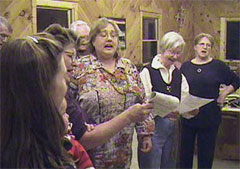
Dievsēta singers

Singers from Illinois, Minnesota and Wisconsin record a Latvian folk song during a recent session at Dievsēta in rural Wisconsin. (Photo by Andris Straumanis)

Andris Straumanis is a special correspondent for and a co-founder of Latvians Online. From 2000–2012 he was editor of the website.

ALA celebrates 50 years, looks to future

Fifty years may seem a short span in human history, but it’s momentous for an emigre organization. As the American Latvian Association (ALA) turned 50 recently, its leaders and members took time to look back and, more importantly, forward.

The past and present

What next? The question seems so natural at a time when Latvia is an independent and rapidly developing democracy that doesn’t directly depend on political support of emigre organizations in the West, as was the case during Soviet rule. In the last 10 years, exile communities have been confronted with the need to “reinvent” their causes, leaving some members skeptical about their future.

However, no such doubts could be heard from ALA leaders during the organization’s 50th anniversary congress April 27-29 in Arlington, Va.

ALA members agree that among the issues that will keep them as well as other Baltic-American organizations preoccupied is enlargement of the North Atlantic Treaty Organization to include the Baltic states.

As NATO’s 2002 Prague summit approaches, the Baltic community will devote much of its efforts to fortifying U.S. commitment to NATO enlargement. As Ints Rupners, who served as ALA chairman from 1992 to 1996, put it humorously, that will be the “last cry—last hurrah” of ALA before it turns into a typical emigre organization.

Rupners said the political work on the NATO issue should be finished in the next six months. “We have to persuade the U.S president and two thirds of Senate to vote for NATO enlargement,” Rupners said. “This is our last big political task.” After that, ALA’s main interests will be culture, schools and language, and much less the political questions, he said.

An active participant in the Joint Baltic American National Committee and a partner to the Latvian embassy in Washington, D.C., ALA is no newcomer to the battle for Baltic causes in Washington.

Current and former leaders of the organization say ALA has to be given credit for maintaining contacts with the U.S. administration and legislature, which in turn helped the United States play a role in the run-up to Latvia’s independence. “We were like thorns under the arms of the Communist bear,” ALA chairman Jānis Kukainis said in his opening speech during the congress.

“When Latvia joins the NATO, it will be to a large extent due to ALA’s efforts,” Uldis Grava, who chaired ALA from 1970 to 1972, told Latvians Online. He said the Latvian lobby has always had strong influence in the U.S. Congress.

Grava was echoed by his colleague Aristīds Lambergs. Under Lambergs’ chairmanship from 1986 to 1988, the Latvian lobby gained impressive political clout in Washington, including close relations with Reagan Administration as well as good contacts in the Congress. In fact, during the 1980s, “we were considered the second most influential lobby after Israel,” Lambergs recalled in an interview with Latvians Online. “Taking into account the relatively small number of Latvians in America, we have done a very good job,” he said.

The effective cooperation reached its peak in 1986 when seven young American Latvians were included in the high-level U.S. delegation to the Chautauqua conference in Jūrmala, which marked the perestroika thaw in the Soviet Union and provided an excellent opportunity for American Latvians to exchange information with supporters of independence in Latvia.

The future

While it’s clear that the Latvian community has to remain strong in its push for a positive NATO result, American Latvians don’t see their work ending after that.

“ALA’s goals have changed, but the organization can still be of great help to Latvia,” said Lambergs.

The Latvian community could work to attract private investments into Latvia and secure the political and financial support of the U.S. government, according to Lambergs. Former ALA chairman Valdis Pavlovskis (1988-1992) agreed that U.S. financing programs would be particularly useful.

Lambergs suggested American Latvians could also expand educational cooperation that would provide students from Latvia with more opportunities to study in the United States.

One of the most promising ways of cooperation would be active business contacts between Latvians in Latvia and their counterparts in America, said Ilgvars Spilners, ALA chairman from 1972 to 1975.

In addition, ALA could cooperate with the Rīga-based Latvian Institute in distributing information on Latvia as a nice tourist attraction and thus give boost to the country’s tourism industry, Spilners said.

Rupners said ALA would continue establishing and widening contacts with different non-governmental groups in Latvia. ALA has done quite a lot through different U.S. government agencies to help build the Latvian nongovernmental organization sector, Rupners added.

But he added that the NGO culture has yet to take root in Latvia. “You can’t learn it from books… People are still not used to it,” Rupners said. “They will get used to it, because that’s how civil society works.”

Some activists pointed out that that many prominent Latvian Americans are serving in high positions in the United States, and Latvia could use them as influential messengers to promote its interests.

Grava said Rīga should set priorities and see where and how—and for what goals—such highly devoted Latvians could be used.

Both Grava and Spilners emphasized that being Latvian and at the same time American citizens is not incompatible. “The concept of being a Latvian shouldn’t be tied to geographical borders,” Grava said.

The main future task of ALA will undoubtedly be keeping alive the Latvian language and passing the interest in Latvia over to younger generations who, in the words of Kukainis, could be the “future CEOs of General Motors or even U.S. presidents,” capable of lending great support to the country of their ancestors.

“You are not a Latvian if you don’t know the Latvian language,” Kukainis said. “We are a small nation, so we need to preserve our language and our culture. Our task is to preserve our Education Division, Saturday schools, and summer schools to teach our children Latvian and tell them about our culture.”

ALA members may be convinced that gradual assimilation is inevitable, but they are not ready to give up their efforts. During the congress, the speech of American American Youth Association President Ingrīda Erdmane may have given some hope. Erdmane spoke about the Baltic studies program at the University of Washington in Seattle, which has already proved its effectiveness in helping the younger generation learn the Latvian language.

It seems that those young people who get involved in the community activities don’t lose their liking for things Latvian. Those young American Latvians, who have returned for permanent life in Latvia, can serve as a good proof.

As Lambergs put it, “I don’t think we’re running short of (Latvian) people and I don’t think we will.”

Grava was even more confident: “This nation will definitely live on as it has proved in many other hard moments.”