Even before Olympics, Latvia creates buzz

With all the buzz in Salt Lake City these days about Team Latvia, who needs a medal in the Winter Olympics? Come Friday evening, Feb. 8, that buzz may just turn into a roar as Latvians across the United States watch the opening ceremony on the NBC television network.

If the indications from Salt Lake City are true, the national TV audience finally will get to see the Latvian team march into Olympic Stadium.

Unlike other recent games, the run-up to the 2002 Winter Olympics has seen an unprecedented amount of attention focused on Latvia—in Salt Lake City and beyond.

"There’s buzz on the street. People stop me and ask me about Latvia," Bruce Lindsay, a news anchor for local station KSL-TV, told Latvians Online. That’s because the station has been giving Latvia nightly coverage ever since Salt Lake City resident Pēteris Stāks told Lindsay how the country’s athletes repeatedly have been passed over during the opening ceremony telecast.

In Washington, D.C., and in Boston, meanwhile, Gunārs Zāgars has generated his own buzz. It started with an opinion piece he wrote for The Washington Post, which resulted in a story about him in The Boston Globe.

Across the United States, many Latvian-Americans now know the names of Lindsay, Stāks and Zāgars. In Latvia, the news that Latvia is in the news is once again news.

And, of course, getting a medal or two wouldn’t be bad for Latvia’s image, either.

TV station adopts Latvia

It all started in January, when Stāks e-mailed KSL and noted that during the past five Olympics, Latvia’s team has not been shown on network broadcasts of the opening ceremony. In each case, commercials have replaced the Latvian team’s appearance on millions of television sets around the United States.

KSL called Stāks to the studio Jan. 17 and Lindsay interviewed him on the air. Lindsay also promised KSL viewers that the station would broadcast regular updates about Latvia.

Since then, KSL has frequently highlighted some aspect of the Latvia story, including a look at the hockey team, an item on a recent survey that found Latvia is among the most optimistic countries in the world and a piece on sixth graders at a local elementary school who made lap quilts for the team, according to the broadcast monitoring service Utah News Clips. Also planned, according to Lindsay, is an interview with President Vaira Vīķe-Freiberga, who will be in town to cheer the Latvian team. The Rīga-based Latvian Institute, among others, has been providing information to the TV station.

Responding to KSL’s frequent "Latvia Update" segments, and perhaps aware of continued complaints about Latvia’s disappearing act, NBC Sports Chairman Dick Ebersol told Lindsay in a televised Jan. 31 interview that the Latvian team indeed will be shown this year. NBC, which owns the rights to broadcast the Winter Olympics in the United States, will still break for commercials before the Latvians enter the stadium, Lindsay said, retelling the interview with Ebersol. But as soon as the commercials are over NBC will air videotape of the Latvian team.

A spokesperson for NBC Olympics in Salt Lake City could not be reached to confirm the plan.

Although KSL is an NBC affiliate, Lindsay said the station’s jabs at the network have not caused trouble. "They seem to roll with it," he said.

Stāks admitted to being a bit surprised at how easy it was to get NBC to bend.

"We tend to grouse, we tend to complain, rather than trying to get things done," he said of Latvians. The Salt Lake City community of Latvians totals about a dozen, according to Stāks. He and three others are volunteering at the Winter Olympics.

For his part, Lindsay said, he’s been surprised at how much response the station’s commitment to Latvia has received. KSL’s broadcast signal is received throughout Utah as well as in parts of Idaho, Wyoming and Arizona, while a satellite signal is available in places like Portland, Ore. But e-mails have come from far and wide.

"You have a very supportive community," he said of Latvian-Americans.

Although he’s never visited Latvia, Lindsay is no stranger to the country. "My eighth grade geography report was on the Baltic republics," the news anchor recalled.

"The eminent pride in the nation is really astounding," he added.

Stopping the rain

In the Boston suburb of Westford, Gunārs Zāgars had finally had enough after watching the NBC telecast of the opening ceremony of the 2000 Summer Olympics in Sydney, Australia. He told Latvians Online he began penning a letter to the editor, but by the time it was finished it had turned into a 1,500-word op-ed piece. Editors at The Washington Post accepted the piece, but suggested that it might be better to publish the article closer to the 2002 Winter Olympics.

And that’s what happened. Zāgars’ bylined article, "Dear NBC: Stop Raining on Our Latvian Parade," ran in the Jan. 27 edition. The article discussed his family’s disenchantment with the continual snubbing of Latvia and other nations. During each of the five Olympics since Latvia regained independence, they had looked forward to seeing the Latvian flag and the Latvian team.

"But coverage of the opening ceremonies in 1992 broke for commercials before the Latvians were introduced and resumed after they had passed by," Zāgars wrote. "The same thing happened in 1994. And in 1996. And in 1998. Each year we would tune in, eager to catch a small glimpse of our Olympic heroes, and each year we would get Japan… Kenya… the Koreas… and Kummercials."

For Zāgars the snubbing took on extra meaning. His Rīga-born mother, sprinter and high jumper Zinaida Liepiņš, had represented Latvia in the 1928 Amsterdam Olympics. She died in March 2000, six months before the Sydney Olympics, never having seen her team again march onto the Olympic field.

Zāgars’ effort has been rewarded with kudos from the Latvian Institute and acquaintances as well as with an invitation to a lunch in Washington featuring President Vīķe-Freiberga. Zāgars had a chance to briefly chat with the president.

‘Kungi’ and ‘Dāmas’

The central meeting point for fans of Team Latvia in Salt Lake City is the Green Street Social Club, 610 Trolley Square. That’s where team members have dined, where fans from Latvia and elsewhere have congregated to get their bearings, and where local patrons have had a crash course in the Latvian language.

Latvian flags adorn the establishment, said Manager Garrett Wilson, and even the restrooms are marked "Kungi" and "Dāmas."

The social club also has been selling Latvian T-shirts and flags. However, one thing missing is Latvian beer.

"We should have got on that," Wilson admitted.

While all the attention has been good for business, the biggest event for the social club may be just ahead. President Vīķe-Freiberga is rumored to be planning to stop by Saturday evening.

So how does a bar in Salt Lake City prepare for a presidential visit?

"We’re gonna find that out," Wilson said with a chuckle.
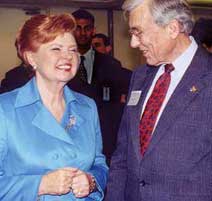
Vaira Vīķe-Freiberga and Gunārs Žagars

Latvian President Vaira Vīķe-Freiberga shares a laugh with Gunārs Zāgars during a meeting in Washington, D.C. (Photo courtesy of Norma Zāgars)
Andris Straumanis is a special correspondent for and a co-founder of Latvians Online. From 2000–2012 he was editor of the website.

Why Latvians should love fir

Finland has Santa Claus. Russia has traditional handmade Christmas ornaments. Germany has Christmas markets.  But arguably the most well-known of Christmas traditions—decorating the Christmas tree—may have its origin in Latvia. And it’s all but unknown.

The story goes that in 1510, Martin Luther, a founder of the Protestant faith, was walking through a Rīga forest one evening. He came upon a fir tree the branches of which glistened in the light of the moon and stars. Impressed by its beauty, he chopped down a smaller tree and took it home for his children. To recreate the moonlight, he fixed candles to the branches. With that, the first decorated Christmas tree in history was born.

For lack of a better word, call the Christmas tree story a legend. It has been mentioned on CNN and there are countless references to it on the Internet (search for “Christmas tradition” and “Latvia”). It appears in books on the origins of Christmas trees.

But ask a local Latvian about the legend and receive a puzzled expression in response. No one seems to know about it.

This is probably not surprising, because during Communist times a Western, Christian tradition originating in Latvia would have hardly been publicized.

Why the story remains such a secret is a mystery. Making it well known could certainly be beneficial, given Latvia’s recent negative publicity. Images of a dying Konrāds Kalējs and a teenage girl slapping a royal Rīga visitor with a red flower come to mind from recent news events. Wouldn’t being known as the “home of the Christmas tree” be a pleasant change?

Latvian Institute Director Ojārs Kalniņš, who works to promote Latvia, agrees.

A foreign-born Latvian who repatriated to Latvia two years ago, Kalniņš said Latvians are often curious about how the rest of the world perceives Latvia. The truth sometimes hurts: He said he tells them the vast majority of the world knows nothing. People who take a special interest in world events or cultures have usually heard of Latvia. If they know anything specifically about the country, he said, it is often a negative association with the former Soviet Union. Others may have had a chance encounter with a specific issue in the foreign press.

“At the moment, most people who have a passing knowledge of the country know about the Russian population,” Kalniņš explained. “The business community may know about corruption here.”

Kalniņš said the Christmas tree legend is the sort of trivia the Latvian Institute can incorporate in the information it distributes. Part of the institute’s work is to encourage foreign journalists to cover Latvia and to provide them with information.

Aldis Tilens, an Australian-Latvian and longterm Rīga resident who sells Latvian handicrafts in Latvia and abroad, has long wondered why the country doesn’t make more of the Christmas tree story. Tilens first heard of the legend several years ago. He was surprised when he asked his local Latvian employees about it and found it was news to them.

The Christmas tree legend is a unique marketing tool because it is not contrived, unlike, for instance, Lithuania’s boast that it has the world’s tallest Christmas tree this year. The information on Martin Luther, whether you believe it’s true or not, is already out there. Tilens described it as "simply a mechanism for people to learn about Latvia." Aside from the potential effects on business and tourism, Tilens said the legend would help to foster a positive image in the world.

“(The Christmas tree legend) sets the geography of the country, it gears the culture toward Western traditions and Christianity,” he said. “It brings up the spirit of giving and well being, and has warm and positive connotations.”

But bringing a warm and fuzzy feeling about Latvia to the collective consciousness of the world is not the only reason for trying to promulgate the Christmas tree story. This simple legend could further help to unify Latvia’s idea of itself.

In an essay on the tragedy of Central Europe, Czech writer Milan Kundera in 1984 forcefully reminded the world that Europe did not end at the Iron Curtain or the eastern border of the then European Community. The essential tragedy, Kundera wrote, is that these countries were removed from the map of Europe. This artificial division temporarily severed cultural ties that are still healing.

“Latvians are still coming to terms with their identity,” Tilens said. “Is it an event, a cultural difference or geography that sets them apart? (The Christmas tree story) is something that Latvians can latch on to that could be a source of pride.”

Kalniņš points out that Latvia is a country of dual cultures. He was not referring to Russian vs. Latvian. Instead, he meant that Latvia has pre-European traditions that are purely Latvian. These include folk art, costumes and culture, Iļģi-type music and folk dancing. This aspect of Latvia’s culture is portrayed through the popular song and dance festivals. It must be preserved, as it makes Latvia unique.

But at least as important—especially now that Latvia is aiming for European Union membership—is that Latvia’s is also a European culture, Kalniņš said. The opera is an example of Latvia’s European cultural heritage. The country’s performers who have made their name in the world of arts have done so through European cultural traditions.

Latvia, perched on the periphery of Europe, its eastern neighbor a close reminder of the recent past, needs to reaffirm its position in Europe.

“People often say Latvia is returning to Europe,” Kalniņš said. “We’re not returning to Europe—we always were a part.”

Such a simple thing as the birth of the tradition of decorating a tree to celebrate Christmas, started by Martin Luther some 500 years ago in Latvia, serves as but another reminder that Latvia was, and still is, European.

With fieldwork done, it’s time for Mārtiņi

“Laid iekšā, saiminiece, man kājiņas nosalušas!” (Let me in—my feet are freezing!). Thus begins another winter and another mummers’ season in the traditional Latvian year, with banging on the door, masked people demanding to come in and be fed, loud singing and dancing. This festival, called Mārtiņi, marks the beginning of winter and occurs halfway between the fall equinox and the winter solstice on Nov. 10.

Mārtiņi is the end of the harvest season. The field work has come to an end by now. The end of threshing is celebrated at Mārtiņi. Horses and cattle are brought in to spend the winter in the barns. It is a time for gathering and preparing food and getting ready for winter, as well as being thankful for a good harvest.

The namesake of the festival, Mārtiņš, is a lesser deity or mythical character associated with the waning of the sun, as well as with war. With the farm work done and the ground and rivers frozen, in years gone by fall was usually the time that raids and wars began. Mārtiņš and the spring character Ūsiņš (celebrated at the opposite end of the year on May 10) have several similarities: they both care for horses, both are associated with sacrifices of roosters, and they symbolize the waning (Mārtiņš) and waxing (Ūsiņš) of the sun.

The hallmark of the Mārtiņi celebration is the costumes and masks, the "mummers." In the evening people dress up so that no one can recognize them. They then go from house to house, where they are greeted with cheers, songs, food and drink. Much singing, dancing, joking and—sometimes—even scaring of children follows. Some mummer groups even prepare a short humorous skit. The mummers, usually called budēļi, čigāni or ķekatas, demand food and drink. The better the fare offered, the better the hosts’ harvest will be next year. The mummers comment on the cleanliness of the house, and sometimes steal a small object or two in jest. They dance around the whole farmyard, bringing blessings and fertility to the animals, buildings, fields and gardens. Then the bunch goes on to the next farmstead, where the whole scene is repeated.

Sounds kind of like Halloween? Of course it does, because many cultures have similar traditions in the fall. Latvians traditionally continued these masked visits all winter long until the Meteņi celebration in early February. Although outside of Latvia we associate the costumed revelers almost exclusively with the beginning of their season at Mārtiņi, most of their activity actually occured around the winter solstice (Ziemassvētki).

The budēļi are said to bring good fortune. They tend to disguise themselves as familiar objects, people and animals, not the supernatural or gory characters so often seen at Halloween parties. Common Latvian costumes include the tall lady, the short man, a gypsy, a bear-tamer and bear, a goat, a wolf, a heron, a rabbit, a tree or a mushroom. The main thing is that no one recognizes you!

Because Mārtiņi occurs after the harvest, it is a wealthy festival with lots of good food. Mārtiņi also is slaughter time, so there is usually a variety of meats at the festival meal. The best known delicacy is rooster. Traditionally, a black rooster was killed to ensure the well-being of the horses (“Mārtiņam gaili kāvu deviņiem cekuliem; Tas baroja, tas sukāja manus bērus kumeliņus”). Pork, pīrāgi, root vegetables, cabbage, bread, apples, cranberries, grey peas, beer and sweetbreads are some of the other foods offered.

Of course, every Latvian region and family develops its own traditions, even outside of Latvia. In central Wisconsin, for example, small groups of budēļi come from all over the state, as well as from neighboring states, and meet at a rural farmstead. Then, after singing, dancing, games and a big meal, the mummers and the homeowners settle in for the night and tell ghost stories. The next morning they finish off the feasting with a pancake breakfast.

Mārtiņi also is often a common theme at fall Latvian school parties. Mārtiņi is a short festival—just one day long—but it is a joyful introduction to the long winter season.