Changes in election law benefit Latvians abroad

Latvian citizens living abroad—including World War II exiles and their descendents who reclaimed citizenship after 1991—may find it a bit easier to vote in the upcoming parliamentary elections. Latvia’s parliament, the Saeima, on May 30 approved changes to the election law that were sought by several Latvian emigre organizations.

Under the revised law, voters abroad will be able to mail in absentee ballots at least 15 days before the official election day. Latvia’s national election day this year is set for Saturday, Oct. 5.

Some citizens abroad had complained that in their countries of residence mail service is not offered on Saturdays, while Latvia’s election law said that citizens abroad could vote either in person or post their absentee ballots on the day of the election. Mailed ballots also had to be received and opened in polling offices within three days of the election.

The World Federation of Free Latvians (Pasaules brīvo latviešu apvienība, or PBLA) was among emigre organizations pushing for the changes.

“The PBLA is very satisfied,” Linda Kovaļevska, head of the federation’s Rīga office, said in an e-mail to Latvians Online, “because the adopted amendment that allows voting by mail 15 days before election day was proposed by the PBLA.”

The president of the Latvian National Federation in Canada (Latviešu nacionālā apvienība Kanādā, or LNAK) agreed the changes are good.

“The changes definitely will help Latvians living in Canada to participate in the elections,” said Imants Purvs. The federation already has begun discussions with the Latvian Embassy in Ottawa about how best to publicize the changes and increase voter participation.

Under the revised election law, citizens living abroad may still vote at an official polling place.

The emigre organizations’ concerns were addressed in election law amendments proposed Oct. 31 by the Central Elections Commission, according to a press release. The commission oversees elections in Latvia. Arnis Cimdars, chair of the commission, also had noted that in some large countries even three days may not be enough time for a ballot to reach a local polling place.

Although the changes may satisfy the concerns of many Latvian citizens abroad, one catch might be that in order to receive an absentee ballot, voters will have to mail their Latvian passport to their polling place to prove their eligibility. Because a unified and computerized registry of voters is not yet available in Latvia, the passport is needed to verify eligibility. By the time the next parliamentary elections would be scheduled in 2006, such a registry should be ready, Kovaļevska said.

The PBLA also headed off an amendment proposed by the Latvian Foreign Ministry which would have barred citizens without a passport from voting, Kovaļevska said. Some citizens may not have a passport, but instead have a document from the Department of Citizenship and Migration Affairs that proves their citizenship.

Also struck from the proposed legislation was a provision that would have allowed a citizen voting abroad by mail to change their ballot by showing up in person at the polling place, taking back their absentee ballot and voting again.

Voters on Oct. 5 will elect 100 members of parliament. Citizens who are at least 18 years old are eligible to vote. Candidates for parliament have a 20-day window, beginning 80 days before the election, in which to apply to be on the ballot.

In the meantime, the Central Elections Commission also will need to decide where polling places will be established abroad. In Canada, Purvs said, LNAK is considering opening an election office in Toronto.

For the last parliamentary elections in 1998, the Central Elections Commission set up a total of 31 polling places abroad, most of them in embassies. Three of those were in the United States: the Latvian House in Chicago, the Latvian Social Center in Los Angeles and the Latvian Embassy in Washington, D.C. Two were in Canada: the Latvian Embassy in Ottawa and the Latvian Canadian Cultural Centre in Toronto. Australia also had two, in the honorary consulates in Sydney and Melbourne.

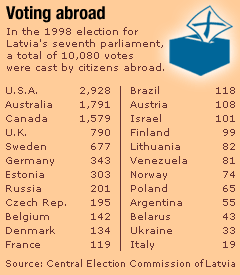
In all, 10,080 votes were recorded from Latvian citizens living abroad, with 2,928 (29 percent) coming from the United States. Australia had the next largest bloc of votes, 1,791 (17.7 percent), while Canada contributed 1,579 (15.6 percent). Together, Latvian voters in the three countries represented more than 62 percent of votes cast abroad.

Voters abroad in general were a conservative group. Of the 10,080 votes cast, 46 percent went to Tēvzemei un brīvībai/LNNK (For Fatherland and Freedom/LNNK), Latvia’s leading conservative party. Overall, the party took third in national elections, earning 17 spots in the 100-seat Saeima. A third of ballots abroad were cast for Tautas partija (People’s Party), the conservative reform party that recorded the best results in the election, earning 24 seats.

More than 32,000 Latvian citizens were living abroad in 2000, according to the Department of Citizenship and Migration Affairs. More than a third—a total of 11,344—were in the United States, followed by 4,447 in Australia and 4,198 in Canada.

Voting in 7th Saeima election

Andris Straumanis is a special correspondent for and a co-founder of Latvians Online. From 2000–2012 he was editor of the website.

Naumova gives up Tibet for trip to Tallinn

No one can predict the future, singer Marija Naumova agrees. All she knows is that if she wasn’t headed for Tallinn next month to compete in the Eurovision Song Contest, she would be on her way to a monastery in Tibet.

Naumova, who speaks five languages including her native Russian, will represent Latvia as one of 24 countries participating in Eurovision. Sometimes maligned as a showcase for packaged pop, the contest nonetheless draws a large international television audience and momentarily heightens feelings of national pride across Europe. Last year, in the contest held in Copenhagen, the Estonian duet of Tanel Pader and Dave Benton won first place, earning Estonia the honor of hosting this year’s competition on May 25.

Could Latvia and Marie N, as Naumova’s stage presence will be known in Tallinn, come out on top this year? Perhaps. But that’s not a goal she’s set.

“I have a wish for myself,” Naumova said in a telephone interview from Rīga, “and that is that I always have plenty to do.”

And right now she does. Naumova is perhaps one of few musical artists in Latvia who, for the moment, can make a living as just a musical artist. Even before she and her backup performers could begin to make final preparations for Eurovision, Naumova was setting her sights on an upcoming concert with Raimonds Pauls in Moscow as well as continuing a tour around Latvia. At the same time, work was continuing on a compact disc that is to contain several of Naumova’s songs, including a couple of mixes of the Eurovision entry, “I Wanna.”

The album in part will showcase Naumova’s ability to sing in English. She’s already released albums in Russian, in Latvian and in French. Those albums, especially Ieskaties acīs and Ma voix, ma voie, combined with her acclaimed performance in the musical production of “Sister Carrie” to help make her one of the most popular performers in Latvia.

Her victory in the national Eurovision contest in March was resounding, with more than 26,500 votes cast by fans to take her to No. 1. (The second-place winners, Linda Leen and Horens, scored about 18,100 votes.) Not bad, considering she came up with the song just two days before entries were due in early January.

“In the shower I’m always humming something,” she said. That’s how “I Wanna” came to her. Although she won, it was not without the requisite controversy that seems to have attached itself to the Latvian run-up to Eurovision. Critics claimed “I Wanna” was plagiarized from Ricky Martin’s hit song from 2000, “She Bangs.” But a group of experts determined that while “I Wanna” may have been inspired by “She Bangs,” it was not plagiarism. Still, some fans of other contestants remain disgruntled that Naumova won. One fan even posted an MP3 file on the Internet, weaving together Naumova’s and Martin’s songs in a mix that may leave some to wonder whether more than inspiration was at work.

Whatever the criticism over “I Wanna,” Naumova is still viewed by many as a talented individual. Besides speaking five languages, she also holds a bachelor’s degree in law.

Naumova credits the popular composer Pauls with kicking off her singing career. It was Pauls who discovered Naumova performing in Jūrmala several years ago. Their collaboration has continued.

Although Naumova said she avoids the politics of ethnicity, she noted that with her surname it usually would be difficult to get a break. But thanks in part to Pauls’ endorsement, “Many Latvians think that I am Latvian.”

Naumova also has kept her image and her music fresh by constantly updating it, trying different styles.

“A character that changes is interesting,” Naumova said. For example, on the cover of Ieskaties acīs she looked like a modern-day flapper, with short hair and an expression of happy innocence. But on Ma voix, ma voie, she literally let down her hair and appeared more distant.

Her stage presence for the Eurovision contest is sure to be different again, especially considering “I Wanna” is touched with salsa rhythms.

But winning a song contest isn’t the most important thing for her. “A contest is a lottery,” she said. First place isn’t represented by a number. “First place is a feeling you have inside,” Naumova said.

Last year, Naumova was passed over for a spot in Eurovision. Instead, Arnis Mednis went for Latvia, but finished 18th out of 23 countries participating. Two years ago, Prāta Vētra (BrainStorm) finished third and saw its star slightly rise among European music fans.

And as for the future beyond this year’s Eurovision? Naumova said she would like to improve her Italian and also learn Spanish. More concerts also are in the offing, perhaps some day even in America. But for now, her plans to travel to Tibet for some quiet time are on hold.

Marija Naumova

Marija Naumova adopted a new image for the release of her French-language album, Ma voix, ma voie. (Photo courtesy of Baltic Records Group)

Andris Straumanis is a special correspondent for and a co-founder of Latvians Online. From 2000–2012 he was editor of the website.

Urā! Latvia live on NBC!

“Well, it’s our five seconds of fame,” said Pēteris Stāks. Speaking to a reporter via his mobile phone Friday night, Feb. 8, Stāks had not yet heard of his and others’ success in convincing the NBC network to air the Latvian team’s appearance in the opening ceremony of the Salt Lake City Olympics.

Stāks was standing outside Rice-Eccles Olympic Stadium, watching a direct feed (rather than the NBC broadcast) of the ceremony on a large television screen.

He was the spark behind Salt Lake City broadcaster KSL-TV’s “adopting” Latvia as its team, an effort that was rewarded by a promise from NBC Sports Chairman Dick Ebersol that this year the network would indeed show the team. In all other Olympic Games since the country regained independence, Latvia’s appearance on U.S. television screens has been preempted by commercials.

According to KSL news anchor Bruce Lindsay, Ebersol said that NBC would still cut to commercials before Latvia’s appearance, but that the network would record the moment and show the team’s entrance right after the commercial break.

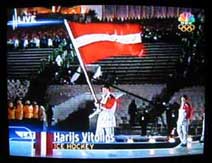
Instead, NBC waited until the team had started its entrance, long enough to see a live broadcast of hockey player Harijs Vītoliņš carrying his country’s flag and leading the rest of Team Latvia into the stadium. Meanwhile, NBC’s co-host for the opening ceremony, sportscaster Bob Costas, noted the significance of the moment.

“They score points with an effective campaign to appear on television during this opening ceremony after years of being relegated to commercial oblivion,” Costas said.

According to reports posted to the Latvians Online forum and the SVEIKS discussion list, television viewers in Australia, Canada and Germany (and, of course, Latvia) saw the entire Latvian team during the opening ceremony. Television commentators in Canada and Germany noted the Latvian effort to convince NBC to broadcast the team’s appearance.

What U.S. television viewers didn’t get to hear was the cheer that went up when the Latvian team entered the stadium, Stāks said.

“It was definitely above average,” he said.

Latvia on NBC

Millions of television viewers in the United States saw Latvian hockey player Harijs Vītoliņš carry his country’s flag in the Parade of Nations during the opening ceremony of the Olympics broadcast on the NBC network. (Photo by Andris Straumanis)

Andris Straumanis is a special correspondent for and a co-founder of Latvians Online. From 2000–2012 he was editor of the website.