A dozen years ago, about 1,000 people with Latvian ancestry lived in Arizona, according to the U.S. Census Bureau. Perhaps lured by the dry climate, the sunshine or the dramatic vistas of the Grand Canyon, the number of Latvians in Arizona had tripled by the year 2000, new census data suggest.
Or perhaps not.
If that many Latvians were living in Arizona even 12 years ago, said Rasma Ekmanis, former chairperson of the Arizona Latvian Club, they would be renting a ballroom to host dances.
“We don’t have the slightest idea where they are,” she said of the 3,020 Arizonans the census bureau estimates had Latvian ancestry when the latest count was made two years ago.
The current chairperson, Jānis Baltiņš, agreed. The Latvian club only has about 40-60 members from throughout the state, he said.
Arizona is not the only state with doubtful numbers of Latvians. Data about Americans’ ancestry is included in the latest batch of Census 2000 figures released to the public in the past several weeks, but the numbers have Latvian leaders in several communities scratching their heads in bewilderment.
The tally of “long form” questionnaires given to one in six American homes during the 2000 census shows that Americans with Latvian ancestry totaled an estimated 94,905 in 2000, down 5.4 percent from the 100,331 recorded in 1990.
The numbers are derived by adding the “first ancestry” and the “second ancestry” reported on the long form. The numbers also are estimates, interpolated by the census bureau from the national sample. The census bureau also reported lower and upper bounds for the data, which suggest that nationally the number of Americans with Latvian ancestry could be as low as 31,351 or as high as 174,711. The census also found that 10,780 persons in the United States were born in Latvia.
While the national number may appear believable, state-by-state breakdowns reveal some astonishing population shifts. One explanation may be that the Census Bureau’s sampling of ancestry and its interpretation of the numbers just gave bad results for Latvians. Or perhaps the numbers are accurate and ethnic Latvians are in fact escaping some states and flocking to others. Perhaps people who never considered themselves Latvian have seen a reawakening of their ethnic identity. The numbers may also raise questions about what exactly Latvian identity means, whether to be counted it’s enough to be from Latvia rather than be a “real” Latvian.
For example, the Latvian population tripled in Utah, Hawaii and Arizona during the 1990s, according to the census. Utah’s Latvians—some of whom became quite visible during the Winter Olympics in Salt Lake City—grew to an estimated 583, while Hawaii’s rose to 683.
Curiously, even North Dakota has more Latvians now than 10 years ago. A total of 182 persons claimed Latvian ancestry in the most recent census, compared to 64 in 1990.
Oregon saw its Latvian population swell by almost 83 percent from 1990 to 2000, the census estimates. One explanation might be found in the influx of Russian-speaking immigrants, said Juris Orle, the leader of the Portland-based Oregon Latvian Evangelical Lutheran Church. “In America there’s a certain prejudice against Russians,” Orle said, suggesting that the new immigrants who came from Latvia identified themselves as Latvian in the census rather than Russian.
According to census figures, Oregon has 50,162 persons of Russian ancestry. Overall, according to the daily newspaper The Oregonian, the 2000 census shows that the Pacific Northwest is the fastest-growing region for the Russian population in the United States.
But only about 400 ethnic Latvians live in Oregon, Orle told Latvians Online.
Several states that for decades have had strong Latvian populations saw significant decreases during the past decade. New Jersey, for example, experienced a nearly 70 percent plunge in persons claiming Latvian ancestry. In the 2000 census, 1,671 persons said they had some Latvian blood, compared to 5,393 in 1990. Pennsylvania saw a 28 percent drop, to 3,468 Latvians, while Washington experienced a nearly 21 percent slide, to 2,319 Latvians.
The figures for New Jersey may be believable, said I. Gabliks, head of the New Jersey Latvian Society. According to the census, the number of New Jersey residents with Latvian ancestry stood at 1,671 in 2000, down 69 percent from the 5,393 reported in 1990. The Latvian society, Babliks said, has about 300 members.
Latvians also appear to have abandoned a number of Midwestern and Western states. Arkansas, Colorado, Iowa, Kansas, Louisiana, Nebraska, New Mexico, South Dakota, Texas and Wyoming—none of which had large Latvian populations in 1990—reported decreases of 20 to 100 percent. Decreases may in part be credited to assimilation. Throughout the United States, more people than in the 1990 census reported their ancestry as simply “American.”
But even in states that had relatively stable Latvian populations, doubts arise about census figures. Florida in 1990 had 5,725 Latvians, increasing 5.9 percent by 2000 to 6,605.
“Around here we have a hard time understanding that,” Andris Ritums, head of the St. Petersburg Latvian Society, said of the numbers. “In St. Petersburg with all the snowbirds we get 500-600,” he said. The St. Petersburg area is home to the largest number of Latvians in Florida he said, and the number shrinks when temporary residents go back north.
The society, he added, has about 300 members.
If the numbers are right, it’s good news for New York, which reclaims bragging rights as the state with the most Latvians. The 2000 census revealed 12,758 people with Latvian ancestry, compared to California’s second-place total of 12,041. Ten years earlier, the largest state on the West Coast had the most.
Also in the top five states in terms of Latvian population are Michigan with 6,972, Illinois with 6,619 and Florida with 6,065. But that’s if you believe the numbers.
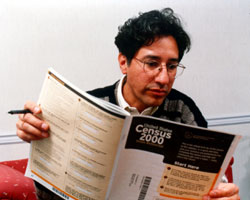
Millions of U.S. residents completed census forms in 2000, with one in six getting the “long form.” (Photo courtesy of U.S. Census Bureau)
Andris Straumanis is a special correspondent for and a co-founder of Latvians Online. From 2000–2012 he was editor of the website.


