Occupation Museum exhibit tours United Kingdom

An exhibit that tells the story of Latvia under Nazi and Soviet occupation is touring the United Kingdom, according to the Latvian Foreign Ministry.

“Latvia Returns to Europe,” the exhibit created by the Occupation Museum of Latvia, was unveiled Nov. 4 in the Parliament building in London. The tour is sponsored by the Latvian Embassy in London and the Latvian National Council in Great Britain.

Speakers at a Nov. 5 presentation of the exhibit in Parliament included British Member of Parliament Nick Hawkins; Jānis Dripe, Latvia’s ambassador to the United Kingdom; Paulis Lazda, director of the Occupation Museum, and Andrejs Ozoliņš, head of the Latvian National Council in Great Britain.

After Parliament, the exhibit moves to Marylebone Library in London, where it will be available from Nov. 12-22.

The exhibit also is on display in Cardiff and Edinburgh and is planned for Bristol, Glasgow, Leeds and Liverpool, among other U.K. cities.

Andris Straumanis is a special correspondent for and a co-founder of Latvians Online. From 2000–2012 he was editor of the website.

Latvia and the European Union: A primer

In a few years, Latvians from outside Europe visiting their ancestral homeland may be surprised that they’ll be paying for souvenirs with euros rather than with the good, old lat.

While Latvians in Canada and the United States have followed with great interest the pending enlargement of the NATO defense alliance, they may have pushed to the back of their minds an equally important debate: whether Latvia should join the European Union.

For those who may have only scanned the headlines of the past several months, here is a primer on European Union expansion, a process that promises to create the largest economic market in the world by eventually adding 13 new countries—including Latvia—to its current roster of 15.

The idea for the modern European Union was born in the context of a Europe still struggling to determine what its future would be like after the end of World War II. British political leader Winston Churchill first suggested formation of a “United States of Europe” in 1946. Four years later, France proposed a federation of European countries. By 1951, six Western European nations had formed the European Coal and Steel Community, the first step in moving Europe toward the ideal of reducing barriers to free trade.

In the early years, efforts at closer cooperation in politics and military defense failed, but succeeded in the economic arena. In 1958, the European Economic Community treaty went into effect, aimed at allowing the free movement of trade across the borders of the countries of the “common market.” The six original members of the EEC—Belgium, France, Germany, Italy, Luxembourg and the Netherlands—have been joined by nine other nations.

The modern European Union came about in 1993 with the adoption of the Treaty of Maastricht, which reorganized and expanded the responsibilities of the member states. Among the most visible changes was the adoption of the euro as the common currency of the EU, agreement on a joint security policy and coordination on issues such as immigration and fighting drug trafficking.

The EU today remains an often confusing array of treaties and institutions. At its head is what the EU refers to as its “institutional triangle” consisting of the European Commission, the European Parliament and the Council of the European Union. Beyond the “triangle” are two dozen other institutions and agencies.

The European Commission may be viewed as the EU’s executive branch. It proposes legislation to the parliament and to the council and administers the decisions of those institutions. The 20-member commission also is the body that often speaks for the EU in international questions.

The European Parliament is elected every five years by the voters of the EU’s member countries. The parliament has 626 members. It and the Council of Europe make laws that govern the EU and also determine its budget. The parliament also oversees the work of the European Commission.

The Council of the European Union, according to EU literature, is the union’s chief decision-making body. It shares lawmaking and budgetary authority with the parliament. Council members are ministers from each of the member countries. The council’s presidency changes every half year. Currently, the presidency is held by Denmark. In January, Greece will take over.

Although full of promise, the EU over the years has had plenty of detractors as well as its share of problems, such as trade disputes with the United States, the growth of a transnational bureaucracy, and enough political scandal to keep things interesting.

Regardless, it’s an economic force to reckoned with—and the government of Latvia is among those that want in.

Already in August 1991, after the Soviet Union crumbled and Latvia regained its independence, leaders began looking west with a dream of “returning” to Europe. Latvia applied to join the EU in 1995, becoming one of 13 Eastern and Central European nations eager for membership in the club.

To join the EU, the candidate countries have to complete 31 “chapters” of accession negotiations. The negotiations are essentially a give-and-take process during which the candidate countries listen to recommendations for fixing things that aren’t up to the snuff of EU standards, known as the acquis.

Five years ago, when the European Commission adopted its Agenda 2000, it seemed doubtful that Latvia and Lithuania could join the EU any time soon. Estonia, where economic and political reforms had moved at a quicker pace, was included in a list of six countries that could be in a first wave of enlargement. Accession negotations with those countries started in 1998. But the following year another six, including Latvia and Lithuania, began talks.

For Latvians eager to see their country join the European Union, the month of October has been a critical time.

Originally, 13 countries were considered for enlargement. Meeting in Brussels on Oct. 9, the European Commission said 10 nations—including the Baltics—are ready for the last leg of negotiations that should lead to them becoming members in 2004. Bulgaria and Romania were told they would have to wait until 2007, while Turkey must continue working on reforms with no clear date for membership.

Then, on Oct. 19, Irish voters ratified the EU’s Treaty of Nice. Last year, Ireland rejected the treaty. If it had done so again, enlargement of the union would have been thrown into question.

Now all that remains is for Latvia and other candidates to keep plugging away at government and economic reforms so that they can join the EU by 2004.

In its latest report on Latvia’s progress toward membership, the EU noted:

  • Continued problems with the nation’s judicial system.
  • Latvia’s problem with corruption “remains a cause for serious concern.”
  • Integration of non-citizens should be accelerated.
  • Improvements to the functioning of the labor market would be welcomed, particularly in areas such as aiding disadvantaged workers and education.

Of course, even if the Latvian government accomplishes all that is left in addressing the EU’s concerns, nothing is guaranteed. One major hurdle remains: public opinion. Referendums are to be conducted in each candidate country to determine if voters want to join the EU.

A referendum on joining the EU is not a sure bet for supporters. In 1994, voters in Norway turned thumbs down on membership.

In Latvia, the margin of potential victory has been shrinking. The latest Eurobarometer poll conducted in March and April by the EU found that just 52 percent of Latvian voters would support a referendum on EU membership. Although that’s enough to get by, it’s a significant drop of 7 percentage points from the last survey in the autumn of 2001.

It’s also the lowest level of support found in all the candidate countries.

By comparison, in Estonia 59 percent of voters said they would support an EU referendum, while in Lithuania support reached 75 percent. In Romania, which now has to wait until at least 2007 for membership, support was at an astounding 96 percent.

Andris Straumanis is a special correspondent for and a co-founder of Latvians Online. From 2000–2012 he was editor of the website.

Jaunais laiks wins; voter turnout shrinks abroad

Latvia’s next government will be a coalition. That much is clear from provisional results from the Oct. 5 nationwide voting for a new parliament. But just which of the six parties that earned spots in the 100-seat Saeima will form the new government remains open to speculation.

Einars Repše’s reform-minded Jaunais laiks (New Era), which at one point expressed confidence that it could win a clear majority and thus avoid a coalition, won the most seats (26) in the 8th Saeima, earning 23.93 percent of the estimated 990,000 ballots cast in Latvia and abroad.

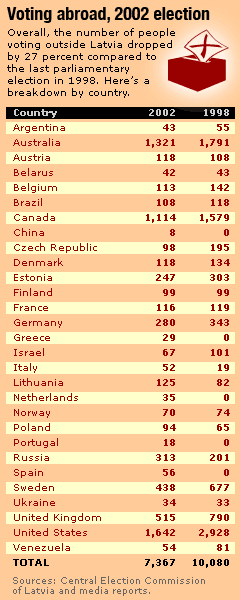
But 27 percent fewer voters cast ballots abroad this year than in the last parliamentary election in 1998. According to reports from 34 of the 35 voting sites abroad, 7,367 votes were cast in person or by mail. In 1998, a total of 10,080 voters abroad participated.

Results are still awaited from Venezuela.

According to the provisional results tabulated by Latvia’s Central Elections Commission, the heavily ethnic Russian party, Par cilvēka tiesībām vienotā Latvijā (For Human Rights in United Latvia, or PCTVL), drew 18.94 percent of all ballots, earning 24 seats in the parliament. Andris Šķēle’s Tautas partija (People’s Party) took third with 16.7 percent of ballots, earning 21 seats. At the time, results from 978 of Latvia’s 979 voting districts—including those abroad—had been tabulated.

A total of 20 parties fielded candidates in the election, but only those earning more than 5 percent of the national vote get a slice of the parliamentary pie. The other parties to clear the barrier were Latvijas Pirmā partija (The First Party of Latvia), 9.58 percent, earning 10 seats; Zaļo un zemnieku savienība (Green and Farmers’ Union), 9.47 percent, earning 12 seats; and Tēvzemei un brīvībai/LNNK (For Fatherland and Freedom), 5.39 percent, earning 7 seats. The Green and Farmers’ Union gets two seats more than the First Party because of how Saeima seats are apportioned according to voting region.

Although its popularity had been waning in recent years, it was still a surprise to some observers to see Latvijas ceļš (Latvia’s Way) drop below the 5 percent line. The party earned 4.88 percent of the national vote.

Latvia’s social democrats, who split into two parties earlier this year as a result of infighting, also won’t be warming any seats in the 8th Saeima. The Latvian Social Democratic Labour Party earned 4.02 percent of the vote, while the splinter Social Democratic Union received 1.53 percent. That suggests that if the social democrats had stayed together, they might have earned enough votes to stay above the 5 percent threshhold.

Voting results from Latvians abroad, particularly from the Americas, came in later as polls closed at 8 p.m. local time.

Voting abroad

Voting got off on a sweet note at the Latvian Ev.-Lutheran Church in Rockville, Md. It was the Three Tenors—Miervaldis Jenčs, Nauris Puntulis and Guntars Runģis—who cast the first ballots in the Washington, D.C., suburb, said Uvis Blūms, chairperson of the local election commission. The singers had performed in concert the previous evening in Washington.

Voting there and in New York progressed smoothly, but election judges may have had less work in this election compared to four years ago. Just 1,642 Latvian citizens voted in the United States, 44 percent less than four years ago, when 2,928 cast ballots in person or by mail.

In all, Blūms said, 263 voters cast ballots in person in the Rockville church. Although a final count of mail ballots was not yet known, Blūms said a total of 1,155 had been sent by the Latvian Embassy to potential voters who requested them. Meanwhile, in New York at the Permanent Mission of Latvia to the United Nations, a spokeswoman reported 281 ballots cast.

In Canada, 465 fewer voters cast ballots this year compared to 1998, a decrease of 29 percent. A total of 930 votes were cast at the Latvian Canadian Cultural Centre in Toronto, making it the busiest in-person polling place abroad. Another 184 ballots were cast at the Latvian Embassy in Ottawa, including just 79 by mail.

Four years ago, a total of 1,579 ballots were cast in Canada.

An hour before closing, Irēne Sadde, Latvia’s honorary consul in Caracas, Venezuela, told Latvians Online that voting was progressing without problems. A total of 54 people cast ballots in person, but nobody voted by mail.

“The mail doesn’t work,” Sadde said of Venezuela’s postal service.

Four years earlier, 81 ballots were cast in Venezuela.

In the Argentinian city of San Miguel, 35 kilometers from Buenos Aires, a total of 43 people voted, 41 of them at the home of Honorary Consul Mirdza Restbergs de Zalts. “We had no problems,” she told Latvians Online.

Four years ago, 55 people cast ballots in Argentina, according to Central Elections Commission data.

This time, according to draft results, the largest bloc of Argentina’s votes—15 in all—went to Jaunais laiks.

Voting in Latvia

Balloting in Latvia apparently went according to ethnic lines. Jaunais laiks and Tautas partija—perceived as more “Latvian” parties—drew strong support in the Kurzeme, Vidzeme and Zemgale regions. Meanwhile, PCTVL ran away with the election in heavily Russian Latgale and received the most votes in Rīga and its environs, where ethnic Russians also outnumber ethnic Latvians. Ten of PCTVL’s seats in the 8th Saeima will be filled by candidates from Rīga, while nine will come from Latgale.

In all, 72.49 percent of an estimated 1.36 million voters cast ballots.

In Kurzeme, Jaunais laiks earned 26.66 percent of the votes, while Tautas partija got 25.32 percent. In Zemgale, Jaunais laiks received 25.57 percent to Tautas partija’s 20.18 percent. And in Vidzeme, Jaunais laiks received 27.85 percent of ballots, compared to 21.61 percent for Tautas partija.

But in Latgale, PCTVL earned 36.8 percent of votes. In a distant second was Zaļo un zemnieku savienība with 9.62 percent. Jaunais laiks, according to provisional results, remained breathing down the Greens’ and farmers’ necks, just five ballots shy of matching them for second place.

In the Rīga region, PCTVL—which had already shown its power in the Rīga City Council election last year—also came out on top, taking 30.11 percent of the votes. Jaunais laiks was in second with 25.94 percent.

Votes from abroad are counted in the Rīga region. Overwhelmingly, most Latvians abroad gave the lion’s share of their ballots, 51.83 percent, to Jaunais laiks. However, in Belarus, Israel, Russia and Ukraine, most voted for PCTVL.

Election results abroad

Andris Straumanis is a special correspondent for and a co-founder of Latvians Online. From 2000–2012 he was editor of the website.