Latvian winners of Fulbright scholarships named

Three college students, four scholars and two high school teachers will study or work in the United States during the next academic year thanks to Fulbright scholarships, the U.S. Embassy in Latvia has announced.

Former U.S. Sen. J. William Fulbright established the Fulbright program in 1946. The goal of the program is to increase mutual understanding between the people of the United States and the people of other countries. The U.S. government maintains the Fulbright program with many countries all over the world. Since 1991, the United States government has offered Fulbright fellowships to outstanding students, teachers, and senior educators from Latvia, and so far some 85 Latvians have received these awards.

The Fulbright awards cover all expenses during the fellow’s stay in the United States, as well as round-trip airfare to and from Rīga. Students normally study for one or two years, while senior educators travel for either one or two semesters to conduct research or teach at the universities in the United States. Teachers go to the United States to teach their subject in an American school for one academic year.

The students from Latvia who received Fulbright scholarships are Rita Kaša, a correspondent for Radio Free Europe and a freelance writer for the politika.lv Internet portal, who will work towards a doctorate in educational policy at the State University of New York at Buffalo; Zigurds Zaķis, director of client services, strategic planner and consultant at Domino Marketing and Public Relations Agency, who will pursue an MBA degree at the Brandeis University, and Vladimirs Visipkovs, an assistant professor at Riga Technical University, will work toward an MBA degree at the Arizona State University.

Fulbright visiting scholars in the coming academic year are Mārīte Kirikova from the Riga Technical University, who will lecture and conduct research on application of knowledge management in information systems development and distance learning at the Boise State University in Idaho; Valda Čakare, professor and head of the Department of History and Theory of Culture at the Latvian Academy of Culture, who will research current theoretical approaches and the stage practice of post-modern theater at the University of Wisconsin in Madison; Kaspars Kļaviņš, a history professor from the University of Latvia, who will research the “Living Middle Ages in Europe of the 18th and 20th Centuries” at the Roosevelt University in Chicago, and Lidija Šiļņeva, rector of the Attīstība School of Social Work, who will conduct research on management and leadership in social work at the Monmouth University in New Jersey.

Two Latvian high school teachers will teach English as a second language in the United States under the Fulbright program. Anita Boreiše from the Rīga Gymnasium No.1 will work at the Quince Orchard High School in Gaithersburg, Md. (In turn, U.S. teacher James Textoris will teach English at the Rīga high school.) Ingūna Stārastiņa from the Jelgava Gymnasium No.2, will teach at Central High School in Omaha, Neb. She will be the first foreign teacher to work at this high school, according to the embassy.
Andris Straumanis is a special correspondent for and a co-founder of Latvians Online. From 2000–2012 he was editor of the website.

Astronomy professor Kaufmanis dies in Florida

Kārlis Kaufmanis, a retired astronomy professor whose “Star of Bethlehem” lecture was a Christmastime favorite of many, died June 21 in Clearwater, Fla., the University of Minnesota has announced. He was 93.

Born Feb. 21, 1910, in Rīga, Latvia, Kaufmanis was educated at the State Teachers Institute, Latvia, and the University of Latvia. After holding positions at the University of Latvia (1936-40), French Lyceum (1940-44) and Essingler Gymnasium, Germany (1945-48), he moved to Gustavus Adolphus College in St. Peter, Minn., as an associate professor in 1949.

Kaufmanis joined the University of Minnesota as a visiting lecturer in 1961 and became an associate professor in 1963. He held the rank of full professor from 1970 until his retirement in 1978. Kaufmanis taught the introductory astronomy course to more than 26,000 students during his years at the university.

Outside the classroom, Kaufmanis became known for his public lectures, especially the one in which he suggested that the biblical Star of Bethlehem was the result of three close pairings of Jupiter and Saturn that took place in 7 B.C. For many fans, going to the “Star of Bethlehem” lecture became a holiday tradition.

Kaufmanis published several textbooks dealing with astronomy, mathematics and cosmology. He was a member of the American Astronomical Society, the American Association for the Advancement of Science, the Mathematical Association of America and the Royal Astronomical Society.

The University of Minnesota astronomy department honors Kaufmanis with its Kaufmanis Public Lecture Series, which brings well-known scientists to campus. Kaufmanis also received an All-University Award for his teaching.

His other honors include the Katie Award for best performance on Minnesota Educational Television; the Kaufmanis Scholarship, established by Gustavus Adolphus students; and the naming of Kaufmanis Way, a street in Eagan, Minn.

Kaufmanis is survived by his wife, Rita, of Clearwater, Fla., and nephew Andris Pulkis and family of Rīga, Latvia. A memorial service was held July 11 in Lakewood Cemetery chapel, 3600 Hennepin Ave., Minneapolis. In lieu of flowers, donations are preferred to the Astronomy Department, University of Minnesota, 116 Church St. S.E., Minneapolis, MN 55455, to help support the Kaufmanis Public Lecture Series; or to Christ Latvian Lutheran Church, in care of the church treasurer, Andris Sprūds, 3800 Pierce St. N.E., Minneapolis, MN 55421.

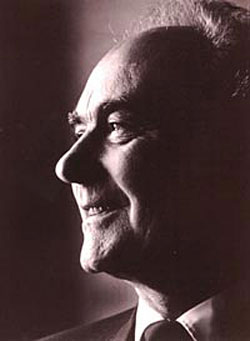
Kārlis Kaufmanis

Kārlis Kaufmanis is remembered as a popular astronomy professor. (Photo by Tom Foley, University of Minnesota)

Andris Straumanis is a special correspondent for and a co-founder of Latvians Online. From 2000–2012 he was editor of the website.

Effort to save Baltic broadcasts stumbles

Baltic-American supporters have suffered a setback in their attempts to convince Congress to continue funding Radio Free Europe and Voice of America broadcasts to Latvia, Estonia and Lithuania.

A subcommittee of the House Appropriations Committee on July 9 failed to restore funding for the broadcasts in the fiscal 2004 budget for the State Department proposed by the Bush Administration.

Now supporters are asking Baltic-Americans to lobby members of the full Appropriations Committee before its July 16 meeting in Washington, D.C. Besides independent efforts, the Washington-based Joint Baltic American National Committee issued an “action alert” to the Baltic-American community.

“It is vital that America’s voice be heard,” JBANC said in a press release. “Baltic language broadcasting offers objective news and analysis about America and the world.”

The subcommittee, in its review of the fiscal 2004 budget proposed by the Bush Administration, approved USD 564 million for U.S. international broadcasting, the same amount requested by the White House. But that amount foresees slashing fudning for the Eastern European language services of Radio Free Europe and the Voice of America—including the Latvian, Estonian and Lithuanian—and shifting the money to new programming aimed to the Middle East.

Without extra funding, the Latvian services would cease in October and the editorial staffs would lose their jobs.

In January, before the Bush Adminstration’s proposed budget was announced, government leaders in all three Baltic republics sent letters to U.S. President George Bush asking him to maintain support for Radio Free Europe broadcasts to their countries.

Both the U.S. Senate and the House of Representatives have bills before them that include continued support for the Baltic broadcasts.

The Senate’s Foreign Relations Authorization Act forbids the Broadcasting Board of Governors from dropping broadcasts to 13 Eastern European countries, including the Baltics, for one year. It also calls for the secretary of state to report within six months on the state of democratic governance and freedom of the press in those countries.

In the House, a similar bill calls for a two-year prohibition on cutting the Eastern European language services.

Andris Straumanis is a special correspondent for and a co-founder of Latvians Online. From 2000–2012 he was editor of the website.