“Būs jāiet apskatīt onkas, citādi liekas, ka ārzemju letiņi mūžam tikai šlāgerēja kā Čikāgas Piecīši un Ilmārs Dzenis.” So wrote one reader of Apollo, an Internet portal based in Latvia, about the news that the Latvian-British rock band Arvīds un Mūrsitēji is coming to town. They will have to go see these old guys, otherwise it seems Latvians abroad only play schlager, like Čikāgas Piecīši and Ilmārs Dzenis.
When the four men and one woman take the stage in three Rīga clubs during the first week of October, schlager won’t be on their play list. But neither will Arvīds un Mūrsitēji be playing lots of punk rock like they did back in the late 1970s and early 1980s.
“We like music to which people can dance,” bass guitarist Pēteris Pētersons said in a telephone interview before a recent concert at the Latvian rest home Straumēni near Catthorpe, England.
Rising in 1979 from the remains of Alva, another Latvian-British band, the group reformed two years ago. It was the second reincarnation for Arvīds un Mūrsitēji. The band had broken up in the early 1980s, but reformed in 1989 only to break apart after the death of 28-year-old guitarist Juris Jostiņš.
Pētersons recalled that when Arvīds un Mūrsitēji began, punk rock and reggae were popular musical genres. Some of the well-known bands of the era included The Clash, The Sex Pistols, UB40 and The Specials. One of Arvīds un Mūrsitējs’ songs from back then, “Latviešu anarchija,” is a variation on the Sex Pistols’ hit “Anarchy in the U.K.”
The idea for the band came during an event sponsored by the European Latvian Youth Association, Pētersons said. And the band’s name was inspired by alcohol.
“We were sitting around and drinking Harvey Wallbangers,” he said, referring the cocktail. Translated to Latvian, the name seemed like a good one for the band—Arvīds un Mūrsitēji.
The band dissolved in 1982 after a tour of the United States and Canada.
“We started getting married, started our careers,” Pētersons said. The 1989 attempt to reform crumbled after the death of Jostiņš, who Pētersons said was the “guiding soul” of the band.
“It wasn’t the right time to continue,” he said.
But in 2002 at the invitation of the London Latvian Folk Dance Group, which was celebrating its 25th annniversary, Arvīds un Mūrsitēji got back together.
Looking at a photograph of the band today, however, one might be surprised that these guys once were punk rockers.
“We can lose weight,” Pētersons joked, “but we can’t glue on hair.” Although the band’s music has mellowed, it also has broadened its influences thanks in part to guitarist Raimonds Dāle, whose wide musical tastes find their way into the band’s newer material.
“When we were together in Portugal (for the Euro 2004 soccer championship),” Pētersons said, “Raimonds was running to all the stores and buying compact discs.”
The band’s music has evolved from punk, to rock, to more rhythmic melodies, Pētersons said. Arvīds un Mūrsitēji perform only in Latvian. The band has never released an album, but has recorded some demos.
Besides Dāle and Pētersons, the band today includes Dāvis Pētersons on drums, Aivars Sinka on vocals and Līnīte Zobens-East on guitar, trombone and vocals. Dāle, Pētersons and Sinka are original members of the band.
In Rīga, Arvīds un Mūrsitēji will perform Oct. 4 in the Austrumu Robeža club, Oct. 7 in the Depo club and Oct. 8 in the Casablanca club. The band also is scheduled to be interviewed Oct. 3 on Radio NABA.
Although band members have all been to Latvia before, this will be the first time together as a band. Pētersons credits Andris Mellakauls, a British-born Latvian who moved to Latvia to work in the record business, for organizing the the concerts.
“We owe him a big bottle of whiskey,” Pētersons said.
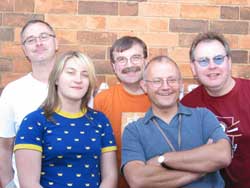
Arvīds un Mūrsitēji includes (from left) Dāvis Pētersons, Līnīte Zobens-East, Raimonds Dāle, Aivars Sinka and Pēteris Pētersons. (Photo courtesy of Arvīds un Mūrsitēji)
Andris Straumanis is a special correspondent for and a co-founder of Latvians Online. From 2000–2012 he was editor of the website.


