In the 1970s and 1980s quite a few Latvian families with young children lived in Brisbane, Australia, but these days the Latvian school has closed down and the twenty- and thirtysomethings have moved elsewhere.
However, a group of five women, all still in their twenties and most raised in the community, are deeply interested in exploring their cultural heritage. About a decade ago they formed a kokle ensemble, now named Zigrīda ansamblis after their first kokle teacher, the late Zigrīda Strazds.
The ensemble draws from the wisdom and melodic influences of their ancestors and creates beautiful sounds that leave the listener entranced and teary, taken off to a land far away and a time long gone.
“Our group doesn’t have a leader as such,” said Valda Biezaite, one of the members. “Each member contributes to our group musically each in their own way, at times composing, helping to work on our compact disc or setting up our Web site.”
Other members include Tija Lodiņa, Jasmīne Lācis-Lee, Eliza Grant and Ance Deksne.
“We’ve been friends from childhood,” Biezaite said. “We went to Latvian school together, started learning to play the kokle together.”
Only one member of the group started out as an “outsider.” She was born in Latvia and moved to Brisbane a few years ago, but is very much one of the girls now.
In the group’s performances the primary instrument is the kokle. However it is often combined with other sounds such as voice and percussion. All five women have a musical education under their belt. Some play the piano, others have played the clarinet and flute in orchestras and other musical groups. The talented young artists have been able to successfully translate their more classical musical training to the arranging and composing of hauntingly beautiful and original Latvian folk melodies.
The group’s purpose is not merely to learn and perform well-known folk tunes. They take it one step further. Group members say they want to explore their cultural heritage by bringing something new and unique to the Latvian repository of folk music (tautas pūrs). Each of the women has been to Latvia at various times over the past decade and whenever they go, they seek out folkloric performances and have met with mentors such as Vilnis Salaks, Māra Vanaga and Iveta Tauriņa, all classical kokle composers and experts. They also have met folklorists such as Artūrs Uškāns, Valdis Muktupāvels, the group Iļģi and Jānis Krūmiņš. All of these leaders in the Latvian folk music world have provided inspiration and improved the group’s technical skill.
“We feel we like to push boundaries in our musical arrangements and performances and we are thankful that the Brisbane community has been very supportive,” Biezaite said.
All members of ensemble are of Latvian descent but their language skills range from native speaker to speaking just a few words of Latvian. All of them have spent some time learning the language, though.
“The group prides itself in taking every effort not to allow the language obstacle to hinder the group’s activities,” Biezaite said. “Despite the language barrier that some of us have, each of us has keenly explored what it is to be Latvian as individuals, and are proud to belong to the community in Australia.”
Zigrīda ansamblis doesn’t restrict its performances to the Latvian community. It has also performed at multicultural events in the wider Brisbane community, even at a wedding recently. The size of the group varies, depending on who’s available to play at the time. During the past few years, the ensemble has been discovered by the interstate Latvian-Australian community. Kultūras dienas, the cultural festival in Melbourne at the end of this year, will be another place to again “push boundaries.”
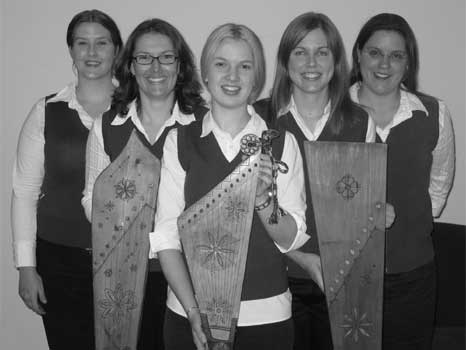
The member of the Brisbane kokle group Zigrīda ansamblis include (from left to right) Tija Lodiņa, Jasmīne Lācis-Lee, Ance Deksne, Eliza Grant and Valda Biezaite. (Photo courtesy of Zigrīda ansamblis)
Daina Gross is editor of Latvians Online. An Australian-Latvian she is also a migration researcher at the University of Latvia, PhD from the University of Sussex, formerly a member of the board of the World Federation of Free Latvians, author and translator/ editor/ proofreader from Latvian into English of an eclectic mix of publications of different genres.


