During the weekend that U.S. President George W. Bush was flying to, staying in and then moving on from Latvia, Karl Altau frequently went online to see what the news reports were saying about the historic visit.
“I spent a lot of time Googling over the past week, seeing news links…grow from about 350 on Thursday morning, to 500 that evening, over 750 Friday early and then skyrocket to 1,000, 2,000, 3,000 over the weekend into Monday,” Altau said in a May 10 e-mail to a reporter. Altau is managing director of the Joint Baltic American National Committee, an advocacy group based in Washington, D.C.
Meanwhile, Juris Mežinskis, director of the American Latvian Association’s Information Bureau, was taking stock of his May 5 e-mailed “ALA Infogram” appeal to Latvian-Americans, asking them to write letters to local newspapers to encourage coverage of Bush’s May 7 visit to Rīga.
Although they say the coverage by American media wasn’t perfect, Altau’s and Mežinkis’s overall impression is that the news reports succeeded in telling the story of the Baltics to U.S. audiences. The American president’s stop in Latvia was part of a four-country European tour that included a May 9 visit to Moscow to join other leaders in marking the 60th anniversary of the end of World War II.
“The coverage by journalists was remarkably even-handed,” Mežinskis told Latvians Online. “It was fair, because there was real controversy during the trip. Fake tension did not have to be manufactured.”
The tension had been mounting ever since January, when Latvian President Vaira Vīķe-Freiberga announced she would participate in the Victory Day celebration in Moscow, but making a point to say that World War II for Latvia ended only in 1991 when the Soviet Union collapsed and her country regained its independence. Bush’s acceptance of Vīķe-Freiberga’s invitation to a pre-Moscow visit in Rīga was seen in many circles as American backing for the Latvian position.
The thousands of links Altau encountered on Google did not mean that thousands of separate articles were written about Bush’s visit. In fact, many American newspapers and online services relied on stories by the Associated Press, The New York Times and the Washington Post. And rather than concentrating on Latvia and its fate during the war, many of those stories focused on cooling relations between Bush and Russian President Vladimir Putin, whose nation came in for strong criticism during the American leader’s speech in Rīga.
“I expect that the coverage will peter out pretty quickly,” Altau said. “However, there was so much gained from this exposure, that I believe it may be a little easier to roust the issue back onto the breakfast table in the medium term.”
Coverage began early, Altau said, with an April 27 column by Anne Applebaum in the Washington Post. Writing about the legacy of Nazi terror in Europe, Applebaum suggested an additional tact for Bush and future presidents: “Perhaps it’s time for American presidents to start a new tradition and pay their respects to the victims of Stalin.”
Applebaum also pushed Congress to adopt a resolution calling on Russia to condemn the occupation of the Baltic states. Introduced in the House of Representatives on April 14, the resolution has seen no action since being referred to the House Committee on International Relations.
The day before Bush left for Rīga, the American Latvian Association peppered e-mailboxes across the United States with a plea for Latvian-Americans to write their local newspaper urging coverage of the visit.
“I knew there would be press coverage,” Mežinskis said. “I thought we might need to write letters to focus the press coverage on the occupation. However, it turns out President Vīķe-Freiberga was eminently successful in doing this. A second reason for writing letters was to increase the local impact. Several of my friends, co-workers and neighbors casually read the newswires about the trip. However, they really paid attention to the president’s trip to Latvia, when a Latvian they knew wrote about it.”
Across the United States, few papers previewed Bush’s visit in their Friday, May 6, editions. National Public Radio, in a preview of what some in Latvia were calling a historic visit, in its May 6 evening “All Things Considered” news show used the visit as a long introduction to a story about how young Russians are increasingly disregarding the United States. But at least NPR played sound-on-tape of Latvian Prime Minister Aigars Kalvītis speaking about Latvia’s occupation by the Soviet Union.
Coverage increased on Saturday, May 7, but marginally. Domestic national and local news dominated front pages, with stories about topics such as the potential for military base closings and the annual running of the Kentucky Derby horse race being common. Latvian-Americans hoping that their ancestral homeland would be the top news of day would have been disappointed. Many media payed little attention to Latvia itself, focusing instead on how Bush’s presence in Rīga was being viewed in Moscow. “Bush in Latvia as Putin fumes,” read a headline over a story by Jennifer Loven of the Associated Press in the May 7 edition of the Democrat and Chronicle of Rochester, N.Y.
The broadcast and cable television networks, of course, were the first to report on the day’s events in Latvia. On the ABC network, Bush’s visit was the lead story, but on CBS and NBC the No. 1 spot went to new insurgent attacks in Iraq. Still, all three showed scenes of Bush in Rīga, laying a wreath at the Freedom Monument and speaking about freedom and democracy. However, the stories weren’t as much about Latvia, but about the drifting apart of Bush and Putin. ABC did note that the roots of the current diplomatic disagreement is Vīķe-Freiberga’s statement regarding the occupation. CBS News White House Correspondent Bill Plante’s report included a brief interview with Pauls Raudseps, an American-born editor for the daily Rīga-based newspaper Diena.
Altau gave relatively good marks to several cable and broadcast television reports on the visit, but said he was “peeved” by a Maria Danilova report for the Associated Press that ran May 7 in the Washington Post and other print and online outlets. “As Moscow celebrates on Monday, aged veterans are thinking back to the war that began for them with the German invasion on June 22, 1941,” Danilova wrote.
“Danilova neglected to inform that the Soviet Union, as a Molotov-Ribbentrop Pact co-conspirator with Nazi Germany, invaded Eastern Poland on Sept. 17, 1939,” Altau said, “forced their troops upon the Baltics a few weeks later, and then invaded Finland on Nov. 30, 1939, to begin the four-month long Winter War. “
Mežinskis said media reports also failed to follow up on Bush’s admonishment to the Baltics to press forward on integration of their Russian minorities.
“How did Latvia come to have such a large Russian minority? There were allusions to a difficult occupation, but no clear narrative about how Latvians were killed or deported, and how non-Latvians were given favorable treatment in moving to Latvia,” Mežinskis said. “It was not mentioned that many people living in Latvia are more loyal to Moscow than to Rīga. It was not noted that some resist learning Latvian and want segregation, not integration.”
Altau also said some media outlets continue to incorrectly report that the Baltics are former Soviet republics.
“The whole point is that they weren’t—they were forcibly occupied, annexed,” he said. “Restored Baltic independence meant that legal continuity was not a figment of our imagination.” NPR’s Don Gonyea, the radio network’s White House correspondent, is among those who have used the term “emerging democracies” to characterize the Baltics, which Altau said is a “definite improvement.”
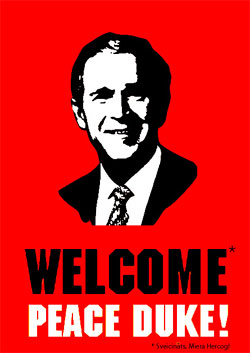
Posters such as this one were the topic of protest coverage.