The Montréal Canadiens professional hockey team has a new enforcer. Raitis Ivanāns measures 6 feet 4 inches (1.93 meters) and weighs 263 pounds (119 kilograms). He’s the biggest Canadien in the team’s storied history. But unlike most hockey pugilists, he’s from Latvia.
Ivanāns has attracted a lot of attention since making the Canadiens roster.
Now 27, Ivanāns came to Canada as a 17-year-old to play Tier 2 junior hockey near Toronto. Since then he has played in just about every minor hockey league in North America. His tour has included the Flint Generals, New Haven Knights and the Rockford IceHogs of the United Hockey League, the Macon Whoopee and the Tulsa Oilers of the Central Hockey League, the Pensacola Ice Pilots, Toledo Storm and Baton Rouge Kingfish of the East Coast Hockey League and the Hershey Bears of the American Hockey League.
By the 2003-2004 season he was established in the AHL as a member of the Milwaukee Admirals, one step away from the National Hockey League. He was on the Admirals roster that won the league’s championship and the Calder Cup. The following summer he was signed as a free agent by the NHL’s Montréal Canadiens and played during last year’s lockout with their Hamilton Bulldogs AHL farm team.
Ivanāns started out as a defenseman. Along the way he shifted to forward and learned how to use his size and fight. The penalty minutes racked up, 270 in New Haven, 208 with Rockford and 259 last year in Hamilton.
The Canadiens were looking to add muscle to their young and fast lineup and Ivanāns fit the bill. He beat out veteran minor league enforcer Peter Vandermeer for the tough-guy spot after taking on Toronto’s Nathan Perrott and Ottawa’s Brian McGrattan in exhibition games. A healthy scratch for Montréal’s first two regular season games, he suited up Oct. 8 for Montreal’s 5-4 victory against the Toronto Maple Leafs and logged just under three minutes. He had no penalties and went down in the books as the latest Latvian to play in the world’s best hockey league.
While Ivanāns’ role is to protect his teammates when the going gets rough, he shouldn’t be discounted as a hockey player.
“He certainly earned himself a spot,” Canadiens Coach Claude Julien told the Toronto Sun. “He’s a good person who came from a long way to adapt to the North American lifestyle, made sacrifices to leave his country and groom himself to be a hockey player. Sure he has a role on this team. Anyone who watches him sees he’s not a bad skater for his size. He creates some space for himself. He does have skills and he earned his spot with us. He deserves a lot of credit.”
Ivanāns also has taken young Russian-speaking players under his wing helping them with English and adjusting to life in Canada. Last year in Hamilton, his protege was Belarus rookie sensation Andrei Kostitsyn. Canada’s Rogers Sportsnet broadcast a 10-minute segment showing the two on and off the ice—in the dressing room, going out for fast food and bowling. This year he’s interpreting for talented Russian Alexei Perezhogin on the Canadiens roster.
Last winter parents and students of Toronto’s Latvian School Valodiņa went out to watch Ivanāns play in Hamilton. Afterwards he took time to meet with them, spoke to them in perfect Latvian and patiently signed autographs. However, he was stumped when asked to name every Latvian’s most favorite food in order to receive a present from the school. His answer was “kaposti” (sauer kraut). Not quite, but he still walked away with a box a 40 pīrāgi.
On the Latvian Web sites Hockey.lv and Delfi.lv, some readers have downplayed Ivanāns’ skills as a player due to his role as a “policeman.” However, most have cheered his success and are urging that he be given a place on Latvia’s national team. By all accounts the team could use someone who’s not afraid to go into the corners to dig the puck out or to park his massive frame and screen an opposing goalie. But then come springtime, it’s very likely that Ivanāns will be in the thick of Stanley Cup playoff action with the Canadiens. The World Championships may have to wait. —Viesturs Zariņš
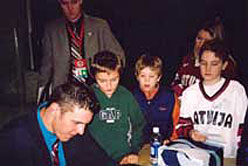
New Montréal Canadien hockey player Raivis Ivanāns signs autographs for pupils from the Toronto Latvian School Valodiņa. (Photo by Viesturs Zariņš)


