


With the arrival of at least 20,000 Latvians in Ireland over the past several years, it is hardly surprising that their passion for hockey wasn’t far behind. The Latvian Hawks, an amateur team consisting of only Latvian players living and working in Ireland, have joined the Irish Ice Hockey League in its inaugural 2007-2008 season. The Latvian Hawks intend to be contenders for the league championship.
In a land where Gaelic football, rugby, soccer, cricket, field hockey and the ancient game of hurling rule the sports pages, ice hockey is a tough sell.
Belfast in Northern Ireland has had several ice rinks for some time and the professional Belfast Giants, albeit heavily stocked with former North American minor leaguers, have played in the British Elite Ice Hockey League since 2000. But in Ireland itself ice hockey is nascent. The country has only one regulation-size ice rink. The first officially recorded game was played in 1983 when a visiting Liverpool team beat one from Dublin. The Irish Ice Hockey Association (IIHA) only joined the International Ice Hockey Federation (IIHF) in 1997. The senior men’s side is ranked 43rd out of 46 countries and competes in the lowest IIHF division along with the likes of Mongolia, Armenia, Luxembourg, South Africa and New Zealand. Latvia competes in the top division and is currently ranked 10th.
Latvians Online caught up with Latvian Hawks representative Ieva Baradouska, who discussed the team in an e-mail interview.
How were the Latvian Hawks founded?
It started simply enough with a group of Latvian guys in Ireland who wanted to play hockey on weekends. The ice hall in Dundalk had just opened and given that it is relatively close to Dublin, getting there didn’t require a lot of time or money so the timing was good. News about the newly formed Latvian hockey club spread quickly. When a couple of former professional players joined, we started thinking about establishing a team that would compete in Ireland.
Why did you choose the name Hawks?
The intent was to choose a name that would accentuate the team’s Latvian ties. At first we couldn’t decide between the names Hawks and Oaks. But Hawks won. The hawk is a strong and fast bird with endurance and these are the characteristics we felt were necessary for the team to compete successfully.
Was it easy to put together a team?
It wasn’t difficult to get players for our team. In fact interested players sought us out. Currently we have 45 members who are players and new ones are joining every month. In fact we’re in the process of putting together a second team that will play at the B level. The Hawks look good when compared with other teams. We’re not professionals, however we are motivated and have a winning attitude. In addition, we’re the only team that has such a large number of fans. That helps.
There’s a lot of movement between Latvia and Ireland. Do you have problems keeping players on your roster?
Yes, this is a serious issue for the team but one that we have taken into account. We realize that not everyone wants to stay and live in Ireland for long periods. However, there are new, young players who continually arrive and are interested in joining. They bring new enthusiasm and skills replacing any players who leave. (The Hawks’ starting goaltender was injured prior to the opening game on Sept. 15 against the Dundalk Bulls, so they flew in a top amateur goaltender from Latvia —VZ.) Right now we have a starting lineup for our A team and everyone is committed to Irish League play until next spring. No one is planning on leaving.
Tell us more about the B team and your plans for youth hockey.
There’s a wide range of skills among the 45 Latvian Hawks. At one end we have those who have played professional hockey in Latvia and internationally while at the other, those who have chased a puck on a frozen pond. Our A team consists of the most experienced players. The B team is for those who are less experienced but still able to go out and play a solid contact game. Right now our B team might be one of the best in the league. While our focus has been on the A and B teams, we do not want to ignore youth hockey. We’re looking into coaching and ice time for them although there are few opponents in Ireland for them to play.
Where is your home rink?
The Irish League has five teams: the Latvian Hawks, Dundalk Bulls, Dublin Flyers, Dublin Rams and the Belfast Bruins. Given that the rink in Dundalk is the only one decent rink in Ireland, games for all teams are played there.
How often does the team train and play? Is it easy for players to work hockey into their day-to-day schedule?
The Hawks are coached by our most experienced players. Practices are held for two hours on Fridays. We’re planning more because they are essential for the team’s development. There have also been exhibition games. Irish League games are held on weekends and the Hawks will play every one or two weeks. Most of our players live in Dublin but given that Dundalk is only an hour away, getting there is not a problem.
Hockey is an expensive sport. How do you fund the team? Do you have any sponsors?
Funding is a painful question. Right now the guys are paying for equipment and ice time out of their own pockets but we’re looking for sponsors. We realize that we need to prove ourselves in order to get sponsors. As a result, we worked hard to be ready for this hockey season. We have also become very popular among Latvians in Ireland. They come not just to watch hockey but also to get together because there aren’t too many opportunities to do that on a day-to-day basis. We’re hoping that our large fan base will interest local sponsors. And if there are any readers who would like to sponsor the Latvian Hawks then they should contact the team’s manager Janeks Oberts (info@latvianhawks.com) or the media and marketing coordinator Ieva Baradouska (ieva.baradouska@latvianshawks.com). We’re an amateur team, but if things work out we’re hoping on turning professional.
How many fans come out to games?
So far we’ve had 300-500 turn out for our exhibition games and of those 90 percent are Latvians living in Ireland. We’re hoping for a lot more at our league games. Ice hockey isn’t popular in Ireland but we’ve heard that after seeing our boisterous fans, locals have started to realize that ice hockey is an interesting and exciting sport. We’re planning various contests for fans in between periods during our games. For example, we’ll pick out the most colourful fan of the game. Hawks souvenirs will be given out as prizes and we’ll post photographs of the winners on our Web site. Fans will also be able to buy hats and jerseys before too long. We’re also working on getting cheap air fares for any fans from Latvia who want to fly out to our games.
Can anyone become a Latvian Hawk?
Up to now we’ve only accepted members who are players. However, we have an initiative called “Latvian Hawks are looking for fans.” This will allow the public to register as official Latvian Hawks fans and be eligible for various contests and special events throughout the season. Official Hawks fans will receive the latest information about the team including game date reminders by e-mail.
How do the Irish react to a Latvian team playing in their hockey league?
The other Irish teams are envious of the Hawks because we’re the first team with so many fans. That of course gives the games a different flavour. One of the goals of the Latvian Hawks is to enhance the image of Latvians in Ireland. That will depend on how we play but a lot will also depend on our fans. We want them not just to support our team but we also want them to bring along their Irish friends to hockey games.
Did you get pressure from the IIHA to drop the tag “Latvian” from the team’s name? Did other teams try to pick up your players?
The IIHA has been extremely supportive of our initiative to found the Latvian Hawks. They see this as an opportunity to bring in a lot more fans to hockey games. So far, other teams haven’t raided our roster but we are conscious of the threat and are doing everything possible to build a team that players would have no interest in leaving.
How did the season opener go on Sept. 15?
The game was emotional. We lost 13-6 to the league-leading Dundalk Bulls. It was a rough game. Two of our players suffered injuries and both were taken to the hospital. One broke his wrist and lost consciousness after being checked heavily in the boards. He will be out for three to four months. The other suffered a shoulder injury but is expected back soon. Our captain, Jānis Kipurs, was ejected from the game after questioning the referee’s decision and then getting embroiled in a fight with two Canadian players from the Bulls. Despite the loss, the large contingent of Latvian fans was loud and behind the Hawks even when we trailed 11-2. The fans drew favourable comments from their opponents who were badly outnumbered in the stands but did manage to field a group of cheerleaders. And when the Hawks scored, the blare of horns was deafening. Supporters also unfurled a huge banner reading “Latvian Hawks—The Best.” After the game the team received a 15-minute standing ovation from their fans.
Any plans for the Hawks to travel and compete elsewhere?
At this point our primary objective is to compete in the Irish League, but in the long term we’re certainly interested in competing in tournaments in Latvia and elsewhere. We’re also great Latvian hockey fans ourselves and our players are looking into heading to the IIHF World Hockey Championships being held in May 2008 in Halifax to support the Latvian senior team.
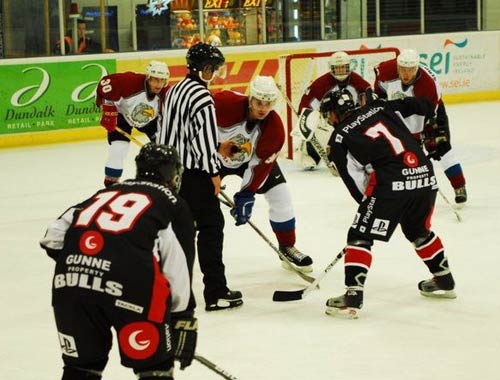
The Latvian Hawks ice hockey team faces off against the Dundalk Bulls during the season opener Sept. 15. (Photo by Guntars Bleiks, courtesy of the Latvian Hawks)
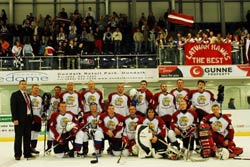
The Latvian Hawks, and some of their fans, pose for a photo. (Photo by Guntars Bleiks, courtesy of the Latvian Hawks)
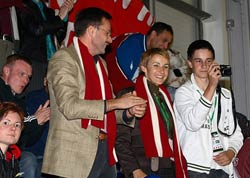
Indulis Ābelis, Latvia’s ambassador to Ireland, and his family were among fans attending the Latvian Hawks’ season opener in Dundalk. (Photo by Guntars Bleiks, courtesy of the Latvian Hawks)
