


Passersby in the Maskavas forštate neighborhood of Rīga may soon be scratching their heads, wondering why a wardrobe full of photographs, books and knick-knacks is sitting out in the open. The large piece of furniture, in fact, will be an installation by Latvian-Canadian artist Rita Beiks and her collaborator Norman Spence, both of Vancouver.
The installation will be part of “Dictatorship of the Majority,” the 2008 Rīga Sculpture Quadrennial open-air exhibition sponsored by Centre for Art Management and Information (Mākslas menedžmenta un informācijas centru, or MMIC). Beiks and Spence are two of 15 artists chosen for the international exhibition, which runs from Aug. 29 to Oct. 10.
Entitled “Time Piece,” Beiks’ and Spence’s installation will feature a wardrobe similar to one built in the 1930s or 1940s and found in many Latvian homes. On display in the wardrobe will be photographs in digital frames. The artists have sought photographs from Latvians in the diaspora, and also will be asking for contributions from residents of Maskavas forštate.
Beiks has more than a passing interest in Maskavas forštate: two of her uncles lived in the neighborhood before World War II.
“Time Piece” will be on display in Klusais dārzs, a park bounded by Jēkabpils, Daugavpils, Katoļu and Lazdonas streets.
Beiks responded to several e-mail questions.
Q: How did you and Norman Spence come up with the idea for the wardrobe as the centerpiece of the installation?
Beiks: The concept is mine. Norm will be be responsible for creating the cabinet and faux painting it to appear antique. I will fill the cabinet with the photos, frames and objects. How did I come up with the idea for the wardrobe? Well, it’s rather long and convoluted and complicated, but I will detail it here. I had received the call to artists and knew I wanted submit an idea but I couldn’t come up with one. With only two weeks to the deadline date, on March 1st, the first anniversary of my father’s passing, the idea came to me very clearly. I was at Norm’s house talking about my father, and how much we were missing him. While he sympathized, Norm was having difficulty understanding my loss, as his own father had disappeared from his life when he was just a boy, and he never had a relationship with his father like I did. Norm and Sarah (my sister-in-law) have a large fireplace mantle, with an old clock and many family photos on it, and on the wall surrounding it. Although I had seen the mantle many times before, when I looked at it that evening, I realized that this connection to family, loved ones and memory through photos is pretty much universal. Looking at the photo of Norm’s mother and father’s picture on that mantle, I realized, too, that we all have our own story. Many people’s lives didn’t turn out as they had planned, or expected, but life carries on. But at the end of the day, family is still the most important thing. We keep photos to remind us. Some years ago, working with a number of homeless folks in Vancouver on an art project, I noticed that while folks may not have a home, they carry their family with them where ever they go—in a photo or in their mind’s eye. It provides comfort on even the darkest days. I had decided to recreate a crumbling fireplace and mantle with a number of photos and other mementos. However, after speaking with my Mum, I realized that most living in Latvia, then or now, wouldn’t have had a fireplace mantle like this. So where do Latvians display their mementos? Almost everyone has a wardrobe of some type—we’d seen it ourselves at every home we visited during our visit there last summer. In fact, the image I used in the proposal comes from the apartment we stayed in in Rīga. The whole apartment was like a time capsule from 1944. The apartment itself looked like someone just left, and was coming back. It was full of personal mementos, artwork and photographs. It reminded me of home. You could feel the attachment that this apartment owner had for these items, and the love for those in the photos, so carefully placed.
Q: Do you think being of Latvian heritage had anything to do in being chosen for the quadrennial?
Beiks: I don’t know why the jury made the short list they did. We were not given any sort of feedback. However, I suspect that the story spoke to them, and I am guessing that the fact that I am of Latvian heritage would have been of interest to them. The artwork also refers specifically to the Maskavas forštate neighborhood, and Latvia as a whole. I assume that a number of the other sculptures will be more general in nature, and may not reference at all the history of the neighborhood or even specifically relate to where the work is situated. Ours very clearly will, and this too may have been of interest. As listed on the Quadrennial Web site, “The event intends to foster understanding and links between the centre and periphery in contemporary art. The Sculpture Quadrennial Rīga 2008 aims at breaking down elitism in art and culture space through openness and culture accessibility, involving groups of the society whose environment rarely is a site for contemporary art practice. The main interests of the event are emotions and lifestyle of the residents of marginal and disadvantaged city areas instead of the identification of a particular city space.” I think our piece speaks to this desire as well, and fit their mandate.
Q: Where exactly will the installation be placed?
Beiks: Norm is in Rīga already, and working on constructing the cabinet. We have yet to determine where exactly in the Klusais dārzs it will be located. We are utilizing solar panels to help power the electronic photo frames, so we are looking for an open area, accessible to light. We hope to be near Lielā Kalna and Daugavpils iela (in the southeast corner of the park—ed.).
Q: Your proposal addresses how the wardrobe will be protected from the elements. What about security? Maskavas forštate, unfortunately, has a reputation of being a rough neighborhood. Do you have any concerns that the wardrobe might just disappear?
Beiks: Yes, we do have concerns about the security of the piece. We will have the unit anchored in concrete, if possible, and the photo frames and other items will be behind a tough plastic material called Lexan that is almost impossible to break through. I am hoping, too, that if people from the neighborhood contribute photos to the project, that there will be some ownership and pride in the work which will help to protect it. Of course, after all this, if someone really wants to destroy it or remove it, they will. I feel it will almost be part of the work. However, we do have it in our agreement with the MMIC that we will have to repair any damage that may happen to the work during the exhibition, and replace it if needed. (Difficult to do from Canada!) We of course won’t be able to replace the unit if it gets totally destroyed either. The budget just won’t allow for it. We are contributing significantly from our own resources to be able to do this, so we certainly hope that the unit will survive for the 6 weeks. The agreement also allows MMIC to hold back 70 percent of the payment until the end of the project, to ensure that we fulfill our obligations. So, yes, we are praying that it survives! Once the Quadrennial is over, we are considering donating the piece to some community organization or seniors home.
Q: What progress have you made in collecting photographs? Will contributors of photographs be somehow acknowledged?
Beiks: I have begun to receive some photos through a posting on the Latvians Online forum. I have collected many photos from family and other Latvians here in Vancouver and in Toronto. I originally said that names will not be used in the work, but I am now thinking that if people would allow it, I will have a list of credits at the end of the slide show with names of the photo contributors and names of those pictured. I think it would be interesting to see, and where they are from.
Q: What progress have you made in obtaining photographs from the Maskavas forštate community?
Beiks: None as of yet. I will be spending time in the community prior to installation to solicit participation. Trying to make a connection within the community needs to be done in person.
Further information on the 2008 Rīga Sculpture Quadrennial is available by visiting www.sculpturequadrennial.lv. Persons interested in submitting photographs for the installation may e-mail Beiks at egc@shaw.ca.
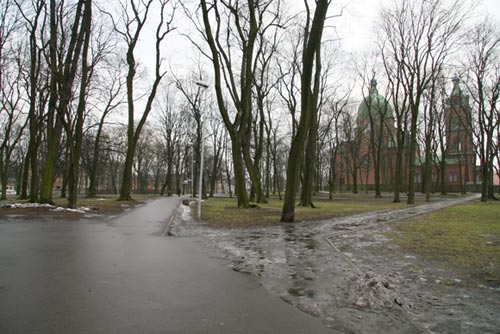
Klusais dārzs, a park in the Rīga neighborhood of Maskavas forštate, will be the site for Rita Beiks’ and Norman Spence’s art installation. (Photo courtesy of the Centre for Art Management and Information)
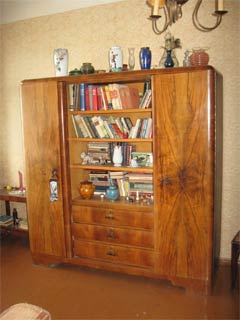
A wardrobe similar to this will be the foundation for “Time Piece,” an art installation by Rita Beiks and Norman Spence to be exhibited in Rīga. (Photo courtesy of Rita Beiks)
