Latvia blasts Russian decision on Georgian regions

Latvian President Valdis Zatlers has strongly condemned Russia’s decision to recognize the independence of Georgia’s breakaway regions of Abkhazia and South Ossetia, the president’s press office announced Aug. 26.

Russia’s decision is in open contradiction to the United Nations Charter, U.N. Security Council resolutions and the 1975 Helsinki Final Act of the Conference on Security and Cooperation in Europe, Zatlers said.

Russian President Dmitry Medvedev—referring to the same documents cited by Zatlers—said he supports the decision of his country’s Federation Council and State Duma to recognize Abkhazia and South Ossetia. The two regions in the north of Georgia share borders with Russia.

Medvedev, in an Aug. 26 statement, blamed Georgia for the latest conflict. Russian forces invaded Georgia on Aug. 9, a day after the Georgian military began an operation to regain control over South Ossetia. Russia says some of its peacekeepers stationed in South Ossetia were killed in the Georgian attacks.

“It stands quite clear now: a peaceful resolution of the conflict was not part of Tbilisi’s plan,” Medvedev said. “The Georgian leadership was methodically preparing for war, while the political and material support provided by their foreign guardians only served to reinforce the perception of their own impunity.”

Zatlers, however, said Russia’s decision is a gross violation of Georgia’s independence, sovereignty and territorial integrity. Latvia will continue to support Georgia’s territorial integrity and the Georgian people’s desire to see their country join the European Union and the NATO defense alliance, the president said.

Latvian Foreign Minister Māris Riekstiņš also blasted Medvedev’s decision and called for a political solution to the conflict.

Zatlers was not alone among European leaders in condemning Russia’s recognition of Abkhazia and South Ossetia. German Chancellor Angela Merkel, on a visit to Estonia, joined Estonia President Toomas Hendrik Ilves in calling Russia’s actions an “illegal aggression against a sovereign nation,” according to the president’s press office. Later in the day, similar statements were made whe Merkel traveled to Lithuania to meet with President Valdas Adamkus.

“The withdrawal of Russian troops and the presence of EU peacekeepers,” Adamkus said, “would help regulate the conflict in Georgia.”
Andris Straumanis is a special correspondent for and a co-founder of Latvians Online. From 2000–2012 he was editor of the website.

Emigration from Latvia rising again, data show

Emigration from Latvia to other countries appears to be on the upswing this year after slowing in 2007, according to data provided by the Central Statistical Bureau in Rīga. At the same time, immigration continues to increase, although the net result is still a loss in population.

In the first six months of this year, 2,752 persons emigrated from Latvia compared to 2,110 during the same period in 2007, an increase of 30.4 percent.

Emigration from Latvia has been an up and down affair for the past decade. The most recent spike in emigration was in 2006—two years after Latvia joined the European Union—when a total of 5,252 people left the country. Last year, a total of 4,183 persons emigrated, but if the trend recorded in the first half of this year continues, the final number for 2008 could be higher again.

On the other hand, immigration to Latvia in the first half of this year jumped more than 33 percent over the same period in 2007. From January through June of last year, 1,410 persons came to live in Latvia. Through June of this year, 1,878 had immigrated.

From 1998 through 2003, immigration to Latvia declined steadily. But in 2004 the trend reversed. Last year, a total of 3,541 came to live in Latvia, an increase of 26.4 percent over 2006, when 2,801 persons immigrated to the country.

During the first half of this year, the difference between emigration and immigration resulted in a net loss of 874 persons, according to the Central Statistical Bureau. The net loss for all of 2007 was just 642 persons.

The population of Latvia in June stood at 2.266 million.

Andris Straumanis is a special correspondent for and a co-founder of Latvians Online. From 2000–2012 he was editor of the website.

Referendum records just 1,000 votes abroad

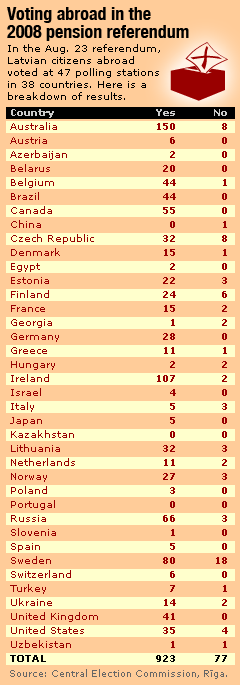
Just 1,000 citizens abroad—less than half the number who voted at the beginning of the month—cast ballots in person or by mail in the Aug. 23 referendum on changes to Latvia’s pension law.

The referendum, which would have raised the minimum retirement benefit in Latvia to LVL 135 per month, failed by more than 105,000 votes. Across Latvia, polling stations reported relatively low turnout.

Provisional results reported by the Central Election Commission in Rīga also show low voter activity at the 47 polling stations that operated in 38 countries outside of Latvia. Two stations, in Kazakhstan and Portugal, reported no voters at all. The polling station in the Latvian Embassy in Beijing reported just one vote, despite the fact that a number of Latvian athletes and fans were still in China for the Olympics.

Of the 1,000 votes recorded abroad in the pension referendum, 92.3 percent were in favor of the amendments to the pension law. Overall, 96.15 percent of those who voted in Latvia and abroad supported the changes. But supporters needed at least 453,730 voters to cast ballots—half the number who participated in the last Saeima election—for the referendum to count.

Voters in Australia were the most active, casting a total of 158 valid ballots across the three polling stations in Adelaide, Melbourne and Sydney, according to the Central Election Commission. But the most active single polling station abroad was the one in Dublin, the only one in Ireland, where Latvians cast 109 votes.

Besides Australia and Ireland, the most active countries outside Latvia were Sweden with a total of 98 votes cast, Russia with 69 (from four polling stations) and Canada with 55 (from two polling stations).

Latvians in the United States, who usually have been relatively active in Saeima elections and referendums, showed little interest in the pension issue and cast just 39 ballots at the polling stations in New York and Washington, D.C.

During the Aug. 2 referendum on constitutional amendments to give citizens the right to initiate a recall of the Saeima, a total of 2,315 ballots were cast abroad by mail or in person.

Pension referendum results

Andris Straumanis is a special correspondent for and a co-founder of Latvians Online. From 2000–2012 he was editor of the website.