Ireland’s allure may be dimming for Latvian migrants

The count of Latvian residents seeking identification numbers in Ireland continued to decrease last year, according to government statistics released Jan. 6. This is perhaps an indication that the allure of the “Celtic Tiger” for Latvian migrants is wearing off as Ireland’s economy worsens.

A total of 3,727 Latvian residents were issued Personal Public Service Numbers (PPSN) in 2008, according to the Irish Department of Social and Family Affairs. That is a drop of 20 percent from 2007 and is the third year in a row that the number has decreased.

PPSNs are used in transactions between individuals and government agencies in Ireland. They were introduced in 1998.

Since mid-2000, a total of 38,786 residents of Latvia have been issued the identification numbers. The figure is perhaps the closest estimate of the total Latvian population in Ireland, although possessing a PPSN does not necessarily mean the person is still living in Ireland.

The greatest number of PPSNs issued to Latvian residents—a total of 9,328— was in 2005, the year after Latvia joined the European Union and travel to Ireland became easier. Since then the number has decreased every year.

The once-booming Irish economy has been hit hard by the global financial crisis. The unemployment rate rose throughout 2008 and stood at 7.8 percent in November.

Estonian residents were issued 572 PPSNs last year, while Lithuanians got 6,443, according to the Irish Department of Social and Family Affairs.
Andris Straumanis is a special correspondent for and a co-founder of Latvians Online. From 2000–2012 he was editor of the website.

Integration secretariat disappears as 2008 ends

Latvia’s integration secretariat, the work of which included support for diaspora communities, disappeared with the close of 2008 as part of the government’s reorganization in the face of emergency budget-slashing. Its functions now will be handled by the Ministry for Children and Family Affairs, which now will be known as the Ministry for Children, Family and Social Integration Affairs.

The secretariat was known by the acronym ĪUMSILS, short for Īpašu uzdevumu ministra sabiedrības integrācijas lietās sekretariāts. Its budget included grants for the developement and maintenance of diaspora organizations.

Oskars Kastēns, the at times controversial special assignments minister for social integration affairs, will return to the Saeima where he represents the First Party of Latvia (Latvijas Pirmā partija). ĪUMSILS staff has been laid off or transferred to the Ministry for Children, Family and Social Integration Affairs. ĪUMSILS Director Juris Asars declined a position in the ministry as assistant state secretary, according to Cabinet of Ministers documents.

The Cabinet of Ministers approved amended regulations Dec. 16 that lay out new duties for the Ministry for Children, Family and Social Integration Affairs, but those do not explicitly mention work with the Latvian diaspora.

A new Department of Social Integration will be formed in the ministry, according to a Dec. 30 e-mail to diaspora organizations sent by Dana Heiberga, who headed the ĪUMSILS section for support of Latvians abroad. Heiberga, however, is not continuing her work in the ministry.

At the core of ĪUMSILS’ work with the diaspora was a five-year plan, beginning in 2004, to offer financial support for ethnic organizations. In 2007, for example, ĪUMSILS granted more than LVL 127,000 for 61 different projects proposed by nongovernmental organizations in 16 countries.

The secretariat was created in 2002. The first special assignments minister for social integration affairs was Nils Muižnieks, a Latvian born in the United States. Others who have held the post are Aivars Aksenoks, Ainars Latkovskis and Karina Pētersone.

Andris Straumanis is a special correspondent for and a co-founder of Latvians Online. From 2000–2012 he was editor of the website.

English-language book tells story of Latvian

A book for foreign audiences that tells the story of Latvian language policy has been released by the State Language Commission in Rīga.

The 400-page English-language book, Break–out of Latvian, is described as the first broad and important study of the status of Latvian in Latvia, a spokesperson for President Valdis Zatlers said in a Dec. 22 press release. The language commission, formed in 2002, reports to the president.

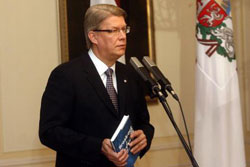
“Every book that shows how close and dear the Latvian language is for us is a success,” Zatlers said during presentation of the new title, according to the press release. “We have to tell that to the world.”

The book is based on a sociolinguistic study and describes the development of the Latvian language during the nation’s years of independence.

Break–out of Latvian is published by the academic publisher Zinātne.

President Valdis Zatlers

President Valdis Zatlers speaks Dec. 22 during presentation of the book Break–out of Latvian. (Photo courtesy Chancery of the President of Latvia)

Andris Straumanis is a special correspondent for and a co-founder of Latvians Online. From 2000–2012 he was editor of the website.