In the aftermath of the Jan. 13 riot in the heart of Rīga, President Valdis Zatlers has issued an ultimatum to the parliament: Pass a constitutional amendment allowing for the popular recall of the Saeima, or he will call for its dissolution.
Zatlers, in a Jan. 14 press conference, gave the Saeima until March 31.
The president’s response to the previous night’s unrest in Rīga’s Old Town district came after his return from a European Parliament meeting in France and after consultations with Latvian government and police officials.
While he condemned the unrest, Zatlers also said it is evidence of how low the public’s confidence in the government has sunk.
“Both the Saeima and the Cabinet of Ministers have lost contact with the voters,” he said during the press conference. “I have already several times pointed out that trust can only be regained with specific actions.” Among those, he added, are amending the constitution to allow for the popular recall, work on an economic stimulus plan and government reform.
By midday Jan. 14 much of the damage from the riot had been cleaned up, Latvians Online observed. Businesses and government offices along Smilšu Street were particularly hard hit, including a Latvijas Balzams liquor store that was looted.
Along Jēkaba Street, a work crew was busy repairing windows at the Latvian National Library’s Letonika Division. The building was closed to patrons, a sign in Latvian and English telling visitors that windows and computers were damaged by rioters.
The Saeima building by midday showed little outward damage. Broken window panes had been replaced, but pockmarks from bricks thrown at the building the night before were still visible. Local and military police patrolled the area on foot.
The rioting began about 7 p.m. Jan. 13 after the close of a peaceful demonstration that drew an estimated 10,000 protesters to the Dome Square. The demonstration was organized by the political party Sabiedrība citai politikai to call on the president to release the Saeima.
Under the Latvian constitution, the president can initiate dismissal of the parliament. A national referendum then must be held. If it passes, the Saeima is dissolved and an election for a new parliament is organized. But if the referendum fails, the president must step down and the parliament chooses a new chief of state.
In his Jan. 14 press conference, Zatlers gave the parliament and the government three assignments:
- Pass amendments to the constitution that allow for the popular recall of the Saeima. He said he would present a bill to the Saeima within a week.
- Change the election law to address two specific problems. First, because Latvians can vote for just one party’s list of candidates, the “locomotive problem” allows a few well-known politicians to pull into parliament deputies who are not known by voters. Second, 10 percent of the Saeima’s 100 deputies are no longer members of the parties from which they were elected, resulting in parties being represented that did not stand in the last election.
- The Saeima as quickly as possible must create a board to oversee Latvia’s economic development plan and the EUR 7.5 billion in loans the country is getting from the International Monetary Fund, the World Bank and others.
Zatlers said he also wants the Cabinet of Ministers to present a clear government reorganization plan in one to two weeks.
“Only with these specific assignments can we calm the public and give it a little bit of hope that the process in the country is headed in the right direction,” the president said. “This time I am clearly stating a deadline for completion of these assignments. It is one thing to work, but something completely different to work effectively with results—to work with results demanded by the public, results that serve the public. This time the deadline is March 31.”
Meanwhile, the leader of Rīcības partija (formerly known as Eiroskeptiķi) announced his group is planning a demonstration at noon Jan. 17 at the Saeima, follwed by a march to the Castle of Rīga, which is the president’s official residence. Normunds Grostiņš, in a message on the party’s Web site, called for the government of Prime Minister Ivars Godmanis to step down.
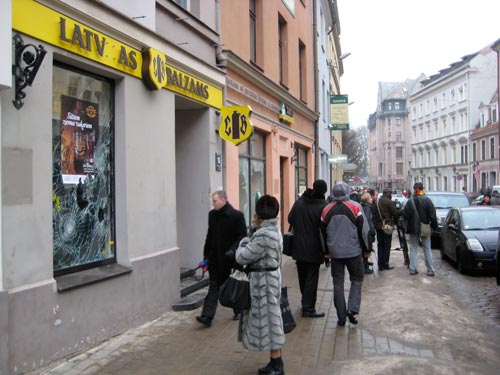
Passers-by and journalists inspect the Latvijas Balzams store on Smilšu Street in Rīga’s Old Town district. The store had its windows smashed and was looted by rioters Jan. 13. (Photo by Andris Straumanis)
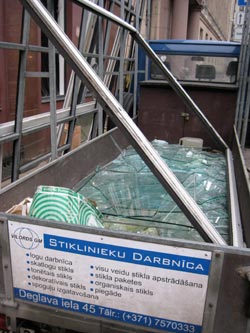
A window repair company’s truck was filled with broken glass from the State Treasury building on Smilšu Street. (Photo by Andris Straumanis)
Andris Straumanis is a special correspondent for and a co-founder of Latvians Online. From 2000–2012 he was editor of the website.


