Latvia shuts out Austria, advances in tournament

Following a 2-0 victory over Austria, Latvia has advanced to the qualifying round of the International Ice Hockey Federation’s World Championship and will next face hometown team Switzerland.

The game was played before a crowd of about 5,200 hockey fans in the PostFinance Arena in Bern.

Latvia got its first goal with just 45 seconds left in the first period, according to a game summary posted on the IIHF’s Web site, www.iihf.com. Mārtiņš Cipulis shot the puck past Austrian goalkeeper Bernd Bruckler. Herberts Vasiļjevs and Kārlis Skrastiņš were credited with the assist.

The two sides went scoreless through the second period. With just more than five minutes left to play in the third period, Latvia’s Guntis Dzeriņš made it 2-0 with help from Miķelis Rēdlihs.

Latvia had 37 shots on goal, compared to 21 for Austria. Edgars Masaļskis guarded Latvia’s goal.

Latvian players earned a total of 31 minutes in the penalty box, compared to Austria’s 18.

With the victory, Latvia finished third in its preliminary round group. The United States was first and Sweden second. Austria, last in the group, will be sent to the relegation round.

Latvia will go up against Switzerland in a game scheduled at 20:15 hours Swiss time April 30.

Andris Straumanis is a special correspondent for and a co-founder of Latvians Online. From 2000–2012 he was editor of the website.

Latvia could advance in hockey championship

If Austria plays as poorly as it has so far, Latvia should have little trouble advancing out of the preliminary round of this year’s International Ice Hockey Federation’s World Championship underway in Berne, Switzerland.

Latvia, with a 1-1 record, faces 0-2 Austria on April 29. If Latvia wins, it will advance to the qualifying round.

Latvia already has gone up against the United States, losing the April 25 game 4-2, and upset Sweden on April 27 in a 3-2 shootout victory.

Austria, on the other hand, has been clobbered 7-1 by Sweden and 6-1 by the U.S.

In its game against the U.S., Latvia was the first to score, according to a game summary posted on the IIHF Web site, www.iihf.com. Four minutes, 40 seconds into the first period, Herberts Vasiļjevs scored on a power play with assistance from Aleksandrs Niživijs and Mārtiņš Cipulis. America’s Jack Johnson answered at 11:15 with help from John Michael Liles and Kyle Okposo.

At 6:39 into the second period, Mārtīņš Karsums scored Latvia’s second goal with assistance from Ģirts Ankipāns and Jānis Sprukts. But less than five minutes later Drew Stafford tied the score for the U.S. and then Johnson made it 3-2.

Patrick O’Sulllivan, aided by Ron Hainsey and Dustin Brown, added one more goal for the U.S. during the third period.

For the game, the U.S. had 38 shots on goal against Latvia’s netminder Edgars Masaļskis, while Latvia tried 20 times to score against America’s Robert Esche. Both teams accumulated 8 minutes in the penalty box.

During last year’s World Championship in Halifax, Canada, the U.S. beat Latvia 4-0 in the preliminary round.

Latvia did not get a chance to play Sweden last year, but this week surprised its opponents with a 3-2 victory.

The Swedes got on the scoreboard first, according to the IIHF game summary, when Linus Omark score at 15:26 into the first period. He was assisted by Johan Harju and Martin Thornberg.

The Latvians answered twice during the second period, making the score 2-1. At 10:20 Krišjānis Rēdlihs shot the puck past Swedish goaltender Stefan Liv, aided on the power play by Ankipāns and Karsums. About nine minutes later Lauris Dārziņš scored with help from Miķelis Rēdlihs and Rodrigo Laviņš.

Sweden tied it up at 10:44 into the third period when Magnus Johansson, helped by Loui Eriksson, took advantage of a power play to score against Latvia’s Masaļskis.

That took the game into overtime, but when neither team scored, into a shootout that Latvia won 3-2.

For the game, Latvia had 22 shots on goal to Sweden’s 40. Latvian players spent 10 minutes in the penalty box compared to the Swedes’ six.

Last year in Halifax, Latvia almost made it to the quarter-finals, but finished 11th overall. Russia won the 2008 championship.

Andris Straumanis is a special correspondent for and a co-founder of Latvians Online. From 2000–2012 he was editor of the website.

Student seeks help researching images of exile

A graduate student from Canada is asking members of the Latvian diaspora to help her research into how Soviet propaganda molded the image of the exile community.

Kristīna Paukšēns, who is pursuing a master’s degree—her second—at the University of Latvia, has been distributing a questionnaire to Latvians outside of the homeland as part of her study.

“My primary goal,” Paukšēns told Latvians Online in an e-mail, “is to examine what sort of negative ‘propaganda’ image the Soviet regime created about the exile community of Latvians; what image the exile community held of Soviet Latvia; and, finally, what image Latvians in Latvia had of their relatives in exile. I am determining if any of these images matched reality, as understood by my questionnaire respondents.”

Paukšēns, who was born in Toronto, has a bachelor’s degree in international relations and a master’s degree in history, both from the University of Toronto. It was there that she was exposed to Latvian history.

“I was especially interested in the dainas, folklore, the 1905 Revolution, and in exile memoirs—both exile in Siberia, and in the West,” Paukšēns said.

Her first trip to Latvia was in 2005, when she traveled there with her grandmother, father and aunt.

“We traveled all across Latvia, met many wonderful relatives, and saw all the places related to the history of my family on this very emotional trip,” Paukšēns said. “I became very interested in Latvia’s history, and I decided that I would like to study it more formally.”

That led her to pursue a master’s degree from the interdisciplinary Baltic Sea Region Studies program at the University of Latvia. Paukšēns lived in Rīga for 1.5 years while studying at the university and working at The Baltic Times newspaper. Because she was not taught Latvian while growing up, Paukšēns said, she also used the time to hone her language skills. She also got involved with a folk dance group and a choir, and sang in last summer’s Latvian Song and Dance Celebration in Rīga.

Now back in Toronto, she has become involved with the folk dance troupe Diždancis and is looking forward to participating in the Latvian Song Festival in Canada, set July 1-5 in Hamilton.

She also is continuing her research, which she said was in part inspired by the 1999 novel The Embrace, by Lithuanian-Canadian writer Irene Guilford. The book is about two Lithuanian brothers separated by World War II, one in the West and one in the homeland.

“And also, I was greatly inspired by my elderly aunt in Limbaži, who is a Siberia survivor, and who I got to know very closely during my time in Latvia,” Paukšēns added. “Her relationship with my grandmother—mostly through letter writing—across the Iron Curtain, was nevertheless very powerful and important to both of them, and it drew me to the idea of studying relationships between the two communities.”

Besides the questionnaire distributed to Latvians in the diaspora, Paukšēns’ research also is relying on surveying Latvians in the homeland; examining several newspapers published in Displaced Persons camps in Germany, in occupied Latvia, and in the West; and reading memoirs, a novel and Soviet-era history books. 

Paukšēns asks that responses to her Latvian-language questionnaire be returned by May 10.
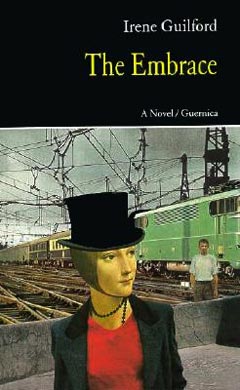
The Embrace

Lithuanian-Canadian writer Irene Guilford’s 1999 novel The Embrace served as inspiration for Kristīna Paukšēns research.

Andris Straumanis is a special correspondent for and a co-founder of Latvians Online. From 2000–2012 he was editor of the website.