Latvian government agrees on more deep budget cuts

The Latvian government has reached agreement on a further LVL 500 million in budget cuts, a move observers say should save it from bankruptcy and clear the way for an international loan to be released to the country.

The sweeping cuts appear to touch everyone, from government ministries and their employees, to retired persons, to those who like a stiff drink or a chance at the roulette table.

The cuts are on top of amendments to the state budget approved last year that trimmed the size of the government work force, reduced salaries of those remaining and increased taxes—including bumping the value added tax to 21 percent.

The government, led by Prime Minister Valdis Dombrovskis, signed off on the cuts June 11 after meeting with representatives from various political parties and social partners including labor unions, employers and pensioners. The cuts are needed if Latvia is to receive the next installment from a EUR 7.5 billion loan package offered by the International Monetary Fund, the World Bank, the European Union and others.

The Saeima may vote on the cuts June 15, according to media reports.

Government operations would take the brunt of the cuts.

The budget foresees a 30 percent reduction in the central administration of government ministries, as well as a halving of expenses from state agencies. The boards of directors of state enterprises would be eliminated. Training of civil servants would be halted and the Latvian School of Public Administration’s functions decreased. The work of a state commission to determine losses caused by the Soviet Union’s occupation (Komisijas PSRS režīma nodarīto zaudējumu aprēķināšanai) would cease on Aug. 1.

In addition to overall cuts in spending for services and goods, a number of ministries would see their budgets reduced. Among these are the Ministry of Finance, LVL 46.1 million; the Ministry of Health, LVL 45 million; the Ministry of Agriculture, LVL 23.8 million; the Ministry of Defense, 15 million; the Ministry of Education and Science, 10 million; and the Ministry of the Interior, LVL 9 million.

Besides cuts to government operations, social spending also is to see a decrease of more than LVL 90 million. Pensions would be cut by 10 percent, pensions for those who are working would plummet by 70 percent and support for parents and families would shrink by 10 percent.   
   
The cuts are to be offset by more than LVL 50 million in additional revenue, according a press release from the Cabinet of Ministers. The state budget would take a larger share of dividends from state enterprises, 80 percent of last year’s profit, except for energy company Latvenergo, which has to turn over 100 percent. The budget projects this will raise LVL 8.8 million. A higher excise tax on beer and liquor would result in LVL 3.8 million more in revenue. The minimum untaxed personal income would drop to 35 lats from 90 lats, resulting in LVL 43.8 million more for the government. Gambling duties and taxes would be increased, too.

After a June 8 meeting with the government coalition and social partners, President Valdis Zatlers told reporters that as soon as the changes to this year’s budget are approved, work will begin on cutting another LVL 500 million in next year’s budget.

Dombrovskis and Zatlers

Latvian Prime Minister Valdis Dombrovskis (left) and President Valdis Zatlers speak after the government signed off on a plan to slash spending. (Photo by Aivis Freidenfelds, State Chancellery of Latvia)
Andris Straumanis is a special correspondent for and a co-founder of Latvians Online. From 2000–2012 he was editor of the website.

New 1-lat coin features Namejs ring

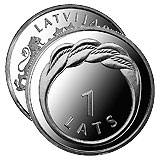
A new 1-lat coin depicting the traditional Namejs ring (Nameja gredzens), often viewed as a symbol of one’s ethnicty, has been put into circulation by the Bank of Latvia.

The coin, made of a copper-nickel alloy, is part of a series of 1-lat coins that have depicted various signs, images and events important to Latvian culture.

The braided ring depicted on the reverse of the new coin is a design that goes back centuries, according to a June 8 press release from the Bank of Latvia.

“This type of ring was named after the Semigallian chieftain Namejs only in the 1930s when two such rings were found in the Daugmale castle mound and they became favorites for replication and wearing,” according to the press release.

Today, the ring “has come to signify that the wearer has some relationship to Latvia: even if he or she belongs to a different nation, it is evidence that they have some connection with the Latvian land or culture,” according to the press release.

The obverse of the ring displays the coat of arms of Latvia.

The coin was designed by Ilze Libiete and the plaster model was made by Baiba Sime, both of whom are marking their debut in coin design. The coin was minted by Staatliche Münze Berlin in Germany.

A total of 1 million of the new coins were minted, according to the Bank of Latvia.

Nameja lats

The reverse of the new 1-lat coin features a Namejs ring.

Andris Straumanis is a special correspondent for and a co-founder of Latvians Online. From 2000–2012 he was editor of the website.

Data on Europarliament vote abroad mingled with prisoners’ ballots

How Latvian citizens abroad voted for the country’s European Parliament representatives may never be known, because their ballots were mixed in with those of prisoners who also voted by mail, according to the Central Election Commission in Rīga.

Before the June 6 election, a total of 1,532 requests for absentee ballots were received from abroad, according to the election commission. By 10 p.m. June 6, when polls closed in Latvia, just 1,096 completed ballots from abroad had been received in Rīga. However, the total number of mail ballots counted in the election is much greater: 4,079.

“In this election incarcerated voters could also participate in the European Parliament election by mail,” election commission spokeswoman Kristīne Bērziņa told Latvians Online in an e-mail. The mailed ballots from prisoners were put in the same box with mailed ballots from citizens abroad. Ballots within in a specific precinct are not allowed to be divided into separate groups.

All mail ballots were processed in Precinct 999 in Rīga, which was set up just for that purpose.

“As a result, it is not possible to determine how exactly voters abroad voted,” Bērziņa said.

What the results do show is that among all mail ballots in the European Parliament election, 19.29 percent of the vote went for the socialdemocratic Harmony Centre (Saskaņas Centrs). The pro-Russian For Human Rights in United Latvia (Par cilvēka tiesībām vienotā Latvijā) came in second with 17.48 percent. Third was the reformist Civil Union (Pilsoniskā savienība) with 16.52 percent of the vote.

Overall provisional results for the Europarliament vote showed that Civil Union came out on top, earning two seats plus one “phantom” seat, while Harmony Centre came in second and earned two seats, according to the election commission. In all, Latvian voters elected eight members of the European Parliament plus one “phantom” representative.

Other results for the mailed ballots showed New Era (Jaunais laiks) with 9.63 percent; the First Party of Latvia (Latvijas Pirmā partija / Latvijas ceļš), 5.66 percent; For Fatherland and Freedom (Tēvzemei un Brīvībai / LNNK), 4.49 percent; the Union of Greens and Farmers (Zaļo un Zemnieku apvienība), 4.36 percent; the People’s Party (Tautas partija), 3.46 percent; the Latvian Socialdemocratic Workers’ Party (Latvijas Sociāldemokrātiskā strādnieku partija), 3.36 percent); Visu Latvijai! (All for Latvia), 3.04 percent; For the Motherland (Par Dzimteni), 2.89 percent; the Society for a Different Politics (Sabiedrība citai politikai), 2.43 percent; Libertas.lv, 1.89 percent; the Osipov Party (Osipova partija), 1.67 percent; the Renaissance Party of Latvia (Latvijas Atdzimšanas partija), 0.98 percent; the Christian Democratic Union (Kristīgi demokrātiskā savienība), 0.91 percent; and the Action Party (Rīcības partija), 0.66 percent.

(Updated with explanatory text in second paragraph and with total number of completed ballots received from abroad.)

Andris Straumanis is a special correspondent for and a co-founder of Latvians Online. From 2000–2012 he was editor of the website.