New U.S. ambassador takes oath, meets with ALA officials

The new U.S. ambassador to Latvia, Judith Garber, has taken her oath of office and is expected to travel to Rīga on Aug. 24 to present her credentials to President Valdis Zatlers, according to the American Latvian Association (ALA).

Garber, who was confirmed by the U.S. Senate late last month, was sworn in Aug. 14 during a ceremony in the State Department in Washington, D.C.

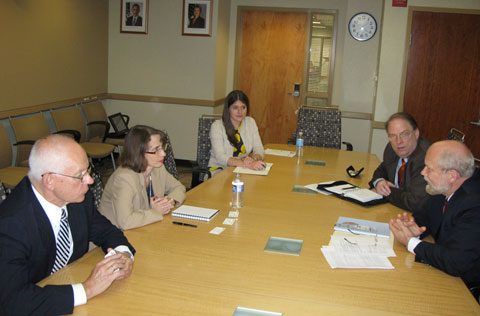
Representatives of the ALA—including Chairman Juris Mežinskis, Public Affairs Director Jānis Kukainis, Treasurer Gustavs Plato and Executive Director Raits Eglītis—met with Garber a day before the ceremony. They discussed diplomatic issues, including U.S. and Latvian cooperation in political, economic and military affairs, U.S. relations with Russia, economic concerns, and how Latvian-Americans can help.

Garber emphasized that U.S. policy toward the Baltic states will remain unchanged under the administration of President Barack Obama. The U.S. values Latvia as a strategic partner, Garber said, according to an ALA press release.

During her term as ambassador, Garber told the ALA representatives, she will try to understand and build bridges between Latvians and Latvia’s Russian speakers.

The new ambassador also told ALA representatives that she is convinced Latvia will soon overcome its economic crisis and will learn from the experience. In the global recession, Latvia has been one of the worst-hit European countries. Its government has been forced to make deep cuts in the national budget to avoid bankruptcy.

Garber is the seventh U.S. ambassador to Rīga since Latvia regained independence in 1991. She is a career diplomat who most recently served as a deputy assistant secretary in the State Department’s Bureau of European and Eurasian Affairs.
Description of image

The new U.S. ambassador to Latvia meets with representatives of the American Latvian Association in Washington, D.C. From left to right are ALA Public Affairs Director Jānis Kukainis, Ambassador Judith Garber, State Department intern Anna Grants, ALA Treasurer Gustavs Plato and ALA Chairman Juris Mežinskis. (Photo courtesy of the American Latvian Association)

Andris Straumanis is a special correspondent for and a co-founder of Latvians Online. From 2000–2012 he was editor of the website.

Embassy in Ireland warns Latvian women to be wary of job offers

Latvian citizens, especially young and unmarried women, should carefully evaluate job offers found on the Internet, the Latvian Embassy in Ireland has warned in response to increasing reports of problems.

The Dublin-based embassy is getting frequent reports from women who are being pressured to enter into fictitious marriages in exchange for the promise of a job. Some are being offered work as prostitutes, according to the Aug. 3 warning.

With the unemployment rate in Ireland now at 11.6 percent, finding work is very difficult, the embassy warned.

Since 2000, the Irish Department of Social and Family Affairs has issued more than 40,500 Personal Public Service Numbers to Latvian nationals who have moved to Ireland. The numbers, which are used in transactions between individuals and government agencies, serve as one indication of how many Latvian nationals have migrated to Ireland, even if temporarily.

The embassy’s warning names the popular Latvia-based social networking site draugiem.lv as one Internet portal where it would be wise to carefully evaluate job offers.

If an offer is received to enter into a fictitious marriage or to work as a prostitute, the embassy recommends contacting the Garda—the Irish police—on the emergency lines 999 or 112, on 1890 610 710 or on the Garda Confidential Line, 1800 666 111. Female victims of violence may contact the nongovernmental organization Ruhama on +353 1 836 0292. The embassy may be reached on +353 1 428 33 20.

Andris Straumanis is a special correspondent for and a co-founder of Latvians Online. From 2000–2012 he was editor of the website.

On eve of 20th anniversary, Baltic Way added to UNESCO register

The Baltic Way, a 600-kilometer-long human chain of Estonians, Latvians and Lithuanians joining hands in protest of the 50th anniversary of the Molotov-Ribbentrop Pact of 1939, has been added to UNESCO’s Memory of the World Register.

The Aug. 23, 1989, event was “a unique and peaceful demonstration that united the three countries in their drive for freedom,” according to a July 30 UNESCO press release announcing the addition of the Baltic Way and 34 other documentary properties to the world register. The announcement comes three weeks before the 20th anniverary of the demonstration.

UNESCO is the United Nations Educational, Scientific and Cultural Organization.

Between 1 million and 2 million people participated in the Baltic Way demonstration, which was organized by the national movements of the three republics: the Popular Front of Estonia Rahvarinne, the Popular Front of Latvia (Tautas Fronte) and the Lithuanian Reform Movement Sąjūdis, according to the Latvian National Commission for UNESCO.

The non-aggression pact was signed by the Soviet Union’s Foreign Minister Vyacheslav Molotov and Nazi Germany’s Foreign Minister Joachim von Ribbentrop. The pact included a secret protocol that carved up Eastern Europe between the two powers

“The objective of the Baltic Way was to gain open acknowledgement of these historic decisions that for a long time had been kept as secret sources deciding the world’s history,” Baltic archivists wrote in their application to UNESCO. “The Baltic Way—an act of solidarity, an act of protest without violence—was a living example of the culture of peace, leading to the open acknowledgement of the secret protocols and their hideous consequences.”

The demonstration gained wide media coverage in Europe and North America.

Documentation of the Baltic Way is found in the National Archives of Estonia, the Museum of the Popular Front of Latvia and the Lithuanian Central State Archive, according to the archivists’ application.

The Baltic Way is the second Latvian-related documentary property to be added to the Memory of the World Register. In 2001, folklorist Krišjānis Barons’ dainu skapis, a specially built cabinet containing tens of thousands of Latvian folk song texts, was added to the list.

Since the UNESCO Memory of the World Register was begun in 1997, a total of 193 documentary properties have been added to the list.

Although the Baltic archivists did not suggest that documentary evidence of the Baltic Way is at immediate risk, the Memory of the World Register program does offer assistance and advice on how best to safeguard valuable archives and to disseminate them to a wider audience.

Andris Straumanis is a special correspondent for and a co-founder of Latvians Online. From 2000–2012 he was editor of the website.