Irish data suggest migrants from Latvia jumped 5% in 2009

New applications for identification numbers by Latvian residents who have moved to Ireland jumped by more than 5 percent from 2008 to 2009, according to figures compiled by the country’s Department of Social and Family Affairs.

A total of 3,916 applications for a Personal Public Service Number (PPSN) were processed last year for immigrants from Latvia, up from the 3,727 issued in 2008. The increase suggests that migration from Latvia to Ireland is on the upswing.

However, the number of new PPSN applications is far less than in previous years. The greatest number of PPSNs issued for immigrants from Latvia was in 2005—a total of 9,328.

The PPSN is a unique customer reference number used for transactions between individuals and Irish government departments, as well as other public service providers.

Since June 2000, Ireland’s Department of Social and Family Affairs has issued more than 42,700 PPSNs to immigrants from Latvia. PPSNs issued to immigrants from Estonia totaled 3,768, while immigrants from Lithuania accounted for 77,050 identification numbers.

New applications for PPSNs from Estonian and Lithuanian immigrants dropped last year compared to 2008.

Andris Straumanis is a special correspondent for and a co-founder of Latvians Online. From 2000–2012 he was editor of the website.

Sorority seeks contributions to complete artist Cenne’s album

The Daugaviete A!L! sorority is seeking contributions to complete an album of the life’s work of Latvian-Canadian artist Gundega Cenne.

Cenne, a lifelong sorority member, died Dec. 16 in Ottawa’s Queensway Carleton Hospital at the age of 76.

Cenne was an accomplished painter, highly regarded in the Latvian community in North America, according to sorority member Ināra Suuberg. Working at times in oil and at times in acrylic media, she frequently experimented with materials.

Her art reflects a very sensitive woman’s world, largely occupied with children, youth and nature. One senses in her paintings a sorrow for the loss of her homeland and a longing for it. Indra Gubiņa, a Latvian-Canadian writer and art critic who has followed and written reviews of Cenne’s art exhibits from 1966 on, noted that her style and subjects have earned her work a distinct place in the Latvian art world. Furthermore, Cenne has been highly acclaimed on the art scene in Canada, mostly in Ottawa.

Cenne graduated from Concordia University in Montréal, earning the Board of Governors’ Gold Medal for “Creative Expression in Fine Arts.” She worked as a drawing teacher and art lecturer, having received a bachelor of education degree from McGill University, Montréal. Cenne participated in many juried group shows and in 30 solo exhibitions.

Cenne received numerous prizes at home in Canada and abroad. She was honored for her life’s work in 2001 with the Gen. Goppers Award and in 2007 with an award from the Culture Fund of the World Federation of Free Latvians (Pasaules brīvo latviešu apvienība).

Her work is included in the Tom Thomson Memorial Gallery and Museum of Fine Art in Owen Sound, Ontario; the Canadian Consulates in New York and Chicago; the Niagara Art Museum; the Shute Institute in London, Ontario; the Bank of Montréal in Quebec; the Latvian Embassy in Ottawa; Tompson Enterprises, Owen Sound; and in the Traveling Exhibition of Latvian Diaspora Art, Global Society for Latvian Art, as well as in many Latvian homes.

Cenne dedicated the last year of her life to fulfilling a dream of publishing an album of her own work, according to Suuberg. Her paintings were being located and professionally photographed in the United States and Canada. The artist was choosing which of the photographs to include in the project. Noted art historian Māris Brancis came from Latvia in May to meet with her to continue his research on her life and art work in preparing the written material for the publication. However, Cenne did not survive to see the project completed.

The Daugaviete sorority took responsibility for the project’s finances in the United States. With permission from Cenne’s surviving family, Daugaviete is continuing the task so that Gundega Cenne/albums may be completed.

Contributions by check should be made payable to “Korporācija Daugaviete” with a notation that the donation is made in Cenne’s memory, and sent to Sarmīte Straupnieks, 16714 Cobblestone Dr., #202, Lynnwood, WA 98037-6980. The contribution will be dedicated to the project, and the artist’s family will be advised of the gift.

Activist, businessman Brunis Rubess dies at 83

Brunis Rubess, a Latvian-Canadian businessman and community activist who became an advisor to the Bank of Latvia, died Dec. 23 in Rīga. He was 83. 

Rubess was born Dec. 21, 1926, in Rīga, according to the online encyclopedia Latvijas ļaudis uz 21. gadsimta sliekšna. His parents were Nikolajs and Milda Rubess.

He attended elementary school (Rīgas pilsētas Kr. Barona 2. pamatskola) and high school (Rīgas pilsētas 1. ģimnāzija) before World War II broke out. While serving in the Januma Regiment of the Latvian Legion, Rubess was captured by the British and ended up in the prisoner-of-war camp in Zedelgheim, Belgium. In the camp Rubess was the editor of the newspaper Laika Griežos and the humor magazine Atskabarga. He completed his secondary education in Latvian high schools in German refugee camps in Oldenburg, Augustdorf and Muenster. From 1948-1953 Rubess was active in the refugee camp in Augustdorf, lending a hand with education, editorial work, in the scouting movement, and as a member of the Latvian National Council (Latviešu Nacionālā padome).

After immigrating to Canada in 1953, Rubess worked in the insurance industry before he started his business career at Mercedes-Benz of Canada. From 1962-1964, he worked at Volkswagen Canada in sales and marketing. Rubess then took a position with the Boston-based management consulting firm Harbridge House, which took him to the United States, Germany and back to Canada.

In 1972, Rubess returned to Volkswagen Canada as president. From 1988-1991, Rubess was senior director for Volkswagen in Munich, Germany.

After Latvia regained independence, Rubess from 1992-1998 served as a member of the Board of Governors for the Bank of Latvia, the country’s central bank. From 1999 on, he continued as a consultant to the bank.

Rubess married Biruta Broks in 1953 and the couple had three children, Baiba, Baņuta and Balvis. Biruta died in 2002. In recent years, Rubess’ partner has been Aija Ebdene.

Rubess was an active member of the Latvian community in Toronto. In 1959 he helped organize the first Youth Festival, followed by the 2×2 Latvian cultural immersion seminars, which were initiated by a group of active Toronto Latvians under Rubess’ leadership. Rubess also was involved with the Latvian Foundation and with the Latvian Canadian Cultural Centre in Toronto.

Rubess’ autobiography, Brīnumainā kārtā…, co-authored with writer Nora Ikstena, was published in 1999.

Rubess was also a philanthropist. Through the Vitols Foundation, he has supported Latvian students with the Biruta Rubess scholarship.

Rubess received the Order of Three Stars (Triju zvaigžņu ordenis), Latvia’s highest civilian honor, in 1997.

The funeral is scheduled at noon Jan. 16 in Rīgas Meža kapi, Aizsaules ielā 2, Rīga. In place of flowers or wreaths, memorials may be directed to the “Brunis Rubess piemiņas stipendija” administered by the Vītols Fund in Latvia.

(Updated Jan. 2, 2010, with funeral and memorial information.)
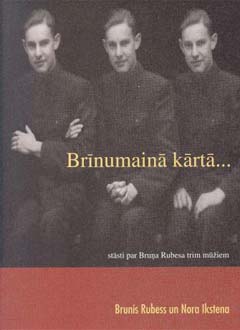
Brīnumainā kārtā

Brunis Rubess’ autobiography Brīnumainā kārtā… was published in Latvia in 1999.

Daina Gross is editor of Latvians Online. An Australian-Latvian she is also a migration researcher at the University of Latvia, PhD from the University of Sussex, formerly a member of the board of the World Federation of Free Latvians, author and translator/ editor/ proofreader from Latvian into English of an eclectic mix of publications of different genres.