Couple starts eclectic shop for clothing, furniture, partying

Partying at Pērle

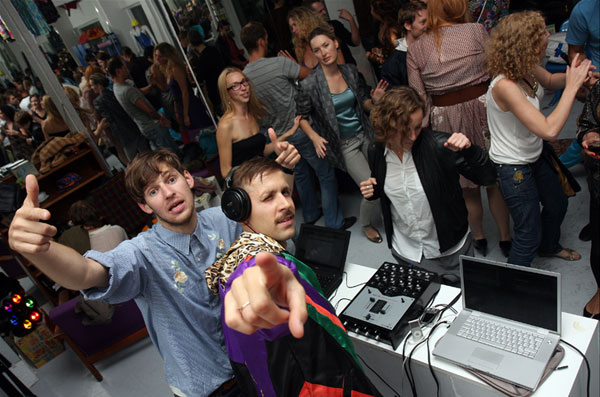
When Pērle isn’t selling clothes or furniture, it could be hosting a party. The shop is located on Tērbatas iela in Rīga. (Photo by M.L. Studio)

Strolling down the bohemian end of Tērbatas iela near the intersection of Matīsa iela in Rīga, one’s eye is drawn to a glittering sign above a shop and lounge called Pērle. The business is the brainchild of Žanete Skarule, a former MTV Latvia VJ, and Edijs Vucēns, who used to manage an extreme sports shop.

On their return from travels in the United States last year, they noticed empty shop fronts appearing everywhere and decided that the time was right—with cheap rents and a cooperative landlord—to fill one of those locations and bring an idea to life.

Pērle is unconventional. The place is a combined café, furniture shop, clothes shop (with new clothes as well as “clothes with experience”), bar, social platform and more. The furniture and clothing, sourced from Berlin and Latvia, has an 1980s theme.

As nearly everything in the shop is for sale, the ambience of the place constantly changes. The table where you sat your coffee or wine down yesterday may not be there the next time you come in. In the evenings there could be a concert on or a film night, an art event or a party open to anyone. The clothes rack is on a pulley system and gets raised above everyone’s heads to open up an area for partying.

Because money was in short supply after the couple’s travels, there was a strong motivation to be creative. The shop was set up with friends helping out with the painting, the knocking down of walls and with ideas. As many people in Rīga cannot afford new things now and are not in a position or willing to pay huge prices for labels, the shop is finding its niche.

A mezzanine chill-out lounge in the shop has free Wi-Fi. Here patrons can contribute to the shop’s blog using a typewriter and paper. The result is placed on the blog board in the shop.

Like many other people starting a business in Rīga, Skarule and Vucēns have faced bureaucratic wrangles. The sign apparently didn’t suit the streetscape or the historic nature of the building. The approval for the sign finally came through on opening day and was still being screwed on as the first guests were arriving.

Issues with having music playing also were encountered, as there was one institution to go to regarding copyright, another to get permission to play the music, with a separate payment to be made if it’s played off a computer rather than from the original disc, according to Skarule and Vucēns. Then come the fines for not having this or that, though there doesn’t seem to be any booklet or one-stop-shop to get information about all the permits one needs or what to watch out for when starting a shop. 

The store has a friendly and artistic atmosphere and seems to provide the answer for the female customer wanting to drag an unwilling male partner with her on her shopping trip. He can sit down, have a drink and watch the passers-by on Tērbatas iela through the large store windows, while she tries on different clothes. Problem solved.

Pērle is located at 65 Tērbatas iela in the central part of Rīga and opens at 11 a.m., closing at 9 p.m. on Mondays and Tuesdays, midnight on Wednesdays, and 2 a.m. on Thursdays to Saturdays. However, when the atmosphere has been really good on a Friday night the last guests have been known to exit at sunrise. Sunday is Pērle’s day of rest.

In survey of diaspora, national anthem ranks as top patriotic song

The homeland’s national anthem, “Dievs, svētī Latviju!,” ranks as the No. 1 song that has kept up the spirits of Latvians in the diaspora, according to organizers of a project to record a collection of patriotic music.

The anthem was penned in 1873 by Kārlis Baumanis. It and 19 other songs will be featured on a compact disc as part of the “Ceļamaize” project organized by the Rīga-based Koknese Fund (Kokneses fonds) in Latvia. The fund will distribute the CD to Latvian schools, libraries and community centers around the world, organizers said in a press release.

The No. 2 song is Renārs Kaupers’ “Welcome to My Country.” Kaupers is lead singer of the band Prāta Vētra. The song was used as the basis of the Welcome to Latvia promotional video produced in 2004 by the Rīga-based Latvian Institute.

Kaupers is one of four artists to appear twice in the list. His “Mana dziesma”—with its moving chorus of “Tie ir vārdi no manas tautas, un dziesma man arī no tās, Un es zinu, neviens manā vietā, to nedziedās”—ranks No. 9. The song was performed by Prāta Vētra, the post-folklore group Iļģi and the youth choir during the last Latvian Song and Dance Festival in Rīga.

No. 3 on the list is Uldis Stabulnieks’ performance of “Tik un tā,” a song with lyrics by poet Māra Zālīte. Perhaps most familiar to listeners is the song’s chorus: “Nāk rudens izgreznot Latviju, Bet nepūlies, necenties tā, Mums viņa ir visskaistākā, Tik un tā.”

The songs were chosen by Latvians abroad who participated in a survey in December and January, according to the press release. A total of 1,026 responses were received from Latvians living in Australia, Brazil, Canada, Ireland, Sweden, the U.K., the U.S. and other countries.

Three exile artists are represented in the list. One is Latvian-American lyricist Brigita Ritmane with her song “Manai tautai,” made famous by singer Ieva Akuratere as an anthem for the National Awakening movement of the late 1980s. The song ranks No. 4. Last year, a number of popular Latvian artists teamed up to record a new version of the song.

Composer Jānis Norvilis, who died in Canada in 1994. His choral piece “Mūsu zeme” ranks No. 11, while “Vakara junda” is No. 18.

The third exile artist is composer Bruno Skulte, who died in 1976 in the United States. His “Aijā” ranks No. 20.

Other songs in the Top 20 are:

  • “Saule, Pērkons, Daugava” by Mārtiņš Brauns.
  • The folk song “Pūt, vējiņi” as arranged by Andrejs Jurjāns.
  • “Dzimtā valoda” by Ainars Virga.
  • “Gaismas pils” by Jāzeps Vītols.
  • “Piena ceļš” by Imants Kalniņš, from the film Sprīdītis.
  • “Es dziedāšu par tevi, tēvu zeme” by Jēkabs Graubiņš.
  • “Pie Gaujas,” with lyrics by Jūlijs Eduards Balodis (Rieteklis) and melody by the German composer Vilhelm Justus Lyra.
  • The folk song “Tumša nakte, zaļa zāle.”
  • “Manai dzimtenei” by the composer Raimonds Pauls.
  • The folk song “Mazs bij’ tēva novadiņis.”
  • “Nevis slinkojot un pūstot” by Andrejs Jurjāns.

Besides preparing the CD, organizers are planning a May 4 concert in Rīga to mark the 20th anniversary of Latvia’s restoration of independence. The concert will be televized by Latvian State Television.

Proceeds from sale of the CD, according to the press release, will go toward building an amphitheater at the Likteņdārzs memorial in Latvia.

Andris Straumanis is a special correspondent for and a co-founder of Latvians Online. From 2000–2012 he was editor of the website.

Latvia’s top bobsleigh team withdraws from Winter Olympics

The withdrawal from Olympic competition of Latvia’s leading four-man bobsleigh team may well have closed out hope of the country gaining any more medals.

The team led by Jānis Miņins announced Feb. 25 that it will not appear in the four heats scheduled to begin Feb. 26 in Whistler, Briitish Columia, a spokeswoman for the team said.

Miņins underwent an appendectomy on the opening day of the Olympics, according to media reports. In addition, his team crashed twice during training runs, leaving crewmen Oskars Melbārdis with a concussion and Daumants Dreiškens with bruising to his shoulder and leg.

The Miņins-led team had been seen by various observers as a medal contender. In February 2009, the team took first place in the bobsleigh World Cup at the Whistler Sliding Centre.

Latvia so far has earned two silver medals, one by Andris and Juris Šics in men’s double luge, the other by Martins Dukurs in the men’s skeleton event.

Latvia has a second team in the four-man bobsleigh competition. It is piloted by Edgars Maskalāns, who on Feb. 21 with Dreiškens finished eighth in the two-man bobsleigh event.

The four-man teams from Australia, Liechtenstein and the Netherlands also have dropped out of the competition.

Andris Straumanis is a special correspondent for and a co-founder of Latvians Online. From 2000–2012 he was editor of the website.