Culture minister to stay on, while government considers its options

The Latvian government may only need to fill three ministerial seats, not five, because one minister has decided to stay on and the ruling coalition is considering breaking up another minister’s duties.

Culture Minister Ints Dālderis said March 19 that he will not join other People’s Party (Tautas partija) members who are quitting. The People’s Party announced March 17 that it is withdrawing from the coalition government led by Prime Minister Valdis Dombrovskis.

“It would not be right to leave the post right now,” Dālderis said in a prepared statement released March 19. “I must continue to work.” The announcement came after Dālderis consulted with Dombrovskis and with representatives of the country’s cultural sector.

Dālderis, previously director of the Latvian National Symphony, became the culture minister when the Dombrovkis government came to power a year ago. He joined the People’s Party only after becoming the minister. Despite his decision to stay in the government, the People’s Party is not planning to expel Dālderis, according to media reports.

Meanwhile, the four remaining parties in the coalition have invited the conservative First Party of Latvia (Latvijas Pirmā partija) to join the government, according to the LETA news service. Without the First Party, the four-party coalition would control just 47 of the 100 seats in the Saeima, making it a minority government.

In addition, the government plans to dissolve the Ministry of Regional Development and Local Government Affairs, dividing its functions among several other ministries, LETA reported. The ministry has been headed by Edgars Zalāns, one of the People’s Party ministers who is leaving the government.

The remaining People’s Party ministers who are expected to leave the government are Foreign Minister Māris Riekstiņš, Justice Minister Mareks Segliņš and Health Minister Baiba Rozentāle.
Andris Straumanis is a special correspondent for and a co-founder of Latvians Online. From 2000–2012 he was editor of the website.

People’s Party quits government, coalition now in minority

The conservative People’s Party (Tautas partija), which for months has been critical of Prime Minister Valdis Dombrovskis, has quit Latvia’s coalition government and recalled its ministers. The move comes just days after the government marked a full year in power.

The party announced its decision March 17 after failing to get Dombrovskis to agree to a program of no new taxes, government reform and budgetary belt-tightening. The government, the People’s Party announced on its Web site, is following a course that “apparently will be directed to increasing taxes, maintenance of an ineffective state apparatus and postponement of unpopular decisions until after the elections.”

Latvia’s parliamentary elections are set for October. Dombrovskis’ party, New Era (Jaunais laiks), recently joined with two other parties in the centre-right coalition Unity (Vienotība) to campaign together in the elections.

Just before the decision to withdraw from the coalition, Dombrovskis had urged the People’s Party to refrain from ultimatums and to give the full coalition time to consider the party’s suggestions.

“If a year ago you agreed to stay in the government,” Dombrovskis wrote in a letter to the party, “knowing that you too will have joint responsibility for the situation in the state, then I ask the People’s Party even now to work together until the Saeima elections, as we pledged when forming the government.”

Since becoming prime minister, Dombrovskis has steered the government through massive budget cuts, unpopular tax hikes and acceptance of large loans from foreign lenders. The People’s Party has several times criticized the government’s actions.

The People’s Party had asked Dombrovskis to support four measures:

  • To hold off on tax increases for this year and 2011.
  • By May 1 to propose to the parliament government reforms to reduce the number of ministries and to turn over some state functions to the private sector. The Latvian government has 14 ministries, but the People’s Party wants the number cut to eight or nine. Turning some functions over to the private sector, according to the party, could save the government LVL 100 million a year.
  • To begin work on the 2011 budget by June 1 and to present it to the Saeima not later than Sept. 1—before the October election.
  • By July 1 to come to an agreement with the government’s social partners—employers and workers—about actions and responsibilities that would lead to renewing the nation’s economic growth.

Although it has quit the coalition, the People’s Party will not ask the Dombrovskis government to step down, according to media reports. However, without the People’s Party’s backing, the government controls just 47 of the 100 seats in the Saeima.

President Valdis Zatlers said he regrets the People’s Party’s decision to quit the coalition, and criticized it for wasting time in the name of short-term political interests, according to a spokesperson. Zatlers said he continues to support the Dombrovskis government.

Ministers recalled by the People’s Party include Foreign Minister Māris Riekstiņš, Justice Minister Mareks Segliņš, Culture Minister Ints Dālderis, Health Minister Baiba Rozentāle, and Regional Development and Local Government Affairs Minister Edgars Zalāns.

Parties remaining in the government coalition are New Era, Civil Union (Pilsoniskā savienība), the Union of Greens and Farmers (Zaļo un Zemnieku savienība), and For Fatherland and Freedom (Tēvzemei un Brīvībai / LNNK).

Andris Straumanis is a special correspondent for and a co-founder of Latvians Online. From 2000–2012 he was editor of the website.

Hundreds march to honor Legion, while protesters attack fascism

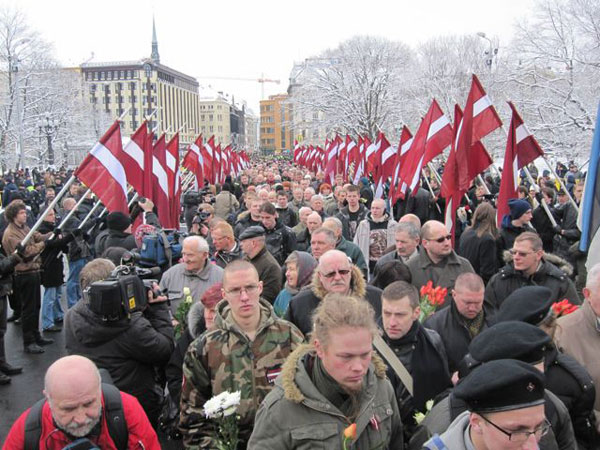
Gājiens uz Brīvibas pieminekli

Between 500 and 1,000 persons took part in the March 16 march to the Freedom Monument. (Photo by Arnis Gross)

An estimated 500 to 1,000 persons in downtown Rīga took part in a controversial March 16 commemoration of the Latvian Legion, according to media reports and eyewitnesses. The event included a march to the Freedom Monument to honor soldiers who fell during World War II while fighting against the Soviet Union.

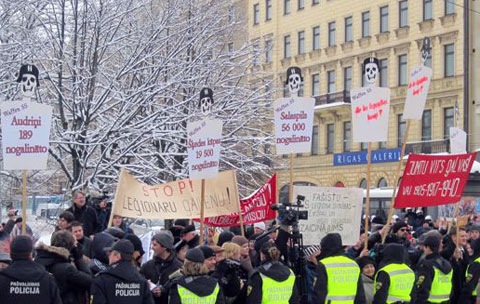
They were countered by protesters who carried signs and shouted slogans against the commemoration, which they argue glorified fascism and the Latvian Legion’s ties to Nazi Germany. Among the protesters was well-known Nazi-hunter Efraim Zuroff, who was in Rīga attending a conference on the rebirth of neo-Nazism.

The annual event is meant to commemorate veterans of the two Latvian Legion divisions that fought on the side of Nazi Germany. The Germans organized the divisions in 1943. About 100,000 men, the majority of them drafted, served in the Latvian Legion. A number of ethnic Latvian politicians have distanced themselves from the commemoration, which is not an official observance, while many ethnic Russians view the event as an affront to Soviet soldiers who against Nazi forces.

As they did last year, Rīga city officials had banned the march and counter-demonstration. However, on March 15 the Rīga District Court overruled the ban. The march was organized by the veterans group Daugavas Vanagi Latvijā, which the counter-demonstration was planned by Latvijas Antifašistiskā komiteja.

Under heavy police presence and freshly fallen snow, the marchers moved from the Dome Square in the city’s Old Town, where they attended a service in the Dome Church, to the Freedom Monument.

A few persons were arrested for minor civil disturbances, and some for making anti-Semitic statements, according to media reports.

Interior Minister Linda Mūrniece thanked security and police workers for guaranteeing that March 16 events took place in a peaceful and orderly manner. Their success, she said in a press release, was in due in part to preventative measures taken before the march and demonstrations, including stopping unwelcome persons entering Latvia.

Antifašisti

Counter-demonstrators held signs recalling the numbers of people killed during the Holocaust in Latvia. (Photo by Arnis Gross)

Andris Straumanis is a special correspondent for and a co-founder of Latvians Online. From 2000–2012 he was editor of the website.