Latvia’s population declines as birth rate slips, emigration rises

Another year, another drop in population: Latvia’s Central Statistical Bureau has reported that the country experienced a net loss in residents during 2009, dropping to a total count of 2.248 million.

Overall, the country lost 12,900 in population, the bureau announced May 27. Marriages fell significantly compared to 2008, while men and women are waiting longer to get married and, if they have children, are having fewer. Emigration from Latvia also contributed to the decline in population.

More people died than were born in Latvia last year, contributing to a decline of 8,200 in population. Long-term migration added another net loss of 4,700, according to data compiled by the bureau.

For the second year in a row, the number of marriages dropped. A total of 9,925 marriages were registered in 2009, compared to 12,946 in 2008, a decrease of 23 percent. In 2007, Latvia saw 15,486 marriages.

Residents of Latvia are continuing to wait longer to get married.

“Since 2000 the age of the first marriage has grown by more than two years,” according to a press release from the statistical bureau. The average age of men the first time they marry rose to 29 last year, while for women the average age is 27.

At the same time, married couples appear to be holding together more. The number of divorces last year totaled 5,099, compared to 6,214 in 2008—a drop of 18 percent.

The number of births dipped 10 percent last year to a total of 21,677. After two years of gains, Latvia’s fertility rate slipped to 1.32 in 2009.

However, people in Latvia are living a bit longer. The total number of deaths last year was 29,897, or a drop of 3.6 percent from 2008, according to the bureau. As a result, the average life expectancy rose to 68.3 years for men and 78.1 years for women.

The highest birth rates were recorded in Rīga and its environs, while the lowest was in Latgale. However, the death rate was highest in Latgale and lowest in Rīga’s environs.
Andris Straumanis is a special correspondent for and a co-founder of Latvians Online. From 2000–2012 he was editor of the website.

Financial regulator shuts VEF banka

Latvia’s banking regulator has shut down the country’s smallest bank, Rīga-based VEF banka, noting that shareholders were not following the law on credit institutions. Five years ago, the U.S. government singled out VEF banka and another institution over money laundering.

The Financial and Capital Market Commission (Finanšu un kapitāla tirgus komisija, or FKTK) announced May 26 that it has annulled VEF banka’s license and ordered that the bank stop all financial operations.

However, the head of the commission said its decision has nothing to do with the bank’s financial condition.

“The reason for annulling the license is not related to the bank’s insolvency,” FKTK Head of Office Anna Dravniece said in a press release.

The bank’s shareholders, according to the FKTK announcement, for some time have not had the commission’s permission to increase their holdings in the bank and do not have a say in the bank’s operation.

As of May 5 the bank had LVL 4.9 million in assets and 170 depositors, only 20 of whom had account balances greater than LVL 1,000. The FKTK has determined that the bank has enough financial resources to cover guaranteed settlements to depositors and that the state’s deposit insurance fund will not be needed. Depositors are guaranteed no more than EUR 50,000 each in settlements.

In their 2009 annual report, VEF banka officials said the financial institution was still recovering from its 2005 designation by the U.S. Treasury Department as a “primary money laundering concern” under a provision of the USA PATRIOT Act. The Treasury Department’s Financial Crimes Enforcement Network in 2006 banned American banks from dealing with VEF banka and with Rīga-based Multibanka.

“These two Latvian banks represent a danger to the international community because they facilitate the placement and movement of dirty money in the global financial system,” a Treasury Department official said in a 2005 statement.

VEF banka, which began operation in 1992, was singled out because of concerns about lax controls against money laundering and because less than 20 percent of the bank’s clients were Latvian residents.

Despite its efforts in curbing money laundering, as well as changes in its major shareholders, the Treasury Department has not lifted its sanctions, VEF banka officials wrote in the annual report. They added that removing the restriction was one of their goals for 2010.

VEF banka officials did not have an immediate comment on the FKTK decision to close the institution.

Andris Straumanis is a special correspondent for and a co-founder of Latvians Online. From 2000–2012 he was editor of the website.

Pharmacy-themed bar finds place in owner’s ancestral homeland

Kristaps Krēsliņš used to live in Washington, D.C, where he ran a popular little place called the Pharmacy Bar and played rock music. Now he lives in Latvia and runs the Aptieka Bar in Rīga.

Having traveled intermittently to his ancestral homeland with his band—Mācītājs on Acid—since 1989, Krēsliņš and his wife decided it was time to try living the Latvian lifestyle on a more permanent basis and moved to Latvia with their two young daughters. On Nov. 1, 2008, he opened the Aptieka (Pharmacy) Bar in Mazā Miesnieka iela, a small cobblestone street in the Rīga’s Old Town district.

The little bar, a continent away from its namesake, attracts a similar crowd to that in Washington: young musicians, artists, students and design people. The bar also gets its regular expatriate crowd, mainly from the U.S. and Canada.

Though it wasn’t planned that way, in Washington his bar is staffed by men, whereas in Rīga the staff is all female and he generally only employs friends. He has had the same staff for more than four years in America and there hasn’t been any staff turnover in the Rīga bar.  He lets his staff organize their shifts amongst themselves, as he himself is a fairly laid-back individual.

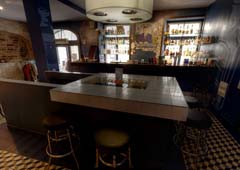
The bar on the ground floor of a historic old building has a modern design but the old stone walls give it the feeling that it’s always been there. In keeping with the pharmacy theme, old bottles used by pharmacists line the shelves. The tables have an interesting touch, with pills and capsules encased under the glass surface. There is a free jukebox with classic and independent rock.

Krēsliņš and his wife say they love the beautiful countryside and the sea, both of which are so accessible from Rīga. The only anxiety Krēsliņš said he has is about the economy, which obviously affects people’s disposable income. However, the bar is breaking even and in these times that’s a measure of success. 

Local friends were a great help with information regarding the opening of a business. Although the number of licenses required are numerous, even including official approval and a license for the bar’s drinks measure, it has never been suggested to him that he should pay a bribe to move things along, Krēsliņš said. In this latter respect he said he believes that Latvia often gets an undeserved bad rap about its business environment, but he does believe that the taxes are too high. Before setting off for Latvia, he remembers his friends in America warning him to be careful because of stories they’d heard about Latvia and questioning whether it was such a good idea, but he has no regrets about having made the move. 

Krēsliņš, who plays rhythm guitar, has good contacts in the Latvian music industry and organizes free shows with high quality musicians for patrons in the basement of his bar twice a month on Sunday nights.         

The pharmacy link comes from Krēsliņš’ grandfather, who was a Rīga pharmacist. An interesting painting overlooking the bar was inspired by a photograph taken of him working in the pharmacy of a refugee camp in Germany.

Further information about the bar is available on its website, www.krogsaptieka.lv.

Aptieka Bar

The Aptieka Bar in Rīga’s Old Town is situated in a historic building and is decorated with elements of a pharmacy. (Photo courtesy of Aptieka Bar)