British authorities say Latvians made to work in ‘appalling’ conditions

British authorities have revoked the license of a labor provider that made a group of fruit pickers from Latvia live and work in what was described as “appalling” conditions.

Citing a “shocking catalogue of failures,” the Gangmasters Licensing Authority (GLA) announced Aug. 11 that it had taken the action against Plus Staff 24 of Skelmersdale, which is in Lancashire northeast of Liverpool.

The more than 30 workers from Latvia were not paid the national minimum wage, had to live in filthy and dangerous houses, and were taken to work in the fields in an uninsured minibus that sometimes was driven by an underage driver, the GLA said in a press release.

The GLA began operating in 2005 to curb the exploitation of workers in the agricultural, horticultural, shellfish gathering and associated processing and packing industries.

The authority named Jose Rosa as the director of Plus Staff 24, but also said that Maria Baptista, whose license had previously been revoked, was involved in the business.

Plus Staff 24 racked up 242 non-compliance points, the GLA said, when 30 is enough to revoke a license. The revocation went into effect July 22.

In one case, a Latvian was left owing Rosa money because the worker had to borrow cash at a repayment rate of 6 percent. The GLA also accused Rosa of not recording holiday and sick pay, and with failing to record deductions to pay on wage slips given to workers.

“This is a flagrant abuse of power over workers,” GLA Chairman Paul Whitehouse said in the press release. “When a human being has worked hard for a month and gets paid nothing after deductions and even owes the gangmaster money, how are they supposed to survive?”

Since March 2007, the GLA has revoked the licenses of 113 labor providers. Among them was Baltic Work Team Ltd., run by Latvian gangmaster Andris Tiltnieks, whose license initially was revoked in March 2007. Tiltnieks unsuccessfully appealed the revocation. In February 2008 he unsuccessfully sued The Guardian for GBP 3.7 million, claiming he was libeled by the British newspaper’s coverage of his business.
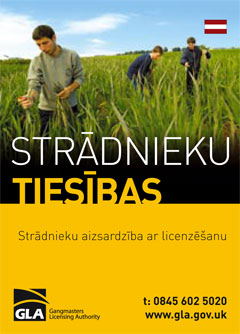
Workers rights brochure

Brochures such as this one in Latvian are distributed to workers by the Gangmasters Licensing Authority.
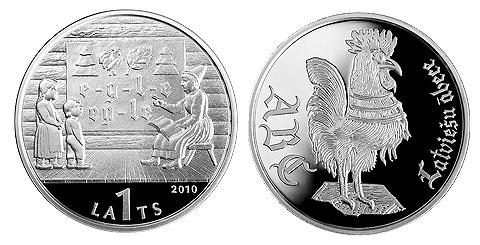
Bank honors history of alphabet primers with commemorative coins

The Bank of Latvia has issued a new 1-lat coin featuring an alphabet primer. The coin is meant for collectors and will not be put into circulation.

The coin, in both silver and copper-nickel alloy versions, commemorates the history of the ābece, or ABC, in Latvia. The coin’s front side depicts a scene in which country children are learning the alphabet. The reverse shows a rooster, a symbol that has been found on many primers through history.

The first Latvian ābece dates to 1683, according to an Aug. 12 press release from the bank. Uncut printer’s sheets of the primer, adorned with a drawing of a rooster, were found in 1941 in the library of the University of Tartu in Estonia.

“The rooster of the Latvian ABC grows out of an old tradition,” Ināra Klekere, head of the Rare Books and Manuscripts Department of the Latvian National Library, said in the press release. “It is often found also in the ABCs of other nations. The oldest known depictions of rooster have been found in the Polish and German ABCs of the 1570s. (The) rooster on the front cover of the ABC even in modern times has retained its pre-Christian symbolism: it is a herald of light who has set his sights eastward; the three ribbons that are featured also in the Latvian ABC probably symbolize the thrice repeated morning call of the rooster.”

About 200 different alphabet primers have been published in Latvia.

Just 5,000 pieces of the silver coin have been minted, while 10,000 piece of the copper-nickel version were made. Both coins were minted by Rahapaja Oy in Finland.

The coins were designed by graphic artist Arvīds Priedīte and mold maker Ligita Franckeviča.

The coins will be available for purchase at the Bank of Latvia in Rīga, as well as at souvenir and jewelry shops in Latvia.

Coin commemorates alphabet primer

The new 1-lat coin issued by the Bank of Latvia commemorates the history of the alphabet primer.

Commission scratches 5 candidates from election, 7 more may face hook

And then there were 1,234. Latvia’s Central Election Commission has scratched from the Oct. 2 parliamentary election five candidates who have criminal backgrounds and who as a result are not allowed to run for office under the Saeima election law.

Oļegs Posadskovs and Sergejs Špaks of the leftist For Human Rights in a United Latvia (Par cilvēka tiesībām vienotā Latvijā, or PCTVL), Sergejs Simčaks of the pro-business Made in Latvia (Ražots Latvijā) and Andris Grīnis of the Christian Democratic Union (Kristīgi demokrātiskā savienība, or KDS) were dropped from the ballot because they have been sentenced for committing crimes, election commission spokeswoman Kristīne Bērziņa said in an Aug. 11 press release.

KDS candidate Zigfrīds Laicāns, meanwhile, has been dropped for committing a crime while mentally unstable. According to the Saeima election law, among those who may not be elected to the parliament are persons who “have committed a criminal offense in a state of mental incompetency or a state of limited mental competency or who, after committing a crime, have become mentally ill and are incapable of taking conscious action or controlling it and as a result have been subjected to compulsory medical treatment or their cases have been dismissed without applying such a compulsory measure.”

The removal of Posadskovs and Špaks leaves PCTVL with a total of 95 candidates. Ražots Latvijā is now at 85 candidates and the KDS is at 83.

The Central Election Commission took the action after receiving information about the candidates from the Ministry of the Interior. Their removal from the ballot leaves the number of candidates at 1,234. A total of 13 political parties or coalitions are fielding candidates for the 100-seat Saeima.

Meanwhile, seven other candidates are under investigation because evidence suggests they may have worked with the Soviet-era State Security Committee (Valsts drošības komiteja, or VDK). The Saeima election law prohibits anyone with such a record from being a member of parliament.

Under question are the candidacies of Ēriks Didrihsons of Saskaņas centrs, Aivars Saliņš of Par prezidentālu republiku, Ēriks Tīrums of Tautas kontrole, Arvīds Ulme of Zaļo un Zemnieku savienība, Roberts Gobziņš of Pēdējā partija, and Aivars Āķis and Rolands Zagorskis of Daugava-Latvijai.

Information about the candidates’ possible relations with the VDK was provided to the election commission by the Centre for the Documentation of the Consequences of Totalitarianism (Totalitārisma seku dokumentēšanas centrs).

Andris Straumanis is a special correspondent for and a co-founder of Latvians Online. From 2000–2012 he was editor of the website.