Citizens abroad request nearly 900 absentee ballots for Oct. 2 election

A total of 890 Latvian citizens abroad have requested absentee ballots to vote in the Oct. 2 Saeima election, according to figures compiled by the Central Election Commission in Rīga. The number represents a nearly 60 percent increase over absentee ballot requests four years ago.

Citizens in the United States led the way, filing 313 requests with the Latvian Embassy in Washington, D.C. Potential voters in Germany submitted 212 requests with the embassy in Berlin, while citizens in Canada filed 109 requests with the embassy in Ottawa.

Citizens abroad had until Sept. 10 to submit the requests for mail ballots. They will receive ballots in time to return them to their local polling stations by the end of voting on Oct. 2, according to election commission officials.

Of the 24 embassies and honorary consulates through which absentee ballot requests could be made, three reported receiving no applications: the honorary consulates in Adelaide and Perth in Australia, as well as the embassy in Tel Aviv, Israel.

In Ireland, where tens of thousands of Latvian citizens now live, only three applications were reported to have been received by the embassy in Dublin.

The embassy in Oslo, Norway, received 74 requests. The embassy in Stockholm, Sweden, got 50 requests, while the embassy in London, England, had 45.

During the 2006 parliamentary election, 557 absentee ballots were requested by voters abroad. In all, 7,530 ballots were cast via mail or at polling stations abroad.

Latvian citizens abroad who do not vote by mail by Oct. 2 will be able to cast ballots on election day at one of 64 polling stations that will operate outside of the homeland.
ELJA50: ‘Par Labu Latviju!’ newsletter discriminates against sexual minorities

Detail from PLL newsletter

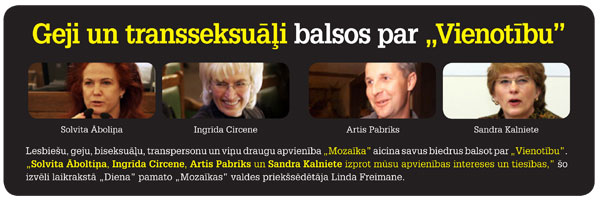
ELJA50 complains that material such as this, found in the August newsletter distributed in Rīga by the political coalition Par Labu Latviju! (PLL), violates anti-discrimination laws. The headline and text link sexual minorities with one of PLL’s rivals, Vienotība.

A nonprofit organization with roots in the European exile community wants Latvia’s ombudsman Romāns Apsītis to rule that a recent political newsletter discriminates against sexual minorities.

ELJA50, an organization founded in 2005 as a continuation of the European Latvian Youth Association, filed the complaint Sept. 13 over a campaign newsletter distributed in Rīga by the conservative political coalition Par Labu Latviju! (PLL).

PLL is one of 13 parties that have fielded candidates in the Oct. 2 parliamentary election. It is a coalition of the First Party of Latvia (Latvijas Pirmā partija) and the People’s Party (Tautas partija).

ELJA50’s complaint is focused on PLL’s August newsletter. The 16-page publication includes three references to gays and transsexuals that portray them as inferior, ELJA50 claims.

Two of the references link sexual minorities with the political coalition Vienotība (Unity), another of the parties competing in the election. On the cover of the newsletter, a headline under a photograph of Vienotība candidate Artis Pabriks states that gays will be voting for Vienotība. On the fifth page, a box with text and photographs of four Vienotība candidates is highlighted with the headline “Geji un transseksuāļi balsos par Vienotību” (Gays and transsexuals to vote for Vienotība). The text notes that the Rīga-based Mozaika alliance of sexual minorities is supporting Vienotība in the parliamentary election.

The last page of the newsletter includes a cartoon of two men holding hands while looking at a poster of PLL leader Ainārs Šlesers. One of the men points to the poster, expresses disgust at Šlesers and says that the politician will not be invited to their wedding.

The newsletter’s comments about sexual minorities violate Latvia’s advertising law and the country’s constitution, as well as several international agreements that forbid discrimination, according to ELJA50’s complaint. ELJA50 suggests PLL’s actions might also be a violation of Latvia’s criminal law against discrimination.

The ombudsman’s office is a state institution. Like similar offices in other countries, Latvia’s ombudsman exists to safeguard the rights of individuals.

The ombuds office has 30 days in which to either accept or decline to further review ELJA50’s complaint.

Under Latvia’s ombuds law, the ombudsman may pursue legal action in cases where discrimination is determined.

A spokesperson for PLL did not immediately respond to a request for comment.

Andris Straumanis is a special correspondent for and a co-founder of Latvians Online. From 2000–2012 he was editor of the website.

Commission seeks volunteer monitors for Oct. 2 parliamentary election

In an effort to reduce doubts about how ballots are counted and whether voting results can be trusted, the Central Election Commission in Rīga is looking for volunteer monitors for Latvia’s parliamentary election set Oct. 2.

Any resident of Latvia—as well as interested persons abroad—can observe the election process, commission spokeswoman Kristīne Bērziņa told Latvians Online.

Sign-up for potential monitors runs from Sept. 13-30 and will be available through the election commission’s website, www.cvk.lv.

To become a monitor, individuals will need to choose which polling station they wish to observe and will have to take an online course about rules governing the election for the 10th Saeima. Upon successful completion of the course, they will receive credentials via e-mail, which together with identification they must present on election day to the chairperson of the local election commission.

For the Oct. 2 election, a total of 64 polling stations will operate outside of Latvia. All polling stations will be open from 7 a.m. to 8 p.m. local time.

Volunteer monitors will be asked to observe the voting process and the counting of ballots. Monitors will watch to ensure that the process is done in accordance with Latvia’s constitution and election commission rules, and that no political agitation occurs at the polls. Monitors will have special forms that can be used to record their observations.

During the last parliamentary election four years ago, few problems were reported, according to a Central Election Commission report. At two polling stations in Latvia, the Interior Ministry investigated allegations of forged election documents.

Anyone who is at least 16 years old may become an election monitor, according to a press release from the election commission.

Further information about becoming an election monitor is available from the project coordinator, Anna Riekstiņa, noverotaji@cvk.lv.

Andris Straumanis is a special correspondent for and a co-founder of Latvians Online. From 2000–2012 he was editor of the website.