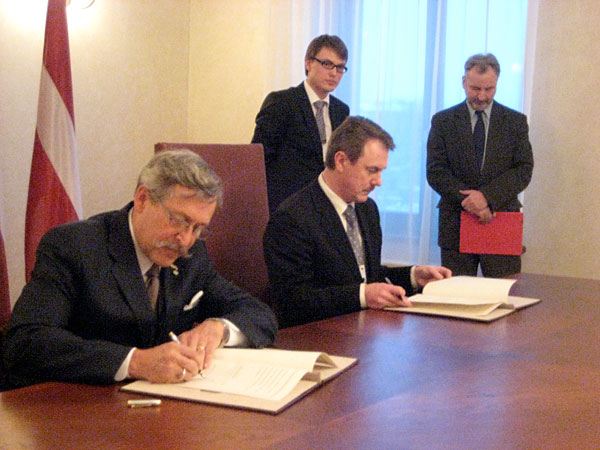
Foreign Ministry, PBLA sign pact on cooperation with diaspora

Līguma parakstīšana

Mārtiņs Sausiņš (left), chairman of the World Federation of Free Latvians, and Foreign Minister Ģirts Valdis Kristovskis sign a cooperation agreement Jan. 6 in Rīga. (Photo by Andris Straumanis)

Although details have yet to be worked out, Latvia’s Foreign Ministry plans to improve its cooperation with diaspora communities under an agreement signed Jan. 6 in Rīga.

The two-page document was signed by Foreign Minister Ģirts Valdis Kristovskis and Mārtiņš Sausiņš, chairman of the World Federation of Free Latvians (Pasaules brīvo latviešu apvienība, or PBLA).

“In truth, it is a big surprise to me that we are just now signing this cooperation agreement,” Kristovkis said in a press conference following the signing ceremony in the Foreign Ministry. “Cooperation between Latvia and the PBLA has been strong and very substantive and valuable for many years.”

The agreement calls on the two sides to foster Latvian language and culture, as well as to strengthen the diaspora’s participation in the homeland’s political life and economy.

The agreement also is in line with the new government’s declaration, Kristovskis said. Among goals of Prime Minister Valdis Dombrovskis’ coalition is strengthening Latvians’ ties with the homeland and supporting their return to Latvia.

The Foreign Ministry will be the main contact point for the diaspora’s collaboration with government institutions, non-governmental organizations and private individuals, according to the agreement. The document, Kristovskis said, will give the diaspora a measure of continuity when dealing with the Latvian government. In recent years responsibility for dealing with the diaspora has been shared at times by the Foreign Ministry, the Justice Ministry, the Education Ministry and the former Secretariat of the Special Assignments Minister for Social Integration Affairs.

Sausiņš agreed, noting that the PBLA “finally feels at home.”

The next step, he said, is completion of a strategic plan between the PBLA and the Foreign Ministry.

Among the questions the two sides are discussing is the issue of allowing dual citizenship. A last-minute bill seeking to amend Latvia’s citizenship law was introduced in October during the last Saeima, but failed to garner support. Kristovskis said a new bill will address shortcomings of that bill and is expected to be introduced soon in the 10th Saeima. The board of directors of the Unity (Vienotība) bloc, of which Kristovskis is a leader, declared in July that Latvia’s citizenship law should be amended to allow dual citizenship for Latvians living abroad, for Latvian citizens who are working long-term abroad, and for descendants of Latvian citizens who were born abroad.

In time, Kristovskis added, the Latvian government might be able to again finance projects to support the diaspora. The integration affairs secretariat provided tens of thousands of lats in aid to Latvian diaspora organizations before it was shut down as part of downsizing of government.

The PBLA’s representative office in Rīga may become busier as people turn to it as a result of the agreement with the Foreign Ministry, Sausiņš said.

Andris Straumanis is a special correspondent for and a co-founder of Latvians Online. From 2000–2012 he was editor of the website.

President’s office protests state TV’s failure to play anthem on New Year’s

President Valdis Zatlers’ office has complained to Latvia’s electronic media licensing board about the failure of state television to play the national anthem after his New Year’s Eve speech.

The chancery has sent a letter to Ābrams Kleckins, head of the National Council of Electronic Mass Media (Nacionālā elektronisko plašsaziņas līdzekļu padome), asking for an investigation, according to a Jan. 3 announcement from the president’s press office.

Usually after the president’s New Year’s Eve speech on Latvian State Television, the national anthem is played. But on Dec. 31 residents of the country received “an unpleasant surprise” when the anthem was not heard, according to the press release.

Playing of the national anthem after the speech on state television is a tradition and raises feelings of festivity and patriotism, according to the press release. For this reason, changing the tradition should not be allowed. The president’s office also noted that commercial broadcasters that aired the president’s speech in fact did play the anthem.

Although state television may not be legally required to play the national anthem after the president’s New Year’s speech, the letter from the chancery noted that under Latvia’s electronic mass media law state broadcasters are charged with developing patriotism for an independent and democratic Latvia.

A number of Latvian State Television viewers have complained on the broadcaster’s online forum about the failure to play the national anthem. The forum administrator apologized Jan. 3 and wrote that not playing the anthem was a director’s error. The broadcaster has started its own internal investigation about the error.

Report says Latvia among world’s best places for ethical travel

Latvia and its southern neighbor are among the developing world’s best places for ethical travel, according to a California-based non-profit organization whose mission is “to use the power of tourism to protect human rights and the environment.”

Ethical Traveler gauged countries in the developing world according to a variety of measures of environmental protection, social welfare and human rights, the organization announced Dec. 9 upon releasing its report.

Latvia and Lithuania scored “particularly high” on the social welfare measure of child mortality rates, according to Ethical Traveler.

However, Ethical Traveler’s report also noted that no country is perfect and said Latvia, Lithuania and Poland should do more to prevent discrimination against ethnic and sexual minorities.

Latvia, Lithuania and Poland are joined in the Top 10 by Argentina, Barbados, Chile, Costa Rica, Dominica, Paulu and Uruguay. Lithuania also made the list last year, as did Argentina, Chile and Poland. Estonia made the list in 2008.

Unclear from Ethical Traveler’s report is what makes a nation “developing” rather than developed. The International Monetary Fund’s World Economic Outlook database groups all three Baltic countries among “emerging and developing economies.”

Its list, Ethical Traveler’s report suggests, can be used by tourists to “vote with our wings.”

“These destinations may not always be as glamorous as Paris, or as modern as Singapore,” Ethical Traveler’s Jane Esberg, Jeff Greenwald and Natalie Lefevre wrote in their summary of the results. “But they’re rich in natural wonders, and alive with fascinating culture. They’re also committed to conserving their natural treasures, while building economies that sustain and empower local communities. Our visits to these countries acknowledges these efforts, and inspires neighboring nations to embrace similar values.”

The Ethical Traveler organization, according to its website, “is dedicated to educating travelers about the social and environmental impact of their decisions, showing how travel can be a potent form of diplomacy, and giving travelers a forum through which their united voices can serve the world community.”