Some updates on Latvia’s election: Mail ballots, the Swedes and money

Summer will soon be over in Latvia. The first day of school on Sept. 1, a day for celebrating educators and education, is a sure sign. So is the new political season, signified by the Sept. 17 parliamentary election.

We have been collecting a few notes and responses to readers related to the election, so here’s a reminder about mail ballots, an update on what the Latvian Association of Sweden is up to, and some background on how much members of the Saeima are paid.

Voting by mail

The deadline for voters abroad to apply for absentee ballots is Sept. 2. Applications, including a valid Latvian passport, must be received by that date at one of 21 Latvian embassies or consulates outside the homeland that are accepting them.

Details on the process, and dowloadable copies of the application form, are available from the website of the Central Election Commission (Centrālā vēlēšanas komisija) in Rīga, www.cvk.lv.

Absentee ballots will be mailed to applicants between Sept. 3-7, according to the website.

Remember that on election day a total of 77 polling stations will operate in locations outside Latvia (see our story, Polling places to include Scotland, but Chile and Venezuela dropped). Polling stations will be open from 7 a.m. to 8 p.m. local time. Voters must be at least 18 years old and must bring with them a valid Latvian passport.

Vienpadsmitnieks

It seemed like just a year ago that some folks affiliated with the Latvian Aid Committee of Sweden (Zviedrijas Latviešu palīdzības komiteja) let loose an unusual publication, Desmitnieks (The Tenth), focused on the election for the 10th Saeima.

Wait, it was a year ago! Aug. 16, to be exact, was the date of the first issue of the print and Web version of the informative publication that included analysis and commentary about the election and key issues.

But at the end of May then-President Valdis Zatlers initiated the dismissal of the 10th Saeima and in July voters overwhelmingly followed through. So here we go again.

The same folks are working now on Vienpadsmitnieks (The Eleventh), except now they are affiliated with the Latvian Association of Sweden (Zviedrijas Latviešu Apvienība).

“We want to address those who perhaps are doubting the sense of participating (in the election), those who perhaps have given up on all that is related to the workings of the Latvian state and society,” according to an email announcement from the association’s Jānis Krēsliņš.

Vienpadsmitnieks will be available on the association’s website, zla.lv.

Last year’s 10 issues of Desmitnieks have been archived and also are available on the association’s website.

The Latvian Association of Sweden, by the way, is relatively new. It serves as an umbrella for various organizations and, as noted on its website, is heir to the long-standing Latvian Aid Committee of Sweden.

Show me the money

A reader asked what members of Latvia’s parliament are paid. The simple answer is 1,417 lats per month.

However, some members get more for leading their party’s caucus (frakcija) or for heading one of the many commissions that are charged with examining proposed legislation and other duties. Members of the presidium (such as the speaker of the Saeima) also get extra pay.

In July, for example, most deputies made 1,417 lats. The highest paid member of the Saeima was the speaker, Solvita Āboltiņa, who made 2,303 lats. The lowest paid member was Juris Žūriņš, who made just 472 lats and 33 santīms. That’s because he only joined the Saeima on July 21, replacing Guntars Galvanovskis of the Vienotība (Unity) bloc, who decided to quit the party and the parliament, according to Neatkarīgā Rīta Avīze and other Latvian media.

Members also get compensation for housing and transportation.

Details can be found on the Saeima’s website, www.saeima.lv.

For comparison, the average gross pay for Latvian workers in March was 465 lats, according to the Central Statistical Bureau (Centrālā statistikas pārvalde).

Vienpadsmitnieks

The Latvian Association of Sweden has launched Vienpadsmitnieks, a special publication examining the forthcoming parliamentary election in Latvia.
Andris Straumanis is a special correspondent for and a co-founder of Latvians Online. From 2000–2012 he was editor of the website.

Think 13 candidate lists is too much? Saeima election in 1925 had 141!

Thirteen political parties or coalitions are competing in the Sept. 17 parliamentary election in Latvia. While that may seem like a lot of interest for the 100 seats in the Saeima, it is worth recalling how things used to be.

The Central Statistical Bureau in Rīga recently posted numbers to remind its readers about elections past. The most notable factoid: In the 1925 election for the 2nd Saeima, a record number of candidate lists—141—was put before voters!

For those unfamiliar with Latvia’s voting system, political parties put forth lists of candidates. On election day, a voter chooses one list to support and may promote or demote specific candidates.

In the election for the 1st Saeima there were 88 candidate lists. The 3rd Saeima election featured 120 lists and the 4th Saeima, 103. The highest number of candidate lists in the post-Soviet era was 23 in the 1993 election for the 5th Saeima.

The number of candidate lists in 1925—many of which were created with dubious motivations—reminds me of the forbidden novel Karjera by A. Lanka (Andrejs Lankovskis, 1881-1944). In the story, first published in 1929 but banned by the Ministry of Education, a fellow by the name of Penteris travels from the countryside to Rīga to make his career. Realizing that other means of making a name for himself will be difficult, he and his newfound acquaintance Slenderis decide to form a political party and campaign for the upcoming Saeima election. (Karjera, by the way, was reprinted in 1991 by the publishing house LGBS Ltd. in Rīga.)

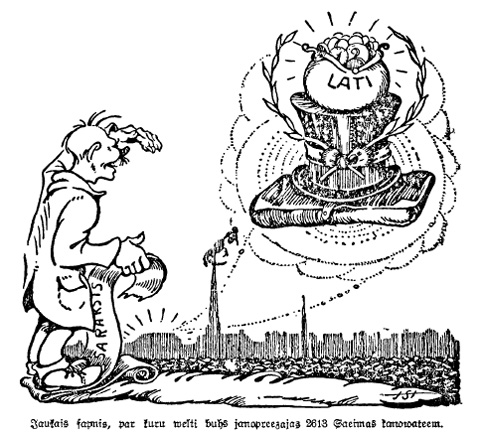
The 1925 election ran for two days and had nearly 75 percent turnout, according to the Saeima website, www.saeima.lv. Of the 141 candidate lists, 48 saw candidates elected to the parliament. No wonder then that the daily newspaper Jaunākās Ziņas two days after the election carried an editorial cartoon poking fun at the 2,613 candidates who did not get into the Saeima and could only dream of the prize they did not win.

Editorial cartoon from Jaunākas Ziņas

An October 1925 editorial cartoon from Jaunākās Ziņas, a Rīga daily newspaper, poked fun at the 2,613 candidates who did not get elected to the 2nd Saeima and were left dreaming of what could have been.

Andris Straumanis is a special correspondent for and a co-founder of Latvians Online. From 2000–2012 he was editor of the website.

Politico: Texas governor’s disclosure causes diplomatic headache for Latvia

Conservative Texas Gov. Rick Perry, who is expected to announce his candidacy for the U.S. presidency on Aug. 13, apparently does not think much of Barack Obama’s foreign policy toward Eastern Europe—and he said as much to Latvia’s prime minister.

Perry’s disclosure of the conversation, writes Ben Smith of Politico, “is a huge diplomatic headache for a small country and longtime ally.”

In an interview with Time Magazine’s Mark Halperin, the governor said he recently met with Latvian Prime Minister Valdis Dombrovskis.

“Our friends need to know that we’re their friends,” Perry said in the interview with Halperin. “The Latvian prime minister was in my office three weeks ago and we were having this conversation about the current administration and the almost aimless or wavering position that he takes from a foreign policy standpoint relative to eastern Europe and those counties who are abutted by folks who might not be their friends.”

President Obama’s “reset” of diplomacy with Russia, announced in 2009, was questioned almost immediately by Eastern and Central European political leaders. The politicians, including former Latvian President Vaira Vīķe-Freiberga, wrote Obama an open letter in which they noted the “nervousness” in their capitals regarding America’s policy toward Russia. The policy has been criticized by both the left and the right.

Dombrovskis recently spent two weeks on a tour of Brazil and the United States to tout Latvia as a great place for economic investment. He met with Perry on July 19.

From the prime minister’s perspective, the discussion with Perry focused on “bilateral cooperation in the area of military and defence matters” as well as the Texas experience with shale gas mining, according to a July 20 press release from the Cabinet of Ministers.

In the interview with Halperin, Perry went on to say that if were to become president, America’s friends “will know that we will be there day in and day out.” He added that the U.S. needs to be strong economically so that it can afford to be strong militarily.

Perry’s announcement that he’s running for president is expected to come while other Republican hopefuls watch with anticipation the outcome of the Ames Straw Poll, a big political event hosted by the Republican Party of Iowa.

Andris Straumanis is a special correspondent for and a co-founder of Latvians Online. From 2000–2012 he was editor of the website.