Barikadopēdija details history of Latvia’s steps to renewed freedom

Barikadopēdija, an online encyclopedia examining the history of the barricades movement in Latvia, opened Jan. 19 at www.barikadopedija.lv.

The Latvian-language site is built as a Wiki. Members of the public eventually will be able to add their memories to the collection of text, photographs, audio and video material, according to the website.

Led by Editor Andrejs Cīrulis, Barikadopēdija provides a timeline-driven look into the Third National Awakening period of the late 1980s and early 1990s that led to the restoration of independent Latvia. The barricades, set up by civilians in January 1991 in Rīga and other cities to defend institutions from feared attacks by Soviet forces, were part of a broader indpendence movement.

Latvia formally broke away from the Soviet Union in August 1991.

The Barikadopēdija site features an interactive timeline stretching from 1985-1991. As users click on specific months, they reveal details on important events in the independence movement. Unfortunately, on a smaller computer screen some of the longer lists are cut off at the bottom.

A navigation menu allows readers to drill down for further details about specific categories from aviācija (aviation) to žurnālistika (journalism); themes, such as the activities of Latvians abroad; places; individuals; and organizations. For now, the details come mostly from articles in the Latvian press of the period.

Among material already available on the site are photographs of the independence movement by noted Latvian photojournalist Uldis Briedis, as well as video from a January 2011 conference on memories of barricades participants, during which Cīrulis first talked about the idea for Barikadopēdija.

In the near future material also will be available in English and Russian, Eduards Cauna, the site’s development director, told Latvians Online in an email.

Barikadopēdija is supported by the Barikadopēdijas fonds, which is seeking donations for its work to continue.
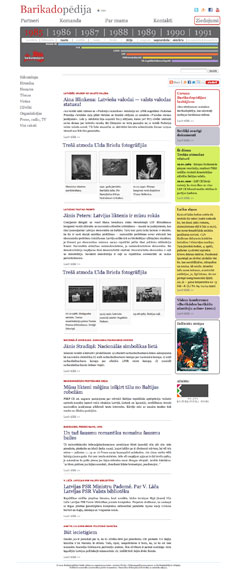
Barikadopēdija

The Barikadopēdija site provides information on the history of Latvia’s renewed independence.
Andris Straumanis is a special correspondent for and a co-founder of Latvians Online. From 2000–2012 he was editor of the website.

Jēgers records album of sacred songs

Latvian countertenor Sergejs Jēgers has released his most recent album, Ave Maria, a collection of mostly sacred songs recorded in the Rīga Cathedral, accompanied by organist Diāna Jaunzeme.

This is now the fourth compact disc that features Jēgers and his unique voice. His debut solo album was 2006’s Ave Musica, a collection of baroque era songs. That was followed by 2007’s duet album with saxophonist Artis Gaga entitled Duende, and interpretations of Latvian folk songs accompanied by the Sinfonietta Rīga orchestra on 2009’s Dziesmiņās remdējos.

Jēgers has performed internationally, including many European countries as well as the United States and Canada. He is a graduate of the Latvian Academy of Music, where he is now a lecturer on early music. Jēgers is also very involved in philanthropy and charity work, and he has his own charity fund, the Sergeja Jēgera Labdarības fonds.

Jaunzeme is also a graduate of the Latvian Academy of Music, having been taught by one of Latvia’s premiere organists, Tālivaldis Deksnis. Jaunzeme has also been collaborating with Jēgers for the past few years.

Tracks on Ave Maria, released on the Latvijs koncerti label, include:

  1. J. S. Bach / Ch. Gounod, “Ave Maria”
  2. H. Purcell, “Fairest Isle” (from King Arthur)
  3. G. F. Händel, Almirena’s aria “Lascia ch’io pianga” from the opera Rinaldo
  4. H. Purcell, “Music for a While”
  5. G. F. Händel, “Dignare from Dettingen Te Deum”
  6. P. Tosti, “Ave Maria”
  7. Anonymous 19th century author, “Pietà, Signore”
  8. C. Saint-Saëns, “Ave Maria”
  9. C. Franck, “Panis angelicus”
  10. G. Fauré, “Pie Jesu from Requiem”
  11. Unknown 18th century author, “Caro mio ben”
  12. G. F. Händel, Xerxes’ aria “Ombra mai fu” from Xerxes
  13. H. Purcell, “What Power Art Thou” from King Arthur
  14. G. Caccini, “Amarilli, mia bella”
  15. V. Vavilov, “Ave Maria”

A brief video (in Latvian) on the album can be found on YouTube.

For more on Jēgers, visit his website, www.sergejsjegers.lv.

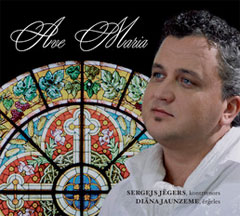
Sergejs Jēgers, Ave Maria

The latest album from countertenor Sergejs Jēgers is Ave Maria.

Egils Kaljo is an American-born Latvian from the New York area . Kaljo began listening to Latvian music as soon as he was able to put a record on a record player, and still has old Bellacord 78 rpm records lying around somewhere.

Iļģi releases album of sauna songs, marks 30th anniversary with concert

Latvian postfolk ensemble Iļģi has released its latest album, Tur saulīte pērties gāja, a collection of songs and instrumental works about the ancient Latvian sauna tradition.

Members of the band include Ilga Reizniece on vocals and kokles, Māris Muktupāvels on kokles, Gatis Gaujenieks on trough fiddle and bass guitar, Egons Kronbergs on guitars, and Mārtiņš Linda on percussion.

The new album was presented Dec. 7 in the Rīga Pharmacy Museum’s “Black Sauna” exhibit room. Organized by Upe tuviem and tāliem Director Iveta Mielava, the event featured Reizniece and Muktupāvels performing a few songs.

Track on the compact disc include:

  1. Pirts kurināšana
  2. Ceļojums
  3. Ceļš
  4. Pēršana
  5. Lidošana
  6. Garā pupa
  7. Paldies

The event also featured a demonstration of proper sauna technique, provided by members of the Pirts skola, a school for those wishing to develop their sauna knowledge and skills. There was even a brief demonstration of sauna techniques, and, by some strange chance, these techniques were demonstrated upon your faithful correspondent!

In addition to the CD release, the ensemble celebrated its 30th anniversary with a concert at the newly refurbished Palladium concert hall in Rīga on Dec. 3. The concert featured songs from the band’s entire history. Also performing were a number of former members, such as Zane Šmite (vocals), Jānis Abens (guitar) and Arnolds Kārklis, among other guests. A highlight of the event was a medley of songs from the Spēlēju, dancoju album, featuring Irīna Mihailovska singing the part of Lelde. She also provides guest vocals on the song “Ceļojums” on Tur saulīte pērties gāja.

For more on Iļģi, visit the band’s website, www.ilgi.lv.

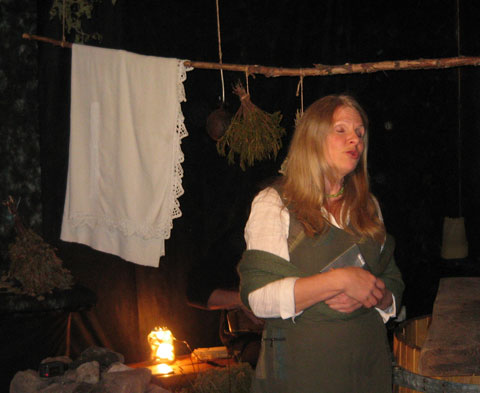
Ilga Reizniece

Band leader Ilga Reizniece performs during the Dec. 7 album release presentation in Rīga. (Photo by Egils Kaljo)

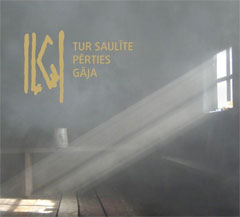
Tur saulīte pērties gāja

The latest album from Iļģi, Tur saulīte pērties gāja, focuses on songs about the sauna.

Egils Kaljo is an American-born Latvian from the New York area . Kaljo began listening to Latvian music as soon as he was able to put a record on a record player, and still has old Bellacord 78 rpm records lying around somewhere.